Dose: level times duration
NIOSH recommends keeping occupational exposure below 85 dBA for eight hours with halving of allowed time per 3 dB increase.[2] Recreational listening lacks enforcement but the physics is identical — ninety minutes at loud levels equals a full quiet day of exposure. Teach teens the trade-off, not just "keep it down."
Headphones versus speakers
In-ear buds seal the canal — small increases in volume produce large SPL jumps.[8] Open-room speakers allow parental monitoring and natural distance rolloff. When homework needs isolation, prefer over-ear with volume limiters and timed breaks every 45–60 minutes.[1]
Infant and toddler specifics
Hugh's infant machine study is the canonical warning for crib-adjacent devices.[5] Toddler tablet sessions need cap — animated apps plus headphones are double stimulus. Model low-volume behaviour; children copy parent AirPod habits.
School and sports noise
Klatte links classroom chatter to learning harm — advocate acoustic treatment, not louder counter-noise.[7] Gymnasiums, band practice, and motorsports need muffs; ambient apps do not protect from impact noise.

Measuring at home
- Use free SPL apps at child's ear height — treat as approximate.[2]
- Target study/sleep beds under ~50 dBA at desk or crib across room.[5]
- If child reports tinnitus, fullness, or post-session muffled hearing — audiologist.[3]
- Enable device volume limiters; disable "loudness normalisation" surprises.[1]
Sound Bubbles family norms
Master Volume culture: start low, raise one bubble not whole garden. Night gardens for children should be speaker-based and distant. Never gamify volume — reward breaks and silence tolerance too.[9]
Summary
Protecting child hearing is daily habit: moderate level, shorter headphone duration, measurable checks, and audiology when symptoms appear. Basner's population data reminds us environmental noise plus personal devices stack.[1][2][4]
Gaming and voice chat
Fortnite plus Discord plus brown noise triples dose — schedule chat-off blocks. Parental controls on console max volume are underused.[6] Esports aspirants need audiologist baseline by age twelve if practicing daily.
School band and headphones culture
Ensemble rehearsals exceed safe dose without musician earplugs — educate band directors. Earbud social status battles health — non-shaming education works better than confiscation alone.
Annual hearing checks
School screenings miss music-dose injury — ask audiologist baseline if child uses headphones daily. Teach "60/60" rule variants adapted to your device limiter reality.[1]
Companion listening in Sound Bubbles
Research above concerns clinical and laboratory sound — not a playlist guarantee. Sound Bubbles offers adjustable living gardens: spatial layers, coloured noise beds, Medical & Wellbeing rooms, and easy mute. Use recommended gardens as environmental support alongside medical care when appropriate.[20]
Not treatment. See clinicians for diagnosis, medication, CBT, neurologic music therapy, or tinnitus programmes. Keep volume comfortable; stop if symptoms worsen.
Why this supports Sound Bubbles — not just "any ambient app"
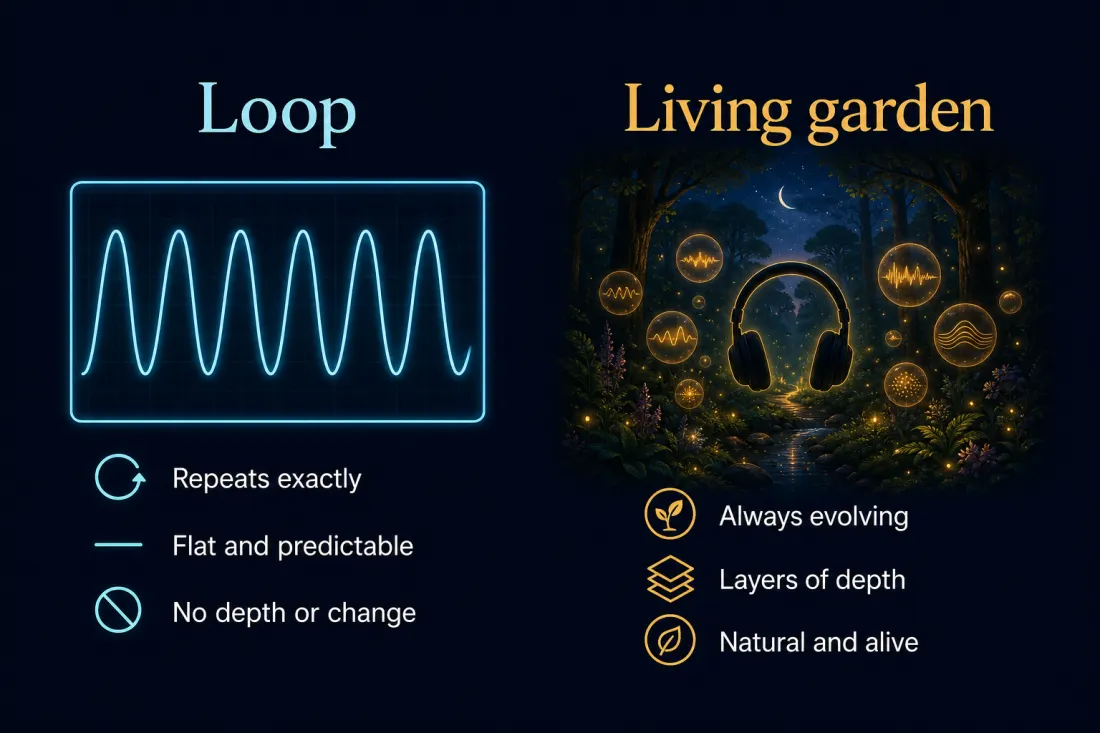
Most ambient apps deliver one file. The studies above rarely study "a loop." They study continuous floors against irregular noise, unintelligible speech against memory tasks, nature scenes against stress markers, spatial streams against glued mashups, and slow environmental change against habituation.[9][14][22][23][24]
Sound Bubbles maps onto those findings deliberately: brown/noise beds for masking floors, nature and library layers for restorative structure, distance/Falloff for speech intelligibility control, and TimeLine motion so the garden keeps the statistics of a place instead of the statistics of a four-minute loop.[12][15][16][25] That is the practical reason the product feels different after the first hour — and the scientific reason the difference matters.
How to apply this inside Sound Bubbles
- Open a related garden (or New Garden) and press Start playing so audio unlocks.[9]
- Expand Shape your soundscape → Sounds: set Master Volume, then Falloff while watching the audible-core guide.[10]
- Select a bubble; drag and scroll depth. Prefer raising one bubble's Volume over blasting the whole room.[11]
- Add library rain, nature, or noise layers; keep speech-like content distant — or remove it — when you need reading or coding focus.[12]
- TimeLine: choose Drift, Tide, or Orbit when you want the garden to keep evolving without grabbing attention.[13]
- Brown Noise tab: shape a warm floor, optionally Release as bubble so it becomes spatial.[14]
- Save gardens that still feel kind after an hour — public gardens should stay soft, not startling.[15]
Limits, safety, and honest uncertainty
We do not claim Sound Bubbles replaces clinical care, sleep medicine, occupational health programmes, or psychiatric treatment.[1][7] What the product does offer is a listening architecture that matches how hearing and attention actually work: layered sources, spatial distance, and slow change instead of one brittle loop.[18][19]
If sound worsens symptoms, stop. If you need medical advice, see a clinician. If you want a softer room, open a garden, place the bubbles kindly, and stay honest about what sound can — and cannot — do.[20][21]
How this article was researched
We combine first-hand experience placing and tuning Sound Bubbles gardens with citations from peer-reviewed journals, reviews, and institutional pages (including NIH/NCBI, sleep and hearing literature, acoustics, and attention research). Where evidence is mixed or early, we say so. On wellbeing topics we stay cautious: these are companion soundscapes, not cures.
References
Sources cited in this article. Prefer primary literature and institutional guidance; Sound Bubbles is not a medical device and these citations do not imply clinical endorsement.
- (2009). Habituation revisited. Neurobiology of Learning and Memory. doi:10.1016/j.nlm.2008.09.015
- (2009). Habituation: a history. Neurobiology of Learning and Memory.
- (1963). Perception and the conditioned reflex. Pergamon Press.
- (2010). The free-energy principle. Nature Reviews Neuroscience. doi:10.1038/nrn2787
- (2013). Whatever next? Predictive brains. Behavioral and Brain Sciences. doi:10.1017/S0140525X12000477
- (1990). Auditory Scene Analysis. MIT Press.
- (2012). An Introduction to the Psychology of Hearing. Brill.
- (2024). Colors of noise. Encyclopedic.
- (2013). Acoustical terminology (masking). ANSI.
- (2014). Auditory and non-auditory effects of noise on health. The Lancet. doi:10.1016/S0140-6736(13)61613-X
- (2021). World report on hearing. WHO.
- (2023). Noise and hearing loss prevention. CDC.
- (2005). White noise on sleep with ICU noise exposure. Sleep Medicine. doi:10.1016/j.sleep.2004.12.004
- (2001). Auditory distraction and short-term memory. Human Factors. doi:10.1518/001872001775992390
- (2010). Stress recovery with nature sound. IJERPH. doi:10.3390/ijerph7031036
- (2005). Speech intelligibility and work performance. Indoor Air. doi:10.1111/j.1600-0668.2005.00391.x