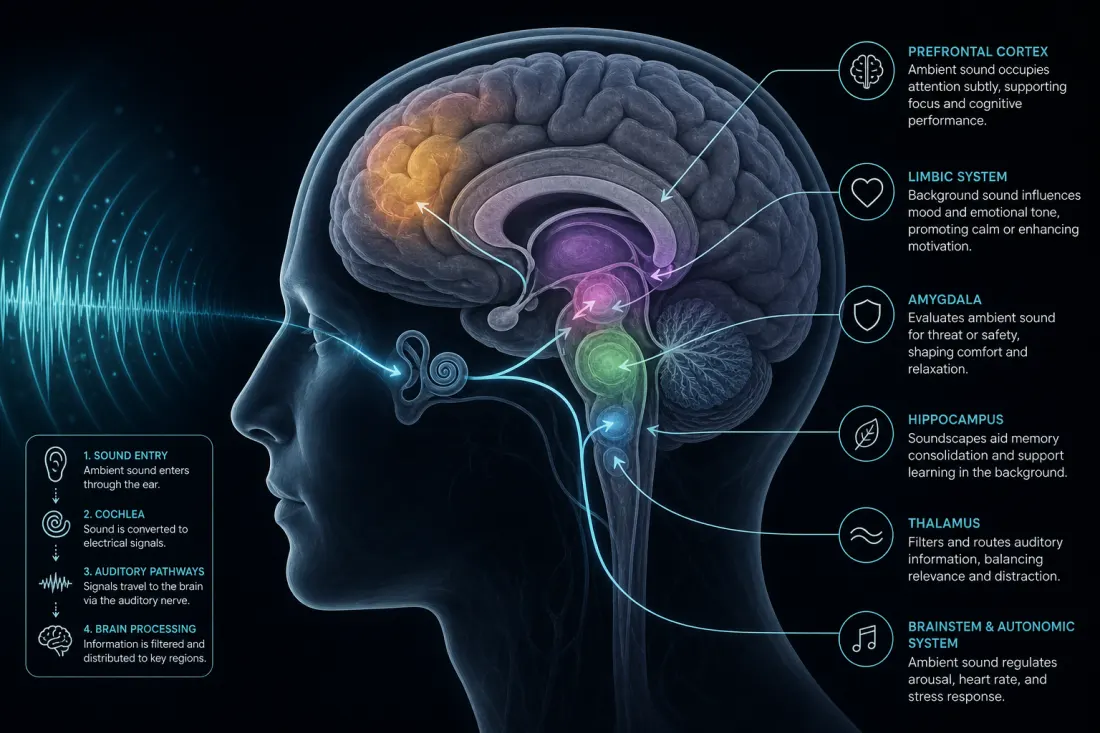

Cherry's shadowing task — attention has a bottleneck
In dichotic listening, different messages arrive at each ear. Listeners instructed to repeat ("shadow") one channel succeed for stretches while remaining largely unaware of the unattended message — unless it contains a personally salient cue like their name.[1] Cherry concluded early selection filters streams before full semantic processing, though later work refined how deep unattended processing goes.
The cocktail party label stuck because real rooms add reverberation, spatial separation, and visual lip-read cues. Darwin reviewed how speech recognition degrades when competing talkers share pitch and timing — informational masking beyond simple loudness.[7] Kidd et al. formalised informational masking: even when energy masking is equal, similarity between target and masker wrecks intelligibility.[8]
Two ears beat one — spatial release from masking
Binaural hearing exploits microsecond interaural time differences and level cues created by head shadowing. Litovsky et al. showed binaural advantage persists in reverberant noise — two ears help you aim attention like acoustic binoculars.[5] Moore's psychoacoustics texts connect masking, spatial cues, and speech reception thresholds in noise.[6]
When hearing is impaired, spatial release collapses; hearing aids and cochlear implants partially restore it but rarely perfectly. Shinn-Cunningham and Best summarised how sensorineural loss turns cocktail parties into fatigue marathons.[4] NIH NIDCD resources emphasise early evaluation when restaurants become exhausting.[20]
Neural spotlight — Mesgarani and Chang's attended speaker
Modern neuroscience made Cherry's filter visible. Mesgarani and Chang recorded from superior temporal gyrus electrodes in epilepsy patients and found neural responses tracked the attended speaker's spectrogram, not the unattended maskers — a cortical "voice filter" aligned with behaviour.[3] Fritz et al. described auditory attention as a searchlight moving across acoustic scenes.[12]
Top-down goals ("listen to my friend") and bottom-up salience ("glass shattering") compete to steer that spotlight. Bregman's auditory scene analysis framework explains bottom-up grouping: harmonicity, common onsets, and continuity bind parts into streams before attention chooses among them.[2]
Why open offices fail the cocktail party test
Workplace acoustics often assume collaboration; cognition research assumes uninterrupted phonological loop. Banbury et al. documented short-term memory costs from irrelevant speech — even when you "ignore" it.[9] Hongisto modelled how speech intelligibility at low levels still degrades knowledge work.[10]
The cocktail party effect lets you follow one talker at a party; it does not immunise you against office chatter while coding. Masking with continuous noise can reduce informational masking by raising the floor — Stanchina's ICU sleep study and Riedy's noise-as-sleep-aid review illustrate contrast management, not conversation enhancement.[18][19]
Hearing loss and the shrinking spotlight
When cochlear damage removes high-frequency consonant cues, talkers blur together even if spatial cues remain. Shinn-Cunningham and Best documented reduced binaural benefit in impaired listeners — the cocktail party problem becomes daily fatigue, not party trivia.[4] Hearing aids restore some segregation but cannot recreate normal scene analysis in every room.
Assistive strategies include directional microphones, FM systems in classrooms, and environmental design (carpet, partitions) that reduce reverberation. Consumer spatial audio can help mildly when two-ear cues are intact; it cannot replace audiology when speech-in-noise scores fall outside age norms.[20]
Mesgarani and Chang's cortical voice filter discovery changed the conversation from metaphor to mechanism: attended speech is reconstructed in superior temporal gyrus with striking fidelity, unattended talkers suppressed below behavioural threshold but still partially processed.[3] That partial processing explains Banbury's memory costs — unattended speech is not deleted, only attenuated.[9]
Litovsky's binaural advantage data suggest headphone spatialisation can partially restore segregation when external rooms are mono and chaotic — useful for focus gardens, not a replacement for hearing aids in moderate loss.[5] Cherry's early work remains pedagogically vital: attention is the bottleneck, but cues determine how hard the bottleneck squeezes.[1]
Designing rooms your brain can parse — Sound Bubbles
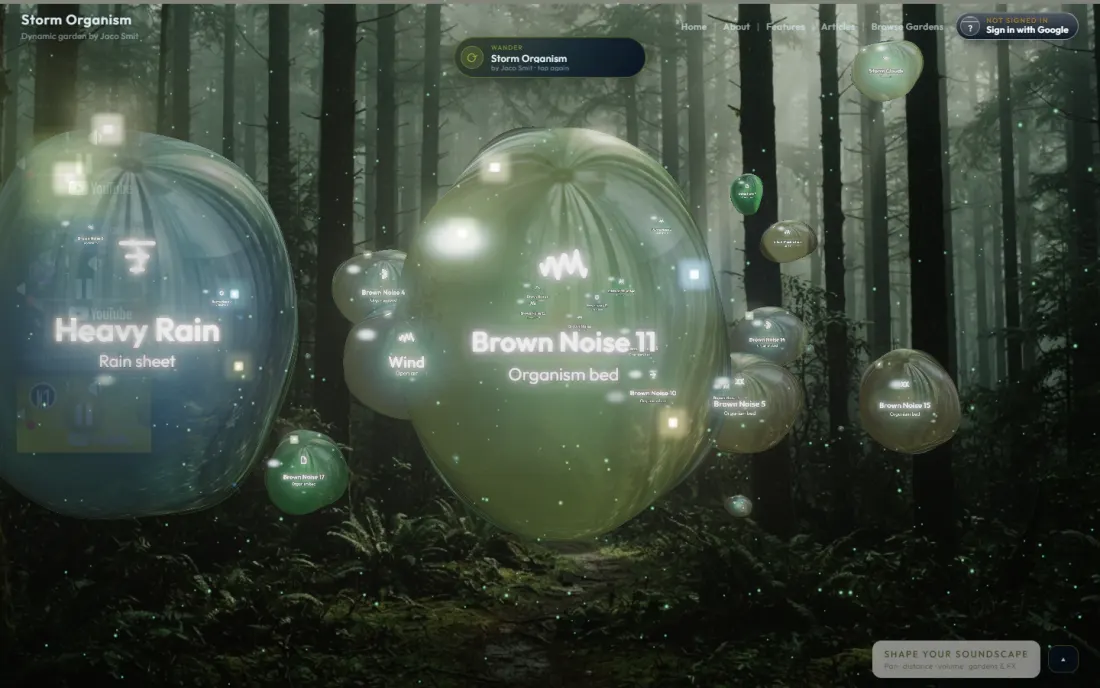
Sound Bubbles maps cocktail-party science into everyday listening architecture:
- Spatial separation — bubbles at different depths mimic natural source distance, helping scene analysis keep streams distinct.[2][5]
- Masking without hijack — brown-noise floors reduce sudden contrast from external speech without adding intelligible lyrics nearby.[18]
- Slow change — TimeLine motion prevents habituation to a static loop so masking stays effective.[11]
Alvarsson et al. showed nature soundscapes support autonomic recovery after stress versus urban noise — useful when cognitive fatigue from all-day listening drains you.[17] That is wellbeing support, not a clinical hearing programme.
Practical listening tactics
- Keep speech-like content distant or absent during deep work — informational masking is semantic, not just loud.[8]
- Use two-ear cues: headphones with gentle spatial separation beat mono mashups for stream segregation.[5]
- Raise a soft noise floor before the room gets loud — pre-emptive masking beats reactive volume wars.[18]
- Take auditory breaks; selective attention depletes like any sustained control task.[9]
- If following conversation in modest noise is hard, schedule audiology — not louder playlists.[4][20]
Remote work shifted cocktail-party problems into kitchen-table Zoom calls: family speech masks work calls even when "quiet." Spatial headphones help only if the masker is external — internal notification sounds defeat segregation because they render inside the scene.[9]
Multilingual environments add linguistic similarity costs; Darwin noted informational masking rises when competing talkers share phoneme inventories. Designing focus rooms may require time-blocking, not only audio.[7]
Everyday scenarios
Restaurant booth: face your partner, use wall absorption — spatial cues help more than concentration grit.[5]
Video calls: headphones with stable voice centre reduce competing household streams.[1]
Study with roommates: mask early with brown noise before their conversation starts — pre-flooding beats reactive volume.[18]
Hearing loss: if "what?" repeats daily, book audiology — apps cannot restore cochlear resolution.[20]
Fritz et al.'s searchlight metaphor remains the best everyday language: you aim attention, but grouping must give you distinct targets first.[12]
Summary
The cocktail party effect is selective auditory attention backed by binaural cues, cortical voice tracking (Mesgarani and Chang), and hard limits on working memory when speech maskers stay intelligible.[3][9] You can steer the spotlight with spatial design, masking floors, and hearing care — not willpower alone.
Sound Bubbles applies those lessons with separable bubbles, distant speech-like layers avoided during focus, and brown noise organisms for contrast control.[18]
Hongisto's office speech models predict performance loss from distant intelligible talk — architectural fixes plus masking beat heroic ignoring.[10]
Moore's psychoacoustics texts remain the practical bridge between cocktail-party theory and measurable speech reception in noise.[6]
Cherry's dichotic legacy: attention is finite; design rooms that respect the bottleneck.[1]
Kidd et al. informational masking formalises why cocktail-party defeat is not mere laziness ever.[8]
Limits
The cocktail party effect is not infinite. Severe hearing loss, central auditory processing disorder, crowded reverberant halls, and multitasking all shrink the spotlight. Protect hearing per WHO and CDC guidance — once cochlear damage occurs, no app restores lost segregation.[14][15][16]
How this article was researched
We combine first-hand experience placing and tuning Sound Bubbles gardens with citations from peer-reviewed journals, reviews, and institutional pages (including NIH/NCBI, sleep and hearing literature, acoustics, and attention research). Where evidence is mixed or early, we say so. On wellbeing topics we stay cautious: these are companion soundscapes, not cures.
References
Sources cited in this article. Prefer primary literature and institutional guidance; Sound Bubbles is not a medical device and these citations do not imply clinical endorsement.
- (1953). Some experiments on the recognition of speech, with one and with two ears. Journal of the Acoustical Society of America. doi:10.1121/1.1901869
- (1990). Auditory Scene Analysis. MIT Press.
- (2012). Selective cortical representation of attended speaker in multi-talker speech perception. Nature. doi:10.1038/nature11020
- (2008). Selective attention in normal and impaired hearing. Trends in Amplification. doi:10.1177/1084713808324081
- (2012). The binaural advantage in reverberation and noise. Journal of the Acoustical Society of America. doi:10.1121/1.4754420
- (2012). An Introduction to the Psychology of Hearing. Brill.
- (2008). Listening to speech in the presence of other sounds. Philosophical Transactions of the Royal Society B. doi:10.1098/rstb.2007.2159
- (2008). Informational masking in speech recognition. Journal of the Acoustical Society of America. doi:10.1121/1.2839889
- (2001). Auditory distraction and short-term memory. Human Factors. doi:10.1518/001872001775992390
- (2005). Speech intelligibility and performance in open offices. Indoor Air. doi:10.1111/j.1600-0668.2005.00391.x
- (2009). Habituation revisited. Neurobiology of Learning and Memory. doi:10.1016/j.nlm.2008.09.015
- (2007). Auditory attention — focusing the searchlight on sound. Current Opinion in Neurobiology. doi:10.1016/j.conb.2007.07.011
- (2021). World report on hearing. WHO.
- (2014). Auditory and non-auditory effects of noise on health. The Lancet. doi:10.1016/S0140-6736(13)61613-X
- (2023). Noise and hearing loss prevention. CDC.
- (2010). Stress recovery during exposure to nature sound and environmental noise. IJERPH. doi:10.3390/ijerph7031036
- (2005). The influence of white noise on sleep in subjects exposed to ICU noise. Sleep Medicine. doi:10.1016/j.sleep.2004.12.004
- (2021). Noise as a sleep aid: A systematic review. Sleep Medicine Reviews. doi:10.1016/j.smrv.2020.101385
- (2024). Hearing, ear infections, and deafness — speech in noise. NIH.