

What the dawn chorus is — biologically
Across temperate regions, songbirds increase vocal activity near sunrise in a predictable daily peak. Ornithologists link the chorus to territory defence, mate attraction, and light-gated behaviour: photoperiod shifts song timing seasonally.[4] Rattenborg's comparative sleep work reminds us birds themselves sleep — often with half-brain vigilance — yet still mount intense dawn vocalisation, suggesting the chorus is not random noise but timed biological output locked to light.[4]
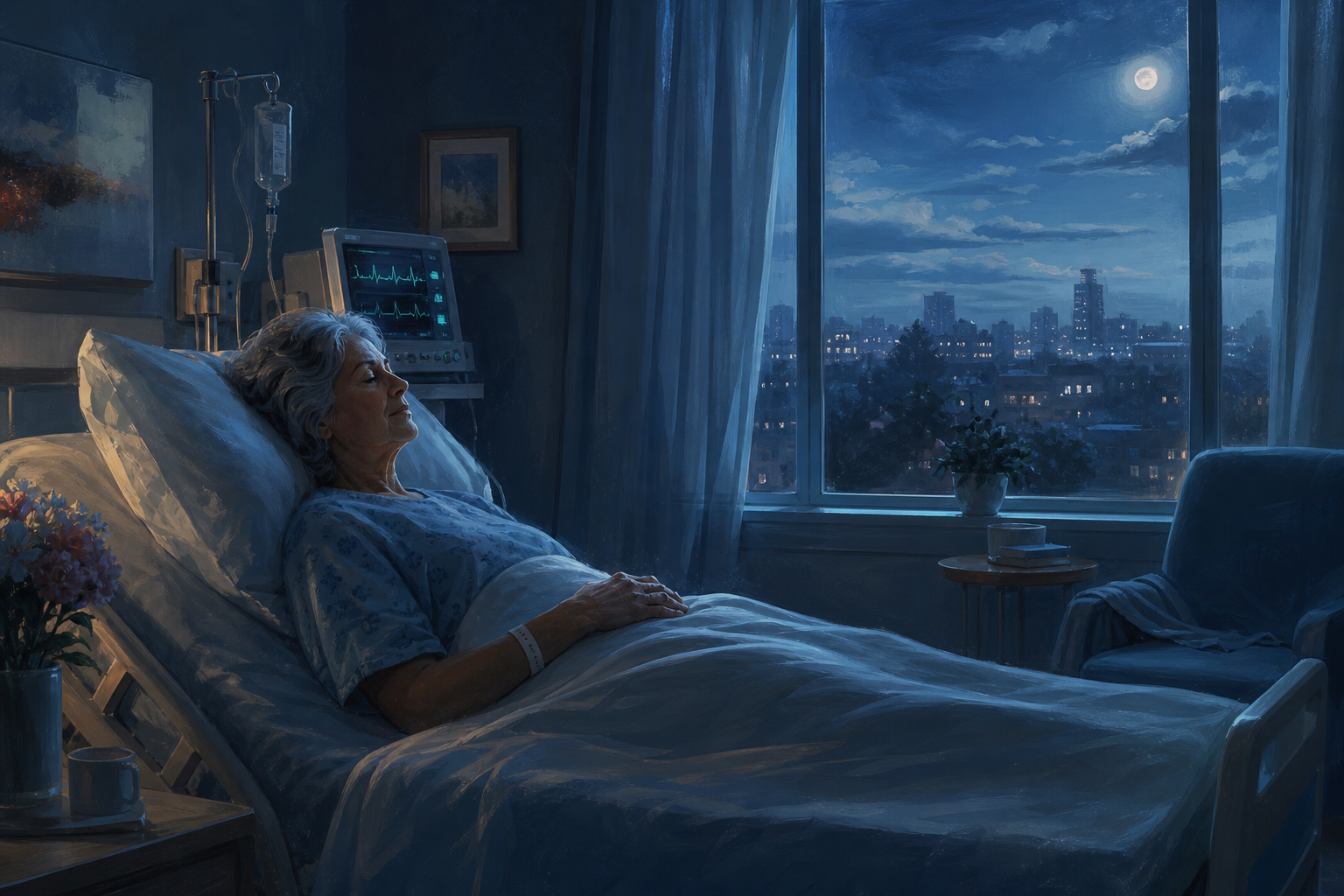
Humans evolved in acoustic environments where dawn bird density correlated with safe, resource-rich mornings. Ulrich's classic window-view study predated modern soundscape research but established that natural morning cues affect physiology and mood in clinical settings.[8] Alvarsson et al. later showed nature sounds — including water and bird-like spectra — improved autonomic recovery after stress more than urban noise at matched levels.[3]
Circadian entrainment: light first, sound second
The suprachiasmatic nucleus remains the master clock; morning light is the strongest zeitgeber for entrainment.[2][6] Wright's forced-desynchrony and field studies demonstrate human circadian period averages slightly over 24 hours, requiring daily light correction.[2] Sound alone cannot reset phase as powerfully as photic input, but multimodal mornings — light plus predictable acoustic rise — may reinforce wake intent when light is scarce (winter latitudes, blackout curtains, basement flats).
Thapan's cortisol awakening work shows light near wake amplifies the CAR.[1] Bruni's adolescent sleep reviews note delayed phase in teens: they biologically prefer later wake, making harsh alarms especially misaligned with physiology.[5] A dawn-chorus soundscape is not a circadian cure, but it supplies the predictable, non-threatening arousal contour missing when teens are jarred awake before melatonin offset.
Why birdsong calms rather than distracts (at low levels)
Restorative environment research distinguishes informational content from threat content. Bird vocalisations at moderate level carry semantic "nature" without intelligible speech — avoiding the irrelevant-speech effect that devastates serial memory.[23][25] Alvarsson measured skin conductance and heart rate recovery: nature sound won.[3]
Fuller's sleep-wake circuit reviews emphasise that arousal is not binary; graded sensory input can shift thalamocortical tone toward wake without full startle.[7] Dawn chorus spectra are rich but irregular — high entropy compared to white noise — which delays habituation per Rankin's updated habituation framework.[9] That irregularity keeps the scene "alive" through a 20-minute wake window without becoming a second alarm.
Urban reality: when the chorus is traffic
City bedrooms often receive traffic rumble instead of birds. Masking literature supports raising a soft naturalistic floor so sudden honks lose contrast.[15][18][22] Recorded dawn chorus in spatial audio is not deception — it is environmental substitution when ecology cannot reach the window. Basner's noise-health syntheses still apply: overall level must stay comfortable.[19]
Building a biologically plausible dawn garden
- Start sub-threshold 15 minutes before target wake; let bird layers gain volume gradually.[9][13]
- Pair with real or simulated morning light when possible.[1][6]
- Use spatial separation: birds "outside," brown bed "room tone."[14]
- Enable TimeLine drift so loops do not freeze — real dawn is never static.[12]
- Keep backup alarm if schedule rigidity demands it.[2]
Seasonal affective and circadian-clinic patients should follow prescriber light protocols; birdsong complements, not replaces, medical phototherapy.[6]
Seasonal, latitude, and indoor constraints
High-latitude winters compress outdoor dawn exposure; recorded chorus restores an acoustic cue when photic input is weak before commute.[2][6] Summer chorus peaks earlier than school schedules in some regions — align playback timing with actual wake goal, not calendar romanticism. Apartment dwellers with sealed windows lose both real birds and ventilation noise; substitution gardens should stay low-level to avoid neighbour conflict while still masking sudden hallway events.[19][22] Adolescent delayed phase makes pre-7am wake especially harsh; pairing chorus ramp with later weekend recovery sleep reduces allostatic load even when weekday alarms cannot move.[5]
Companion listening in Sound Bubbles
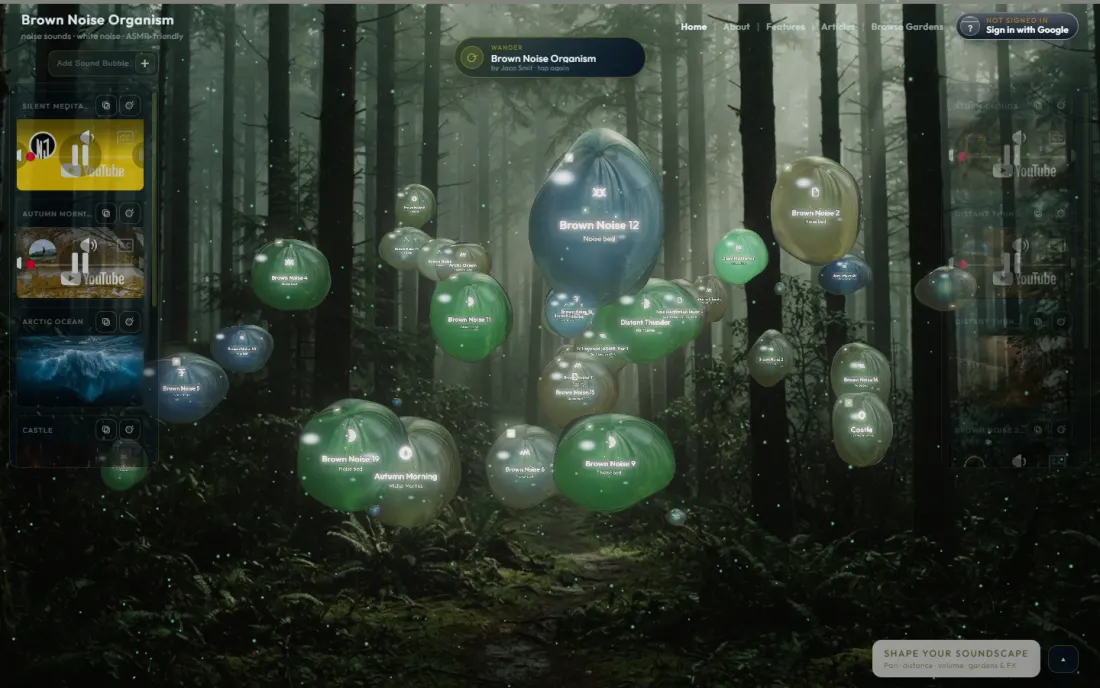
Research above concerns clinical and laboratory sound — not a playlist guarantee. Sound Bubbles offers adjustable living gardens: spatial layers, coloured noise beds, Medical & Wellbeing rooms, and easy mute. Use recommended gardens as environmental support alongside medical care when appropriate.[20]
Not treatment. See clinicians for diagnosis, medication, CBT, neurologic music therapy, or tinnitus programmes. Keep volume comfortable; stop if symptoms worsen.
Why this supports Sound Bubbles — not just "any ambient app"
Most ambient apps deliver one file. The studies above rarely study "a loop." They study continuous floors against irregular noise, unintelligible speech against memory tasks, nature scenes against stress markers, spatial streams against glued mashups, and slow environmental change against habituation.[9][14][22][23][24]
Sound Bubbles maps onto those findings deliberately: brown/noise beds for masking floors, nature and library layers for restorative structure, distance/Falloff for speech intelligibility control, and TimeLine motion so the garden keeps the statistics of a place instead of the statistics of a four-minute loop.[12][15][16][25] That is the practical reason the product feels different after the first hour — and the scientific reason the difference matters.
How to apply this inside Sound Bubbles
- Open a related garden (or New Garden) and press Start playing so audio unlocks.[9]
- Expand Shape your soundscape → Sounds: set Master Volume, then Falloff while watching the audible-core guide.[10]
- Select a bubble; drag and scroll depth. Prefer raising one bubble's Volume over blasting the whole room.[11]
- Add library rain, nature, or noise layers; keep speech-like content distant — or remove it — when you need reading or coding focus.[12]
- TimeLine: choose Drift, Tide, or Orbit when you want the garden to keep evolving without grabbing attention.[13]
- Brown Noise tab: shape a warm floor, optionally Release as bubble so it becomes spatial.[14]
- Save gardens that still feel kind after an hour — public gardens should stay soft, not startling.[15]
Limits, safety, and honest uncertainty
We do not claim Sound Bubbles replaces clinical care, sleep medicine, occupational health programmes, or psychiatric treatment.[1][7] What the product does offer is a listening architecture that matches how hearing and attention actually work: layered sources, spatial distance, and slow change instead of one brittle loop.[18][19]
If sound worsens symptoms, stop. If you need medical advice, see a clinician. If you want a softer room, open a garden, place the bubbles kindly, and stay honest about what sound can — and cannot — do.[20][21]
How this article was researched
We combine first-hand experience placing and tuning Sound Bubbles gardens with citations from peer-reviewed journals, reviews, and institutional pages (including NIH/NCBI, sleep and hearing literature, acoustics, and attention research). Where evidence is mixed or early, we say so. On wellbeing topics we stay cautious: these are companion soundscapes, not cures.
References
Sources cited in this article. Prefer primary literature and institutional guidance; Sound Bubbles is not a medical device and these citations do not imply clinical endorsement.
- (2001). Light and cortisol awakening response. JCEM. doi:10.1210/jcem.86.1.7116
- (2013). Entrainment of the human circadian clock. Current Biology. doi:10.1016/j.cub.2013.08.011
- (2010). Stress recovery with nature sound. IJERPH. doi:10.3390/ijerph7031036
- (2009). Sleep in birds and mammals. Neuroscience & Biobehavioral Reviews.
- (2014). Sleep and circadian rhythms in adolescence. Sleep Medicine.
- (2016). Circadian light and human health. Journal of Biological Rhythms.
- (2019). Neurobiology of sleep-wake circuits. Handbook of Clinical Neurology.
- (1984). View through a window may influence recovery. Science. doi:10.1126/science.6143402
- (2009). Habituation revisited. Neurobiology of Learning and Memory. doi:10.1016/j.nlm.2008.09.015
- (2009). Habituation: a history. Neurobiology of Learning and Memory.
- (1963). Perception and the conditioned reflex. Pergamon Press.
- (2010). The free-energy principle. Nature Reviews Neuroscience. doi:10.1038/nrn2787
- (2013). Whatever next? Predictive brains. Behavioral and Brain Sciences. doi:10.1017/S0140525X12000477
- (1990). Auditory Scene Analysis. MIT Press.
- (2012). An Introduction to the Psychology of Hearing. Brill.
- (2024). Colors of noise. Encyclopedic.
- (2013). Acoustical terminology (masking). ANSI.
- (2014). Auditory and non-auditory effects of noise on health. The Lancet. doi:10.1016/S0140-6736(13)61613-X
- (2021). World report on hearing. WHO.
- (2023). Noise and hearing loss prevention. CDC.
- (2005). White noise on sleep with ICU noise exposure. Sleep Medicine. doi:10.1016/j.sleep.2004.12.004
- (2001). Auditory distraction and short-term memory. Human Factors. doi:10.1518/001872001775992390
- (2010). Stress recovery with nature sound. IJERPH. doi:10.3390/ijerph7031036
- (2005). Speech intelligibility and work performance. Indoor Air. doi:10.1111/j.1600-0668.2005.00391.x