Why fireplace loops fatigue faster than real hearths
Real fires produce crackle on a stochastic schedule — pops arrive unpredictably across a stable low-frequency combustion bed. Rankin's habituation model predicts that fully regular or frozen statistics lose cortical gain; the scene becomes "invisible" until a seam or exaggerated pop triggers orienting.[2] Consumer fireplace tracks often compress dynamic range and repeat identical crackle samples every four minutes, turning comfort into deviance detection.[9][11]
Bregman showed listeners segregate concurrent sources by onset, spectrum, and location — a crackle stream and a rumble stream can coexist as separate objects when not mashed into one file.[1] Monolithic fireplace MP3s collapse those streams, forcing the brain to track every pop as foreground. That is the fatigue mechanism: vigilance on a "relaxation" sound.
Spectral anatomy of fire: what to separate
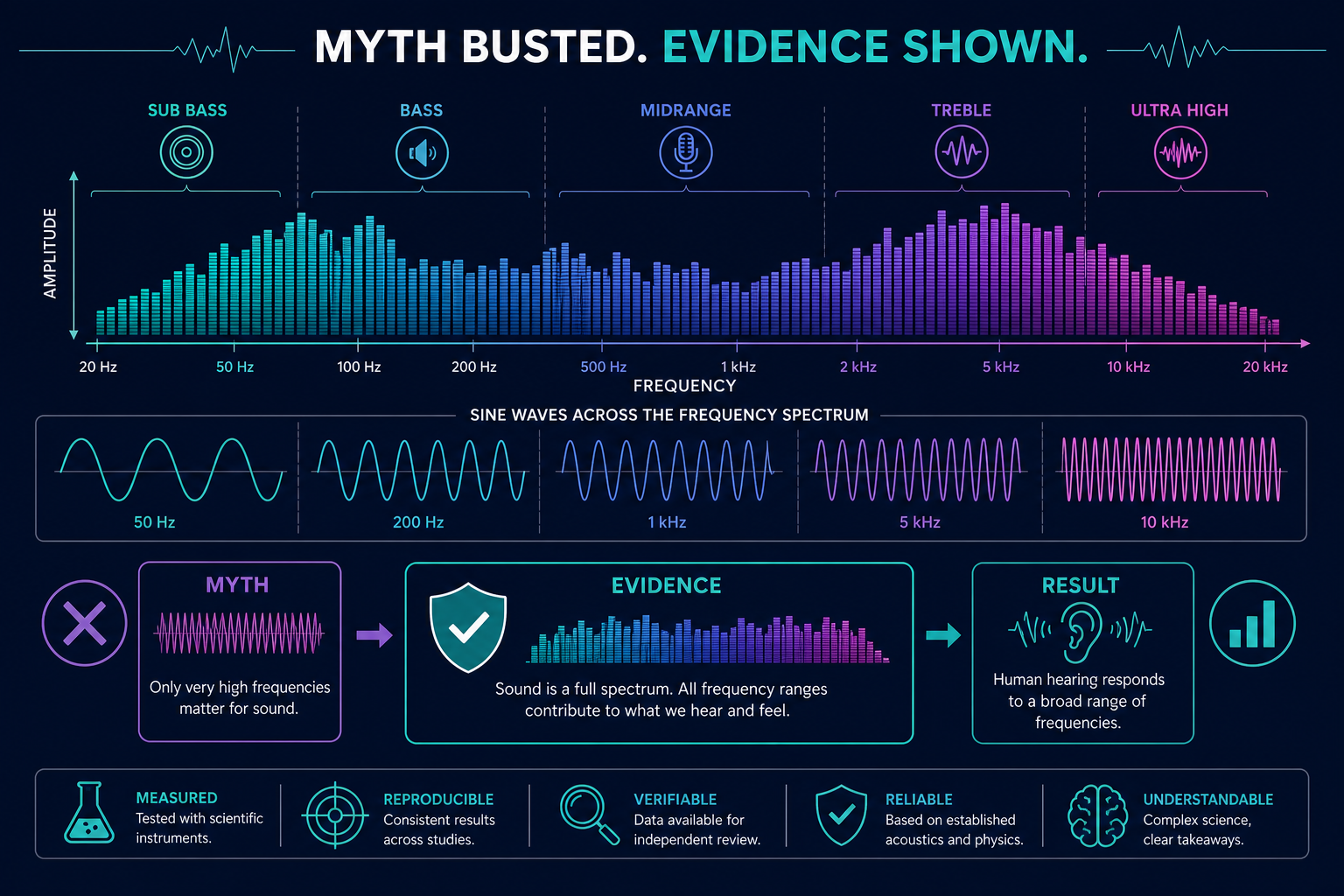
Fire audio spans roughly 80 Hz–8 kHz: low rumble from convection and fuel, mid crackle from wood fracture, occasional high ticks from sap or metal grate. Moore's masking chapters emphasise that effective beds cover the band where unpredictable spikes live — not necessarily the whole spectrum at equal loudness.[3] Zwicker and Fastl note human hearing is most sensitive in the 2–5 kHz speech band; isolated crackle energy there demands more attention than the same energy buried under brown rumble.[4]
Design implication: treat rumble as continuous floor, crackle as sparse garnish. ISO soundscape guidance frames environments as layered acoustic scenes rather than single dominant sources — hearth logic fits that model.[7]
Layer one: brown or pink floor
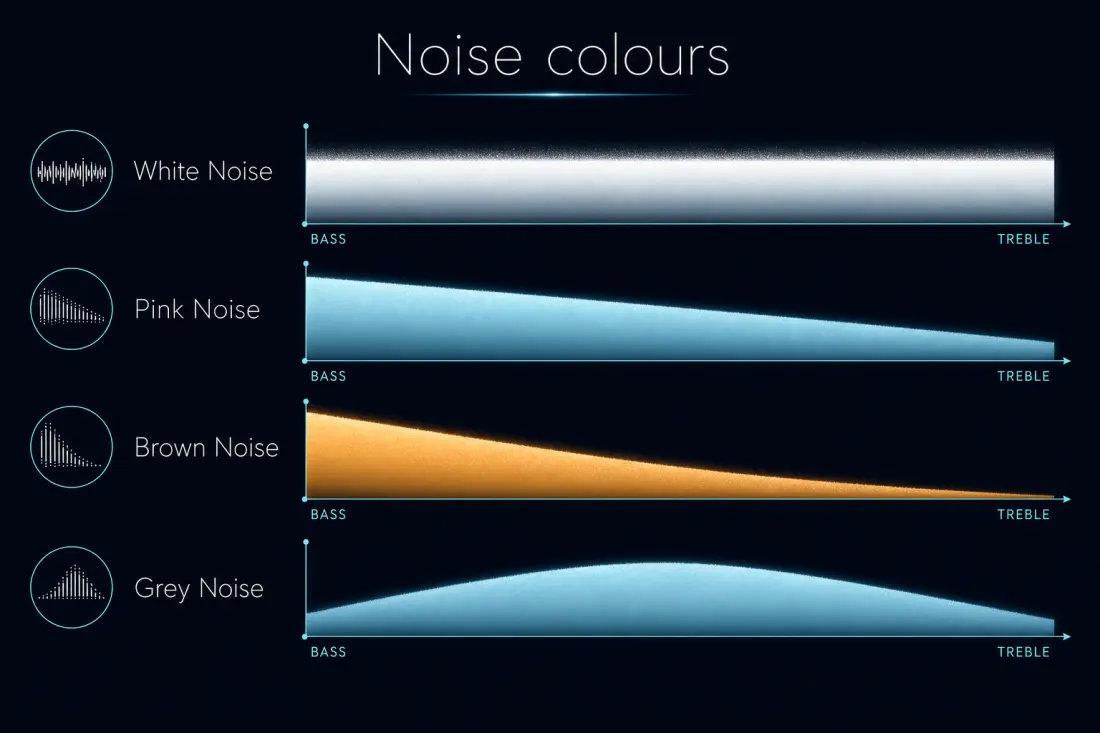
Stanchina's ICU masking trial established that raising a continuous internal floor improves sleep continuity against unpredictable noise spikes.[5] Fireplace crackle is structurally similar to ICU events — irregular transients on a quiet background. A brown noise bed (or very low fireplace rumble stem) shrinks contrast so pops feel embedded rather than announced.[15][18]
Start the floor at whisper level — just below conscious tracking. If you can describe each pop in detail, crackle is too loud relative to floor. ANSI masking definitions apply: the goal is threshold elevation for sudden events, not drowning the room.[18]
Layer two: spatial crackle bubble
Place the explicit fire-crackle bubble away from head position — simulated hearth across the room, not inside skull. Bregman's spatial separation cues let the brain file crackle as environmental object while brown stays room tone.[1][14] Falloff in Sound Bubbles implements distance: high falloff pushes crackle toward the "fireplace wall," preserving reading and conversation bandwidth.[14]
Banbury's irrelevant speech work reminds us semantic content captures working memory; fire has no words, but salient crackle still competes when it is the only foreground stream.[8] Spatialising reduces salience without removing charm.

Layer three: slow change via TimeLine
Static loops habituate; then listeners raise volume until seams punish them.[9][10] Friston and Clark's predictive processing accounts describe suppressed prediction error for stable backgrounds until deviation spikes error again.[12][13] TimeLine Drift, Tide, or Orbit introduces slow statistical motion — volume wander, subtle pan — so the hearth remains a place, not a metronome.[13]
Keep Chaos low for sleep-adjacent sessions; higher drift suits reading and evening wind-down when mild unpredictability delays habituation.[2]
Activity-specific recipes
Sleep adjacent: brown floor dominant, crackle bubble at 20–30% of floor level, high falloff, no sudden wood-collapse samples.[5][22]
Reading / focus: slightly more crackle presence acceptable if spatialised; never add lyric music to "complete" the hearth — phonological loop conflict per Banbury.[8]
Stress recovery: Alvarsson measured faster autonomic recovery with nature spectra than urban noise at matched SPL — fire sits between: organic but volatile.[6] Pair low crackle with distant rain if fire alone feels too dry.
Volume, duration, and ear safety
Basner's noise-health syntheses apply even to chosen sound: dose accumulates across hours.[19] WHO hearing guidance recommends comfortable recreational levels — fireplace cosiness is not an excuse for 85 dB overnight.[20] Re-test at the 45-minute mark; if you want louder, change layers or motion instead of cranking one loop.[9]
Common mistakes
- Single fireplace file at bedside speaker — maximum salience, minimum scene depth.[1]
- No floor under crackle — every pop is an event.[5]
- Maximum crackle volume to "feel" the fire — triggers orienting, not calm.[11]
- Identical loop for weeks — habituation guaranteed; rotate stems or enable TimeLine.[2]
Building your first layered hearth garden
- Add brown noise bed; set master volume conservatively.[15][16]
- Release brown as spatial bubble behind listener if supported.[14]
- Add fireplace crackle bubble forward-left or forward-right; increase falloff until pops feel "across the room."[1]
- Enable TimeLine Drift at low intensity.[13]
- Listen 60 minutes; note fatigue point; adjust crackle-to-floor ratio before raising master gain.[9]
Honest expectation: layered fire supports ambience and mild masking — not therapy, not sleep medicine. Clinical insomnia and hyperacusis need professional paths; hearth audio is environmental craft.[8][22]
Companion listening in Sound Bubbles
Research above concerns clinical and laboratory sound — not a playlist guarantee. Sound Bubbles offers adjustable living gardens: spatial layers, coloured noise beds, Medical & Wellbeing rooms, and easy mute. Use recommended gardens as environmental support alongside medical care when appropriate.[20]
Not treatment. See clinicians for diagnosis, medication, CBT, neurologic music therapy, or tinnitus programmes. Keep volume comfortable; stop if symptoms worsen.
Why this supports Sound Bubbles — not just "any ambient app"
Most ambient apps deliver one file. The studies above rarely study "a loop." They study continuous floors against irregular noise, unintelligible speech against memory tasks, nature scenes against stress markers, spatial streams against glued mashups, and slow environmental change against habituation.[9][14][22][23][24]
Sound Bubbles maps onto those findings deliberately: brown/noise beds for masking floors, nature and library layers for restorative structure, distance/Falloff for speech intelligibility control, and TimeLine motion so the garden keeps the statistics of a place instead of the statistics of a four-minute loop.[12][15][16][25] That is the practical reason the product feels different after the first hour — and the scientific reason the difference matters.
How to apply this inside Sound Bubbles
- Open a related garden (or New Garden) and press Start playing so audio unlocks.[9]
- Expand Shape your soundscape → Sounds: set Master Volume, then Falloff while watching the audible-core guide.[10]
- Select a bubble; drag and scroll depth. Prefer raising one bubble's Volume over blasting the whole room.[11]
- Add library rain, nature, or noise layers; keep speech-like content distant — or remove it — when you need reading or coding focus.[12]
- TimeLine: choose Drift, Tide, or Orbit when you want the garden to keep evolving without grabbing attention.[13]
- Brown Noise tab: shape a warm floor, optionally Release as bubble so it becomes spatial.[14]
- Save gardens that still feel kind after an hour — public gardens should stay soft, not startling.[15]
Limits, safety, and honest uncertainty
We do not claim Sound Bubbles replaces clinical care, sleep medicine, occupational health programmes, or psychiatric treatment.[1][7] What the product does offer is a listening architecture that matches how hearing and attention actually work: layered sources, spatial distance, and slow change instead of one brittle loop.[18][19]
If sound worsens symptoms, stop. If you need medical advice, see a clinician. If you want a softer room, open a garden, place the bubbles kindly, and stay honest about what sound can — and cannot — do.[20][21]
How this article was researched
We combine first-hand experience placing and tuning Sound Bubbles gardens with citations from peer-reviewed journals, reviews, and institutional pages (including NIH/NCBI, sleep and hearing literature, acoustics, and attention research). Where evidence is mixed or early, we say so. On wellbeing topics we stay cautious: these are companion soundscapes, not cures.
References
Sources cited in this article. Prefer primary literature and institutional guidance; Sound Bubbles is not a medical device and these citations do not imply clinical endorsement.
- (1990). Auditory Scene Analysis. MIT Press.
- (2009). Habituation revisited. Neurobiology of Learning and Memory. doi:10.1016/j.nlm.2008.09.015
- (2012). An Introduction to the Psychology of Hearing. Brill.
- (1999). Psychoacoustics: Facts and Models. Springer.
- (2005). White noise on sleep with ICU noise exposure. Sleep Medicine. doi:10.1016/j.sleep.2004.12.004
- (2010). Stress recovery with nature sound. IJERPH. doi:10.3390/ijerph7031036
- (2014). Soundscape — Definition and conceptual framework. ISO.
- (2001). Auditory distraction and short-term memory. Human Factors. doi:10.1518/001872001775992390
- (2009). Habituation revisited. Neurobiology of Learning and Memory. doi:10.1016/j.nlm.2008.09.015
- (2009). Habituation: a history. Neurobiology of Learning and Memory.
- (1963). Perception and the conditioned reflex. Pergamon Press.
- (2010). The free-energy principle. Nature Reviews Neuroscience. doi:10.1038/nrn2787
- (2013). Whatever next? Predictive brains. Behavioral and Brain Sciences. doi:10.1017/S0140525X12000477
- (1990). Auditory Scene Analysis. MIT Press.
- (2012). An Introduction to the Psychology of Hearing. Brill.
- (2024). Colors of noise. Encyclopedic.
- (2013). Acoustical terminology (masking). ANSI.
- (2014). Auditory and non-auditory effects of noise on health. The Lancet. doi:10.1016/S0140-6736(13)61613-X
- (2021). World report on hearing. WHO.
- (2023). Noise and hearing loss prevention. CDC.
- (2005). White noise on sleep with ICU noise exposure. Sleep Medicine. doi:10.1016/j.sleep.2004.12.004
- (2001). Auditory distraction and short-term memory. Human Factors. doi:10.1518/001872001775992390
- (2010). Stress recovery with nature sound. IJERPH. doi:10.3390/ijerph7031036
- (2005). Speech intelligibility and work performance. Indoor Air. doi:10.1111/j.1600-0668.2005.00391.x