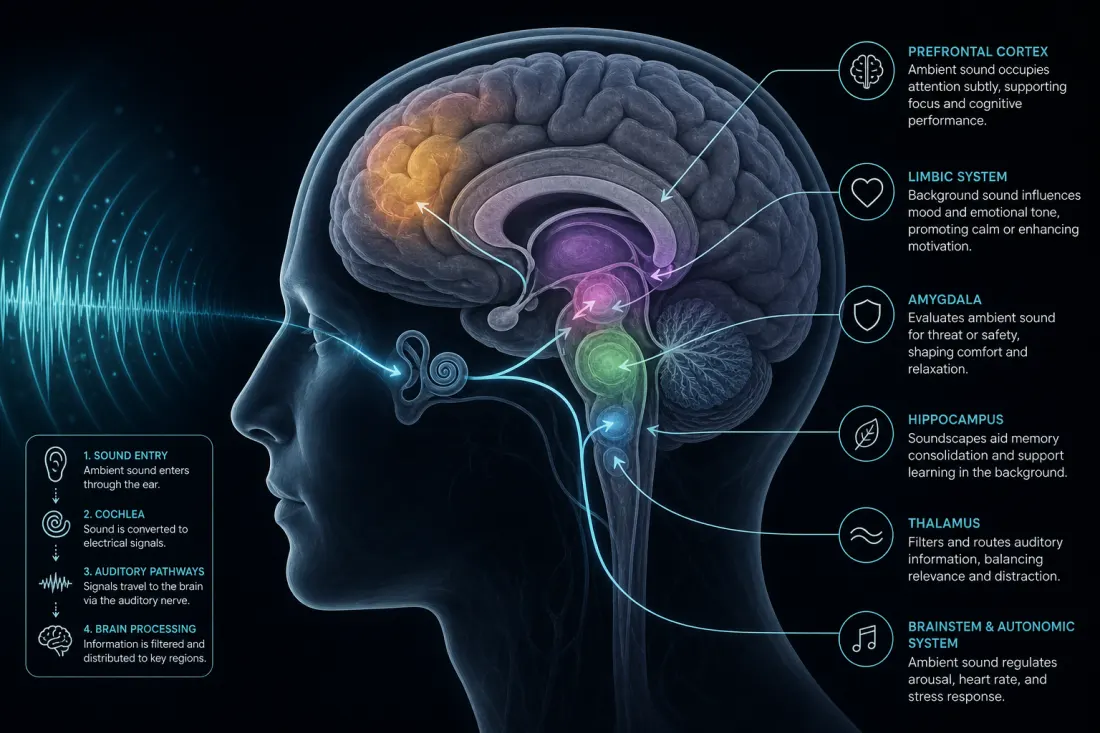

A brief history — from spinal reflexes to office noise
Thompson traced habituation from Pavlovian overshadowing through Groves and Thompson's dual-process theory: one process decreases response, another sensitises the system, yielding the characteristic inverted-U with repetition.[2][4] Sokolov's orienting response paired with habituation: novelty triggers a body-wide snapshot; repetition withdraws the snapshot if nothing bad happens.[3]
Auditory habituation is why city dwellers sleep through traffic yet wake to a child's whimper — not because the whimper is louder, but because traffic predictions are absorbed and infant cries stay high-salience.
The Rankin hallmarks — a checklist for any stimulus
Rankin et al. distilled decades of invertebrate and mammalian work into testable criteria. Key ideas for listeners:
- Repeated stimulation reduces response — heart rate, startle, EEG, or annoyance ratings drop.[1]
- Spontaneous recovery — after a break, the old response returns, then re-habituates faster.[1]
- Dishabituation — a novel stimulus restores response to the habituated one (the loop seam you suddenly hear).[1]
- Generalisation — similar sounds partially inherit habituation — why pink and brown noise swap more easily than rain to jackhammer.[1]
Predictive coding reinterpretation
Modern accounts frame habituation as increased predictability — brains down-weight precision on expected input (Friston; Clark).[5][19] Mismatch negativity studies show cortical models updating with repetition until deviants alone provoke error signals.[6] Habituation is not "ignoring"; it is successful forecasting.
When a loop repeats identically, two failures occur: masking effectiveness drops as precision falls, then dishabituation at the seam spikes orienting — worse than silence for some sleepers.
Clinical edges — when habituation fails
Tinnitus patients often cannot habituate to internal tones; Rauschecker et al. described limbic-auditory loops that keep error signals alive.[13] Robertson and Simmons documented sensory sensitivity profiles in autism where habituation slopes differ — the same HVAC may never fade.[17] Dunn's sensory processing framework helps occupational therapists tailor environments — clinical work, not playlist guessing.[18]

Habituation in sleep and focus contexts
Stanchina et al. showed continuous white noise reduced EEG arousals to ICU spikes — external randomness habituated against a stable floor.[7] Riedy's systematic review notes inconsistent benefit across populations — habituation to the masker itself limits long nights.[8]
Banbury et al. remind us speech habituation is partial at best: intelligible talk continues stealing working memory even when "ignored."[12] Habituation is not a superpower for cocktail parties.
Dishabituation and the loop seam problem
Rankin's dishabituation criterion explains the jolt when a perfect loop restarts: the seam is a deviant relative to the habituated pattern — orienting returns at 4:00 exactly.[1] Groves and Thompson's dual-process theory adds sensitisation: after many repeats, some pathways become more responsive, not less — explaining why a once-ignored loop can become irritating.[4]
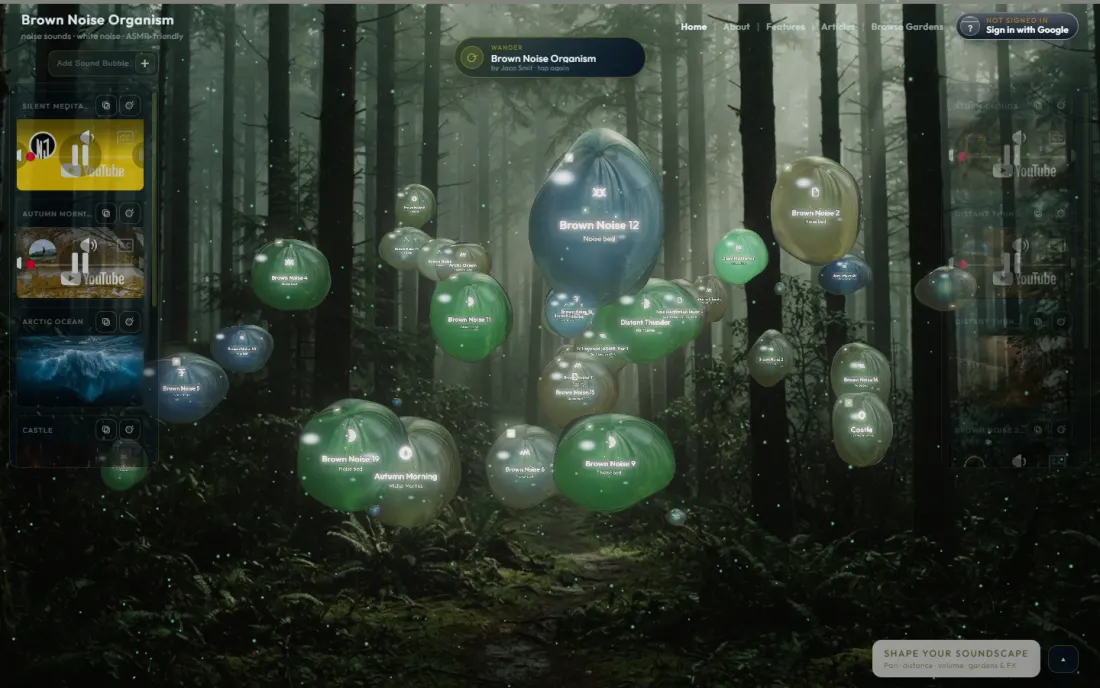
TimeLine motion in Sound Bubbles trades perfect repetition for controlled drift — enough novelty to avoid seam spikes, not enough to trigger full orienting. That is habituation-aware design, not random chaos.
Thompson traced habituation from Pavlovian overshadowing through dual-process theory — sensitisation and decrement coexist, explaining non-monotonic annoyance curves over weeks.[2][4] A sound that calms on night one may irritate by night fourteen unless statistics drift.
Groves and Thompson's framework also predicts dishabituation after long silence — Monday morning traffic feels sharp after a quiet weekend in the countryside. Rankin's spontaneous recovery criterion is the same phenomenon on shorter timescales.[1]
Designing around habituation — Sound Bubbles
Sound Bubbles TimeLine modes (Drift, Tide, Orbit) introduce slow statistical change without sharp transients — keeping models updating so habituation does not collapse into seam detection.[1] Spatial bubbles maintain separable streams per Bregman's ASA principles, so individual sources habituate independently rather than as one mashed file.[10]
Alvarsson et al. showed nature sounds support stress recovery — natural scenes carry endless micro-variation, explaining why real rain outlasts MP3 loops psychologically.[11]
Practical tactics
- Rotate gardens across nights to exploit spontaneous recovery without shocks.[1]
- Prefer brown noise with gentle motion over perfect loops.[7]
- Keep volume low; loud maskers fatigue cochlea and attention.[9][14][15]
- Do not expect habituation to intelligible speech — remove it.[12]
- If tinnitus intrudes despite masking, see audiologist — not longer loops.[16]
Spontaneous recovery after vacation explains why a once-tolerated office loop feels fresh Monday then unbearable Thursday — Rankin's recovery criterion in everyday terms.[1] Rotating Sound Bubbles gardens leverages recovery without introducing shock.[1]
Clinical habituation training (tinnitus TRT, graded exposure) differs from environmental habituation — supervised protocols measure distress scales, not only annoyance. NIH NIDCD tinnitus pages outline professional pathways.[16]
Habituation in product lifecycles
App developers sometimes misread habituation as "users want new content daily." Rankin's framework suggests users want statistics that stay valid — slow drift, not new jingles.[1] Seamless evolution beats playlist churn.
Rankin also notes generalisation: habituation to one brown noise partially transfers to similar spectra — useful when swapping Sound Bubbles gardens with comparable floors.[1]
Thompson's historical chapter notes habituation appears across phyla — if Aplysia can learn to ignore, your notification bar can learn to stay silent.[2]
Stanchina and Riedy together bracket ICU-grade evidence and population reviews — both say continuity matters more than brand.[7][8]
Summary
Habituation is learned ignore for safe repetition — Rankin's hallmarks, dual-process sensitisation, and seam-triggered dishabituation explain why loops betray sleep and focus.[1][4] Slow change preserves masking; identical files do not.
Clinical sensory differences (tinnitus, autism) alter slopes — environmental kindness helps many, therapy helps when distress persists.[13][17]
Groves and Thompson's dual-process theory predicts some listeners sensitize to loops over days — rotate gardens before irritation becomes identity.[4]
Rankin's generalisation criterion explains why switching brown to pink sometimes works without resetting the whole night.[1]
NIH NCCIH cautions complementary sound tools vary widely — habituation science informs design, not cure claims.[20]
Thompson's history notes habituation was once mistaken for fatigue — modern sleep product design still repeats that mistake with louder loops.[2]
Stanchina and Riedy bracket evidence from ICU beds to bedrooms: continuity helps, individual response varies, seams hurt.[7][8]
Sound Bubbles TimeLine exists partly because Rankin's dishabituation criterion predicted loop hatred years before streaming apps.[1]
Sokolov orienting never signed a waiver for open offices — novelty is still novelty at 2pm.[3]
Rankin spontaneous recovery is why vacation quiet makes Monday traffic feel brutal — plan gentle re-entry masks.[1]
Banbury distraction data should haunt open-plan pitch decks until architecture changes.[12]
Alvarsson nature recovery is not habituation, but calmer baselines help new sounds habituate faster.[11]
Rauschecker tinnitus loops show failed habituation can be pathological — not every grab fades with exposure.[13]
NIH NIDCD tinnitus pages separate habituation training from merely turning up rain today — seek clinical care when distress stays high now.[16]
Limits
Habituation does not imply safety — chronic traffic noise still harms cardiovascular health even when subjectively faded (Basner et al.).[9] NIH NCCIH cautions that complementary sound approaches vary individually.[20] Use habituation as design science, not an excuse to ignore harmful environments.
How this article was researched
We combine first-hand experience placing and tuning Sound Bubbles gardens with citations from peer-reviewed journals, reviews, and institutional pages (including NIH/NCBI, sleep and hearing literature, acoustics, and attention research). Where evidence is mixed or early, we say so. On wellbeing topics we stay cautious: these are companion soundscapes, not cures.
References
Sources cited in this article. Prefer primary literature and institutional guidance; Sound Bubbles is not a medical device and these citations do not imply clinical endorsement.
- (2009). Habituation revisited: an updated and revised description of the characteristics of habituation. Neurobiology of Learning and Memory. doi:10.1016/j.nlm.2008.09.015
- (2009). Habituation: a history. Neurobiology of Learning and Memory.
- (1963). Orienting response and novelty detection. Pergamon Press.
- (1970). Habituation: a dual-process theory. Psychological Review. doi:10.1037/h0029810
- (2010). The free-energy principle. Nature Reviews Neuroscience. doi:10.1038/nrn2787
- (2007). The mismatch negativity (MMN) in basic research of central auditory processing. Clinical Neurophysiology. doi:10.1016/j.clinph.2007.04.026
- (2005). The influence of white noise on sleep in subjects exposed to ICU noise. Sleep Medicine. doi:10.1016/j.sleep.2004.12.004
- (2021). Noise as a sleep aid: A systematic review. Sleep Medicine Reviews. doi:10.1016/j.smrv.2020.101385
- (2014). Auditory and non-auditory effects of noise on health. The Lancet. doi:10.1016/S0140-6736(13)61613-X
- (1990). Auditory Scene Analysis. MIT Press.
- (2010). Stress recovery during exposure to nature sound and environmental noise. IJERPH. doi:10.3390/ijerph7031036
- (2001). Auditory distraction and short-term memory. Human Factors. doi:10.1518/001872001775992390
- (2010). Tuning out the noise: limbic-auditory interactions in tinnitus. Neuron. doi:10.1016/j.neuron.2010.04.032
- (2021). World report on hearing. WHO.
- (2023). Noise and hearing loss prevention. CDC.
- (2024). Tinnitus — causes and management. NIH.
- (2013). Sensory sensitivity in autism. Journal of Autism and Developmental Disorders.
- (2001). The sensations of everyday life: sensory processing framework. American Journal of Occupational Therapy.
- (2013). Whatever next? Predictive brains, situated agents. Behavioral and Brain Sciences. doi:10.1017/S0140525X12000477
- (2024). Sound and music based interventions — evidence overview. NIH.