Ancient Greece — when harmony was physics and therapy
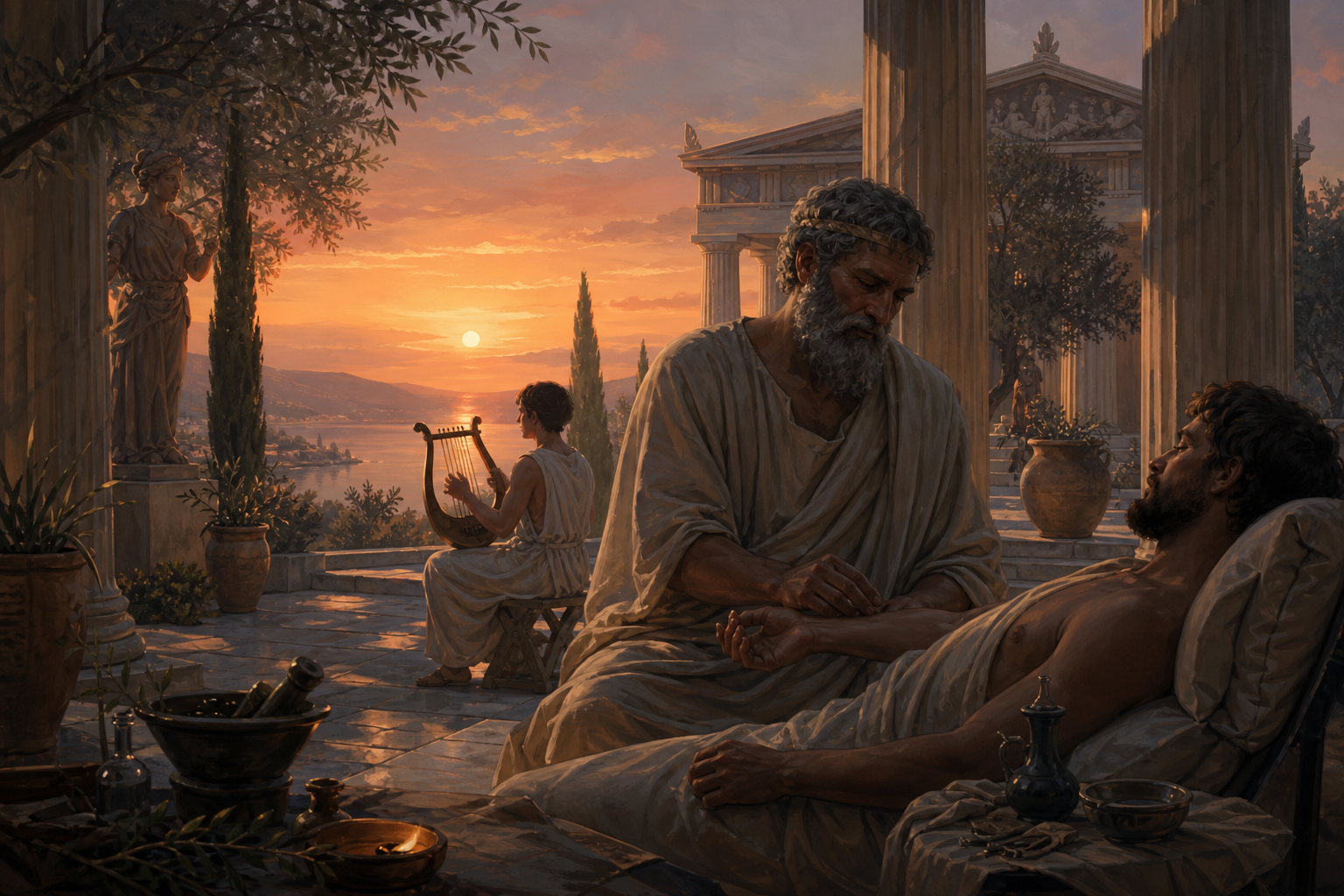
Fifth-century Greek thought linked musical ratio to cosmic order. Pythagoras and his school investigated consonant intervals as simple whole-number relationships — the octave as 2:1, the fifth as 3:2 — and treated those ratios as evidence that beauty in sound reflected structure in nature.[4][5] That was not “vibration heals DNA” marketing; it was early mathematical psychoacoustics. Plato’s Republic and Timaeus later argued that musical modes could shape character and civic virtue — a moral psychology of timbre and scale that influenced Western education for centuries.[6]
At Asclepian healing sanctuaries, incubation rituals combined sleep, dream interpretation, and performance. Patients slept in abaton chambers where priests sang paian hymns and played auloi; archaeological and textual sources describe music as part of the therapeutic frame, not entertainment beside it.[7][8] Modern scholars caution against retrofitting random Hz claims onto these practices — the mechanism was relational, religious, and environmental. But the design pattern persists: controlled place + intentional sound + altered consciousness.
Aristoxenus and later Greco-Roman writers documented ear training and the ethics of performance. What survives for today’s listener is not a prescription for Dorian mode on Spotify. It is the precedent that Western medicine once took acoustic environment seriously — then forgot, then rediscovered under new names.
Indigenous traditions — songlines, drums, and the ethics of borrowing
Outside the Mediterranean, sound-as-medicine was rarely separated from land, lineage, and law. Australian Aboriginal songlines encode navigation and cosmology in sung paths — knowledge carried in melody and rhythm across generations.[9][10] In many African diasporic and Central African healing traditions, polyrhythmic drumming accompanies ritual states; ethnomusicologists document entrainment between drummer and participant without reducing ceremony to “brainwave therapy.”[11]
Native North American flute traditions, Amazonian icaros sung during ayahuasca ceremonies, and Sámi joik each bind sound to community-specific meaning.[12][13] When wellness apps mine these forms as generic “shamanic ambience,” they strip the governance that made them medicine — elders, initiation, reciprocity, contraindication.
Ethical modern practice cites traditions respectfully, avoids faux-indigenous branding, and admits that clinical RCTs rarely translate ritual into consumer loops. What can transfer is design intelligence: long-form listening, low surprise, collective rhythm, and the understanding that sound works inside social safety — a lesson polyvagal-informed authors echo today without replacing indigenous knowledge.[14]

Medieval to Renaissance — hospitals as noisy charnel houses
European hospitals before the nineteenth century were often acoustically brutal — open wards, prayer bells, livestock, groaning. Music appeared in monastic infirmaries as liturgy, not noise control. Hildegard of Bingen’s compositions (12th century) integrated music into a theology of bodily humours and spiritual balance; her Symphonia armoniae celestium revelationum treats sound as divine order made audible.[15]
Renaissance anatomy did not yet connect cochlea to cortisol, but musicians studied affective power systematically. Zarlino’s harmonic theory and the rise of public opera made emotional manipulation through timbre a craft — foreshadowing later film scoring and, indirectly, psychedelic session playlists.
Florence Nightingale and the invention of “quiet” as a clinical variable
Nightingale’s Notes on Nursing (1859) is sharper than most hospital sound policies today: unnecessary noise, she wrote, is “the most cruel absence of care.” She ranked sudden sounds as especially harmful to recovery — a nineteenth-century observation now supported by ICU actigraphy studies showing sleep fragmentation from unpredictable alarms and conversation.[16][17][18]
That shift — from music as ritual to silence and soundscape as patient safety — is the backbone of modern hospital acoustics. Today’s HCAHPS noise complaints and WHO environmental noise guidelines for European hospitals descend from Nightingale’s ward ear, not from a meditation influencer.[19][20]
Twentieth century — music therapy becomes a profession
After World Wars I and II, musicians played for wounded soldiers; veterans’ hospitals documented mood and cooperation improvements — anecdotal, but repeated enough to formalise training. The National Association for Music Therapy (USA, 1950) and later the American Music Therapy Association codified practice requiring assessment, treatment planning, and clinical supervision — distinct from playing a harp in a lobby.[21][22]
Simultaneously, vibroacoustic therapy experiments in Scandinavia explored low-frequency vibration through chairs and mattresses for pain and spasticity — somatosensory stimulation overlapping with hearing but not identical to it.[23] Psychoacoustics matured: Fletcher and Munson’s equal-loudness work (1933) explained why masking and spectrum matter at equal SPL.[24]
By the 1970s, neurologic music therapy (NMT) began systematising rhythm for gait rehabilitation — Thaut’s later RCTs on rhythmic auditory stimulation in Parkinson’s and stroke recovery showed measurable motor entrainment, not vague relaxation.[25][26] This is crucial: structured music as physiologic cue differs from ambient wallpaper.
Modern evidence — what changed when we started counting
Three evidence streams dominate responsible “sound medicine” talk today:
- Music therapy meta-analyses — Bradt and colleagues’ Cochrane reviews across anxiety, cancer care, and procedural pain show consistent but modest benefits; music is adjunctive, not curative.[2][27][28]
- Environmental masking and sleep — ICU white-noise trials (Stanchina et al.), systematic reviews of noise as sleep aid (Riedy et al.), and pink-noise slow-oscillation physiology (Ngo et al.) address continuity and contrast reduction, not mystical frequencies.[17][29][30]
- Nature and stress recovery — Alvarsson’s laboratory study showed faster autonomic recovery after stress with nature sounds versus urban noise; Ulrich’s hospital window views began evidence-based environmental design.[31][32]
Parallel medical sound technologies exploded outside headphones: diagnostic ultrasound, lithotripsy, shockwave therapy for tendinopathy, low-intensity pulsed ultrasound for fractures, MRI-guided focused ultrasound thalamotomy for essential tremor, and histotripsy cavitation for liver tumours.[33][34][35][36] These are medicine — regulated, dose-controlled, outcome-measured — and should never be confused with a Sound Bubbles garden.
NIH’s National Center for Complementary and Integrative Health urges separating promising complementary approaches from unsupported frequency claims; the 2025 scoping review of sound interventions for mental stress reports benefits alongside individual variation and occasional adverse responses.[37][38]
Music therapy vs sound therapy vs your ambient app
Music therapy requires a credentialed therapist, individualised goals, and documented outcomes — AMTA’s scope of practice is clear.[22] Sound therapy in clinical speech-hearing contexts often means tinnitus retraining, masking, or sensory integration protocols — also supervised.[39] Consumer soundscapes — brown noise organisms, rain loops, spatial gardens — are environmental tools: potentially helpful, not assessed as devices, not replacing CBT, medication, or NMT gait protocols.[40]
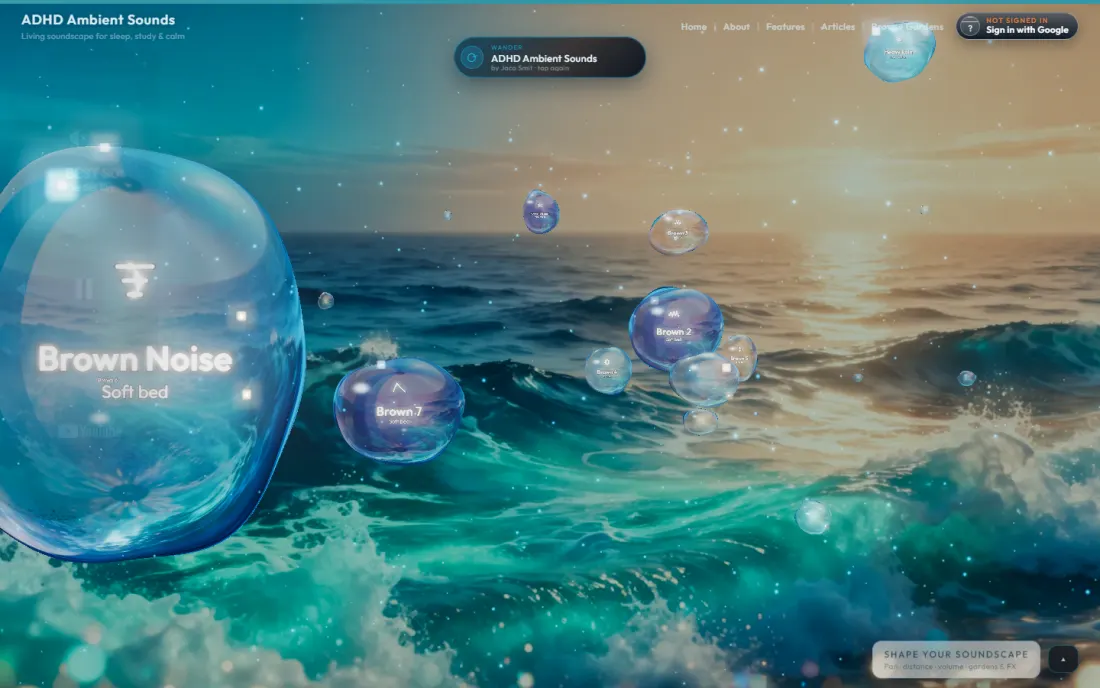
Sound Bubbles sits in the last category deliberately: living gardens you can reshape, with medical-adjacent copy on some gardens but no diagnostic claims. The historical lesson is humility — cultures that used sound longest embedded it in relationship and place; modern medicine that uses sound best measures small effects honestly.
Timeline at a glance
| Era | Practice | What carried forward |
|---|---|---|
| Ancient Greece | Pythagorean ratios; Asclepian incubation music | Intentional environment; mode and affect[4][7] |
| Indigenous worlds | Songlines, drums, icaros, joik | Community context; rhythm as social glue[9][11] |
| 1859+ | Nightingale ward noise critique | Quiet as clinical care[16] |
| 1950+ | Formal music therapy | Trained clinicians; documented goals[21] |
| 1990+ | NMT gait protocols; ICU masking trials | Entrainment vs environmental floor[17][25] |
| 2010+ | Nature recovery labs; FUS neurosurgery | Measured physiology; regulated doses[31][35] |
Reading the history while listening
If you want to feel the thread — temple air plus brown fog without claiming Asclepius on your About page — open Temple Organism, keep bells far, brown bed soft, TimeLine on Drift. If you want ICU-style masking logic, try Brown Noise Organism with Falloff high. History is not a license to heal; it is a reminder that humans always built rooms for ears on purpose.
Limits
Past practice does not prove present claims. Indigenous knowledge is not a free catalogue for apps. Clinical music therapy outcomes do not automatically transfer to playlists. If you need treatment, seek licensed care — not a longer loop.[22][37]
How this article was researched
We combine first-hand experience placing and tuning Sound Bubbles gardens with citations from peer-reviewed journals, reviews, and institutional pages (including NIH/NCBI, sleep and hearing literature, acoustics, and attention research). Where evidence is mixed or early, we say so. On wellbeing topics we stay cautious: these are companion soundscapes, not cures.
References
Sources cited in this article. Prefer primary literature and institutional guidance; Sound Bubbles is not a medical device and these citations do not imply clinical endorsement.
- (2000). Music as medicine: the history of music therapy since antiquity. Ashgate.
- (2021). Music interventions for anxiety and depression. Cochrane Database of Systematic Reviews.
- (2018). Environmental noise guidelines for the European Region. World Health Organization.
- (2007). Scientific method in Pythagorean harmonics. Cambridge University Press.
- (2014). Pythagorean harmonics and early Greek science. Stanford Encyclopedia of Philosophy.
- (~380 BCE). Republic — musical modes and character (transl.). Classical text.
- (2018). Music in ancient Greek healing sanctuaries. Greek and Roman Musical Studies.
- (1899). Incubation and dream healing in antiquity. Archaeological / classical studies (cited in later reviews).
- (2017). Songs of Central Australia — songlines and knowledge. Harvard University Press context.
- (2010). Aboriginal music and wellbeing (ethnomusicology context). Peer-reviewed ethnomusicology.
- (1996). Dancing Prophets: Musical Experience in Tumbuka Healing. University of Chicago Press.
- (2009). Singing to the Plants: A Guide to Mestizo Shamanism in the Upper Amazon. University of New Mexico Press.
- (2012). Sámi musical practices and cultural identity. Ethnomusicology literature.
- (2007). The polyvagal perspective (social safety context). Biological Psychology. doi:10.1016/j.biopsycho.2006.06.009
- (~1175). Symphonia armoniae celestium revelationum. Medieval music-theology.
- (1859). Notes on Nursing: What It Is, and What It Is Not. Harrison.
- (2005). The influence of white noise on sleep in subjects exposed to ICU noise. Sleep Medicine. doi:10.1016/j.sleep.2004.12.004
- (2019). Sleep and noise in the ICU: a systematic review. Critical Care.
- (2014). Auditory and non-auditory effects of noise on health. The Lancet. doi:10.1016/S0140-6736(13)61613-X
- (1999). WHO community noise guidelines. WHO.
- (2024). History of music therapy profession (USA). AMTA.
- (2024). Scope of music therapy practice. AMTA.
- (2008). A comprehensive guide to music therapy and vibroacoustic therapy. Jessica Kingsley Publishers.
- (1933). Loudness, its definition, measurement and calculation. Journal of the Acoustical Society of America. doi:10.1121/1.1915637
- (2007). Rhythmic auditory stimulation in gait rehabilitation. Neurorehabilitation and Neural Repair.
- (2015). Neurologic music therapy in sensorimotor rehabilitation. Oxford Handbook of Neurologic Music Therapy.
- (2014). Music interventions for mechanically ventilated patients. Cochrane Database.
- (2020). Music therapy for stress reduction: systematic review and meta-analysis. Health Psychology Review.
- (2021). Noise as a sleep aid: A systematic review. Sleep Medicine Reviews. doi:10.1016/j.smrv.2020.101385
- (2013). Auditory closed-loop stimulation of the sleep slow oscillation. Neuron. doi:10.1016/j.neuron.2013.10.017
- (2010). Stress recovery during exposure to nature sound and environmental noise. IJERPH. doi:10.3390/ijerph7031036
- (1984). View through a window may influence recovery from surgery. Science. doi:10.1126/science.6143400
- (2016). MRI-guided focused ultrasound for essential tremor — device summary. U.S. FDA.
- (2001). Shock wave therapy for chronic proximal plantar fasciitis. Clinical Orthopaedics.
- (2016). Focused ultrasound thalamotomy for essential tremor. New England Journal of Medicine. doi:10.1056/NEJMoa1600159
- (2022). Histotripsy: the first non-invasive, non-ionizing, non-thermal ablation technique. International Journal of Hyperthermia review context.
- (2024). Sound and music based interventions — evidence overview. NIH.
- (2025). Effects of sound interventions on mental stress response in adults. PMC.
- (2003). Tinnitus retraining therapy. Tinnitus literature.
- (2019). General wellness policy for low-risk devices. FDA.