
Auditory symptoms in long COVID cohorts
Natelson and colleagues reported auditory symptoms including hyperacusis, tinnitus, and sound intolerance among long COVID patients, proposing central sensitisation and neuroinflammatory pathways as plausible mechanisms pending larger mechanistic studies.[1] Davis's international long COVID characterisation study documented hundreds of symptoms across organ systems — fatigue and cognitive dysfunction topped lists, with sensory sensitivity frequently cited in patient free-text responses.[3]
Nalbandian's Nature Medicine review framed post-acute COVID-19 syndrome as multisystem, noting that auditory complaints often co-occur with postural orthostatic tachycardia and sleep disruption — compounding total symptom burden.[2] Schwartz's otologic survey found hyperacusis and auditory processing difficulties persisting months after acute infection in subsets of respondents.[4]
Evidence remains early: sample sizes are growing but long-term natural history of COVID-associated hyperacusis is not yet established in large prospective cohorts.
Hyperacusis, fatigue, and the cost of listening
Hyperacusis lowers uncomfortable loudness levels — moderate sounds register as too loud or painful. Basner's noise-health synthesis links auditory stress to sleep loss and cognitive fatigue, pathways already maxed out in long COVID.[5][19] When every dish clatter costs spoons-of-energy, environmental design becomes medical adjacency: reducing unpredictable contrast may preserve capacity for work, conversation, and rehabilitation exercises.
Alvarsson's stress-recovery study showed nature sound accelerated autonomic recovery after laboratory stress versus urban noise — suggesting biophilic soundscapes may feel less taxing than mechanical noise for some listeners, though long COVID-specific RCTs do not yet exist.[8][24]

When masking helps — and when silence wins
Paradoxically, some hyperacusis patients tolerate soft continuous brown or pink floors better than silence punctuated by unpredictable spikes — the floor reduces delta between baseline and sudden events.[15][22] Others cannot tolerate any added sound during flares; POTS exacerbations and PEM (post-exertional malaise) days often correlate with sensory collapse. WHO's long COVID guidance emphasises pacing and symptom-contingent activity — sound choices should follow the same rule.[6]
American Tinnitus Association hyperacusis resources recommend gradual desensitisation under audiology supervision for severe cases — consumer apps should not mimic clinical retraining without professional oversight.[7]
Building a long COVID-aware garden
- Default to minimalism: one distant brown bed, optional far rain — pop everything else.[16]
- High Falloff; nothing in the audible core near the head.[14]
- No crickets, bells, or speech during sensitivity flares.[25]
- Stop immediately if listening increases fatigue, headache, or autonomic symptoms.
- Coordinate with audiology if tinnitus or hyperacusis persists beyond three months.[7]
Pacing, PEM, and sensory load budgeting
Post-exertional malaise means sensory effort counts as exertion. A loud video call followed by household noise may leave zero capacity for rehabilitation homework.[2][6] Budget auditory load like steps: soft gardens during low-spoon windows, ear protection during high-demand environments, silence during crashes.
Long COVID clinics increasingly recommend autonomic testing when orthostatic symptoms co-occur with hyperacusis — sound sensitivity may improve when dysautonomia is treated, not only when ears are addressed.[2] Environmental tweaks support recovery; they do not replace pacing, nutrition, sleep scheduling, or clinician-guided rehabilitation.
Online patient communities report wide variance: some regain tolerance within months; others need ongoing protection years later.[1][3] Avoid comparing your trajectory to social-media recovery narratives. Start with the quietest viable garden, increase only when symptom-free windows expand, and document changes alongside heart-rate and sleep data if dysautonomia is part of your picture. Recovery is non-linear; sound tolerance may fluctuate week to week without indicating permanent setback.
Companion listening in Sound Bubbles
Research above concerns clinical and laboratory sound — not a playlist guarantee. Sound Bubbles offers adjustable living gardens: spatial layers, coloured noise beds, Medical & Wellbeing rooms, and easy mute. Use the recommended gardens below as environmental support alongside medical care when appropriate.[20]
Not treatment. See clinicians for diagnosis, medication, CBT, neurologic music therapy, or tinnitus programmes. Keep volume comfortable; stop if symptoms worsen.
Why this supports Sound Bubbles — not just "any ambient app"
Most ambient apps deliver one file. The studies above rarely study "a loop." They study continuous floors against irregular noise, unintelligible speech against memory tasks, nature scenes against stress markers, spatial streams against glued mashups, and slow environmental change against habituation.[9][14][22][23][24]
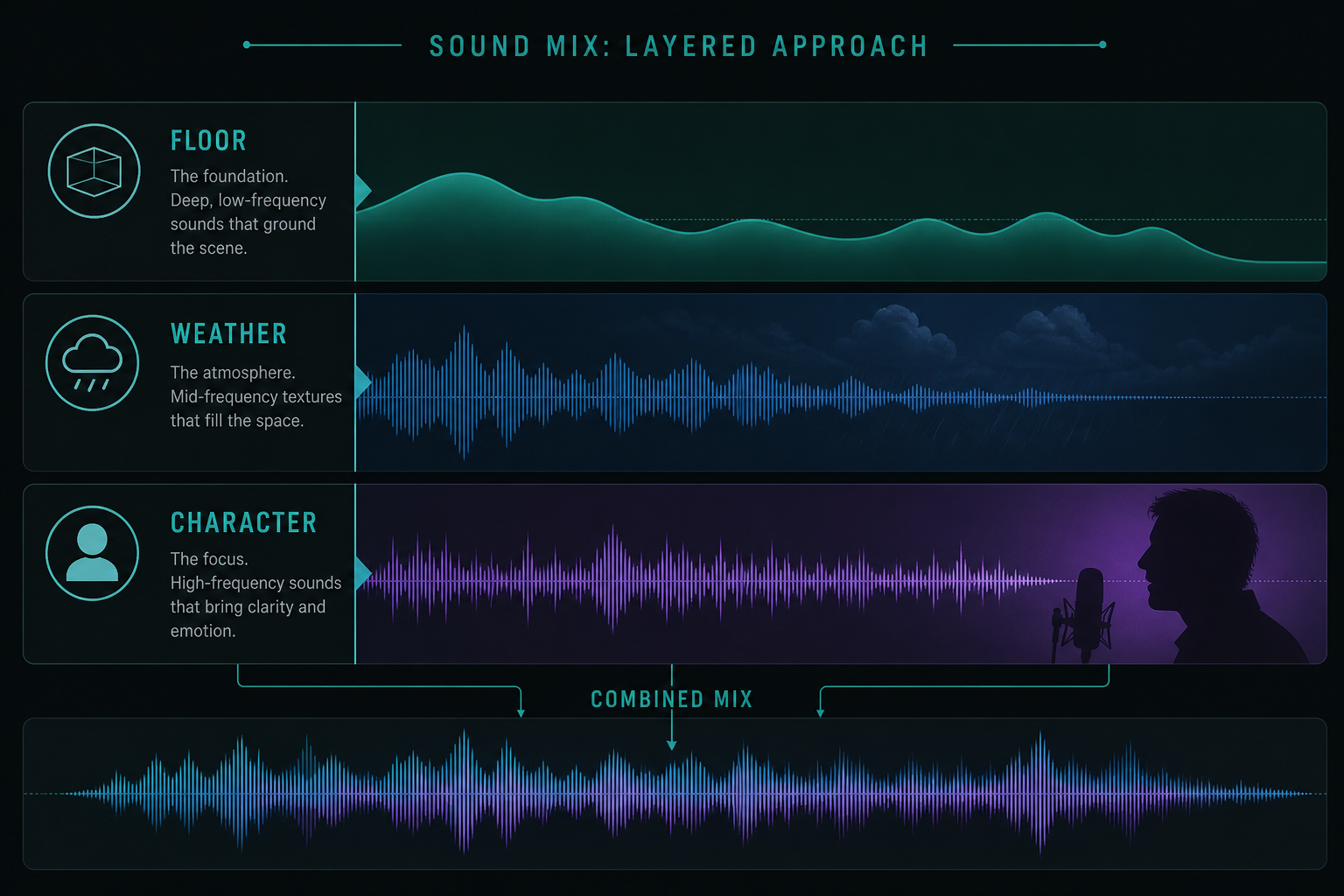
Sound Bubbles maps onto those findings deliberately: brown/noise beds for masking floors, nature and library layers for restorative structure, distance/Falloff for speech intelligibility control, and TimeLine motion so the garden keeps the statistics of a place instead of the statistics of a four-minute loop.[12][15][16][25] That is the practical reason the product feels different after the first hour — and the scientific reason the difference matters.
How to apply this inside Sound Bubbles
- Open a related garden (or New Garden) and press Start playing so audio unlocks.[9]
- Expand Shape your soundscape → Sounds: set Master Volume, then Falloff while watching the audible-core guide.[10]
- Select a bubble; drag and scroll depth. Prefer raising one bubble's Volume over blasting the whole room.[11]
- Add library rain, nature, or noise layers; keep speech-like content distant — or remove it — when you need reading or coding focus.[12]
- TimeLine: choose Drift, Tide, or Orbit when you want the garden to keep evolving without grabbing attention.[13]
- Brown Noise tab: shape a warm floor, optionally Release as bubble so it becomes spatial.[14]
- Save gardens that still feel kind after an hour — public gardens should stay soft, not startling.[15]
Limits, safety, and honest uncertainty
We do not claim Sound Bubbles treats long COVID, hyperacusis, or autonomic dysfunction.[1][6] What the product does offer is a listening architecture that matches how hearing and attention actually work: layered sources, spatial distance, and slow change instead of one brittle loop.[18][19]
If sound worsens symptoms, stop. If you need medical advice, see a clinician. If you want a softer room, open a garden, place the bubbles kindly, and stay honest about what sound can — and cannot — do.[20][21]
How this article was researched
We combine first-hand experience placing and tuning Sound Bubbles gardens with citations from peer-reviewed journals, reviews, and institutional pages (including NIH/NCBI, sleep and hearing literature, acoustics, and attention research). Where evidence is mixed or early, we say so. On wellbeing topics we stay cautious: these are companion soundscapes, not cures.
References
Sources cited in this article. Prefer primary literature and institutional guidance; Sound Bubbles is not a medical device and these citations do not imply clinical endorsement.
- (2022). Auditory symptoms and hyperacusis in long COVID. Frontiers in Neurology. doi:10.3389/fneur.2022.933736
- (2021). Post-acute COVID-19 syndrome. Nature Medicine. doi:10.1038/s41591-021-01283-z
- (2021). Characterizing long COVID in an international cohort. EClinicalMedicine. doi:10.1016/j.eclinm.2021.101019
- (2023). Hyperacusis and auditory processing after COVID-19. Otology & Neurotology. doi:10.1097/MAO.0000000000003789
- (2014). Auditory and non-auditory effects of noise on health. The Lancet. doi:10.1016/S0140-6736(13)61613-X
- (2024). Post COVID-19 condition (long COVID). World Health Organization.
- (2024). Hyperacusis and sound sensitivity resources. ATA.
- (2010). Stress recovery during exposure to nature sound and environmental noise. IJERPH. doi:10.3390/ijerph7031036
- (2009). Habituation revisited. Neurobiology of Learning and Memory. doi:10.1016/j.nlm.2008.09.015
- (2009). Habituation: a history. Neurobiology of Learning and Memory.
- (1963). Perception and the conditioned reflex. Pergamon Press.
- (2010). The free-energy principle. Nature Reviews Neuroscience. doi:10.1038/nrn2787
- (2013). Whatever next? Predictive brains. Behavioral and Brain Sciences. doi:10.1017/S0140525X12000477
- (1990). Auditory Scene Analysis. MIT Press.
- (2012). An Introduction to the Psychology of Hearing. Brill.
- (2024). Colors of noise. Encyclopedic.
- (2013). Acoustical terminology (masking). ANSI.
- (2014). Auditory and non-auditory effects of noise on health. The Lancet. doi:10.1016/S0140-6736(13)61613-X
- (2021). World report on hearing. WHO.
- (2023). Noise and hearing loss prevention. CDC.
- (2005). White noise on sleep with ICU noise exposure. Sleep Medicine. doi:10.1016/j.sleep.2004.12.004
- (2001). Auditory distraction and short-term memory. Human Factors. doi:10.1518/001872001775992390
- (2010). Stress recovery with nature sound. IJERPH. doi:10.3390/ijerph7031036
- (2005). Speech intelligibility and work performance. Indoor Air. doi:10.1111/j.1600-0668.2005.00391.x