

Masking defined — contrast, not volume wars
In psychoacoustic terms, masking occurs when one sound raises the detection threshold for another — the masker does not need to be louder than the intruder globally, it needs to reduce the intruder's salience at the ear and brain.[15][18] Moore's hearing textbooks formalise simultaneous and temporal masking; sleep applications focus on preventing sudden events from standing out against a steady floor.[15]
Stanchina's classic study exposed sleeping adults to recorded ICU noise with and without white noise overlay. Sleep quality improved with masking because alarm-like spikes lost contrast — not because white noise sedated participants.[1] The lesson transfers directly to urban bedrooms: the enemy is delta, not decibels alone.
What systematic reviews conclude
Riedy et al. reviewed noise as a sleep aid and found evidence strongest for masking disruptive environments and aiding sleep onset in healthy listeners — weaker for replacing behavioural insomnia treatment.[2] Messineo reported broadband sound reduced sleep onset latency in healthy subjects, supporting gentle floors during transition rather than all-night loud playback.[8]
Masking does not stop autonomic responses to very loud events — WHO night-noise guidelines document health effects of environmental noise even below awakening threshold.[3][4] Masking is a bedroom tactic for moderate urban noise, not a substitute for building insulation or policy-level noise reduction.
Event-rich noise versus steady maskers
Griefahn's traffic noise polysomnography work showed autonomic arousals tied to event structure — irregular peaks matter.[6] Buxton documented hospital noise fragmenting sleep even when patients believed they slept through it.[5] Effective maskers are statistically steady: brown, pink, or distant rain with minimal transients.[16][24]
Halperin's review emphasises that sleep disturbance from noise is clinically meaningful for cardiovascular and metabolic health — masking is harm reduction in uncontrollable environments, not wellness luxury.[7]
Choosing colour, level, and spatial layout
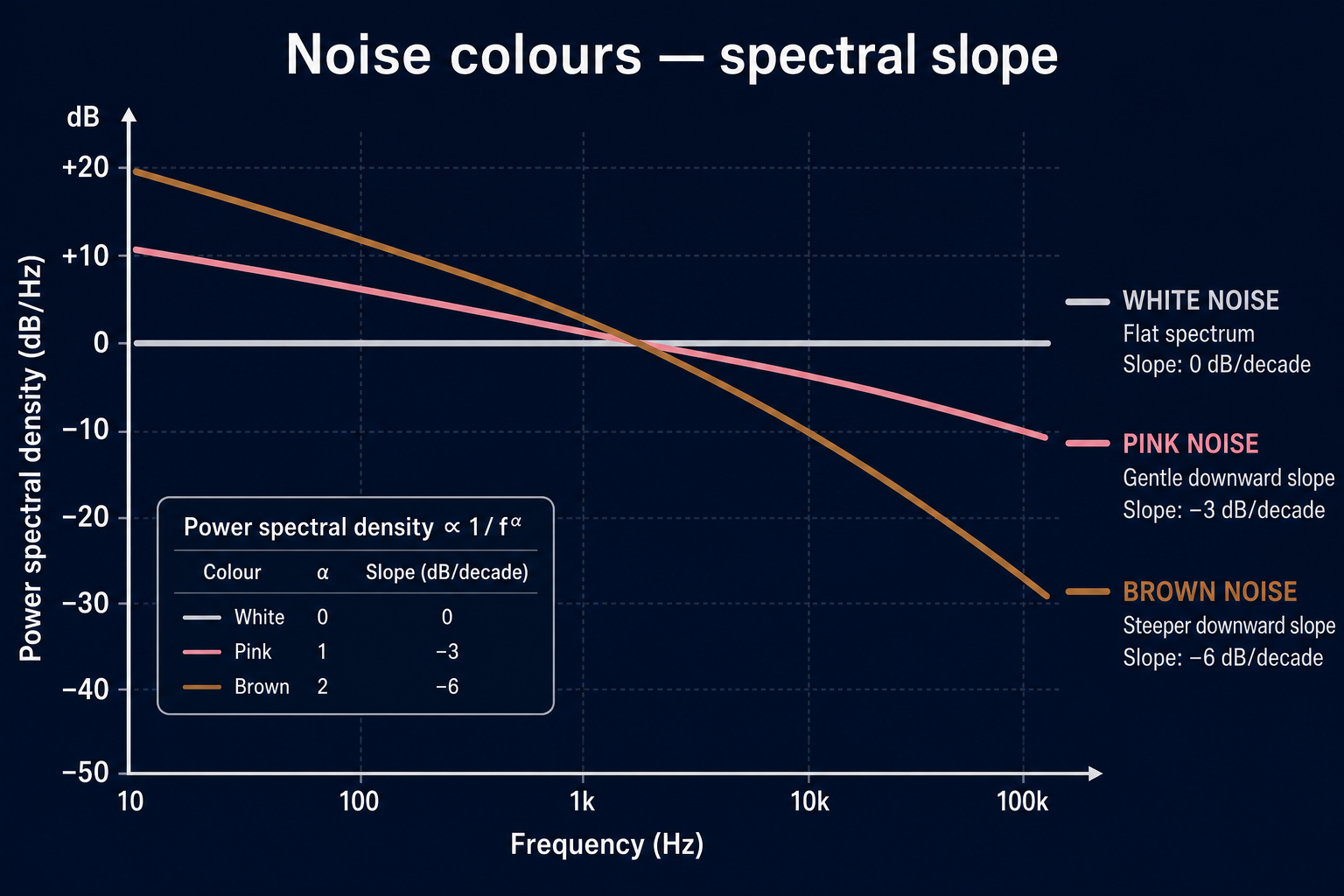
White noise masks broadly but many listeners find high-frequency content fatiguing over hours. Pink and brown shift energy downward — often preferred for overnight tolerance.[15][16] Level should sit near the bottom of audible — you should still hear a knock at the door. NIOSH and WHO caution against prolonged elevated SPL regardless of spectrum.[20][21]
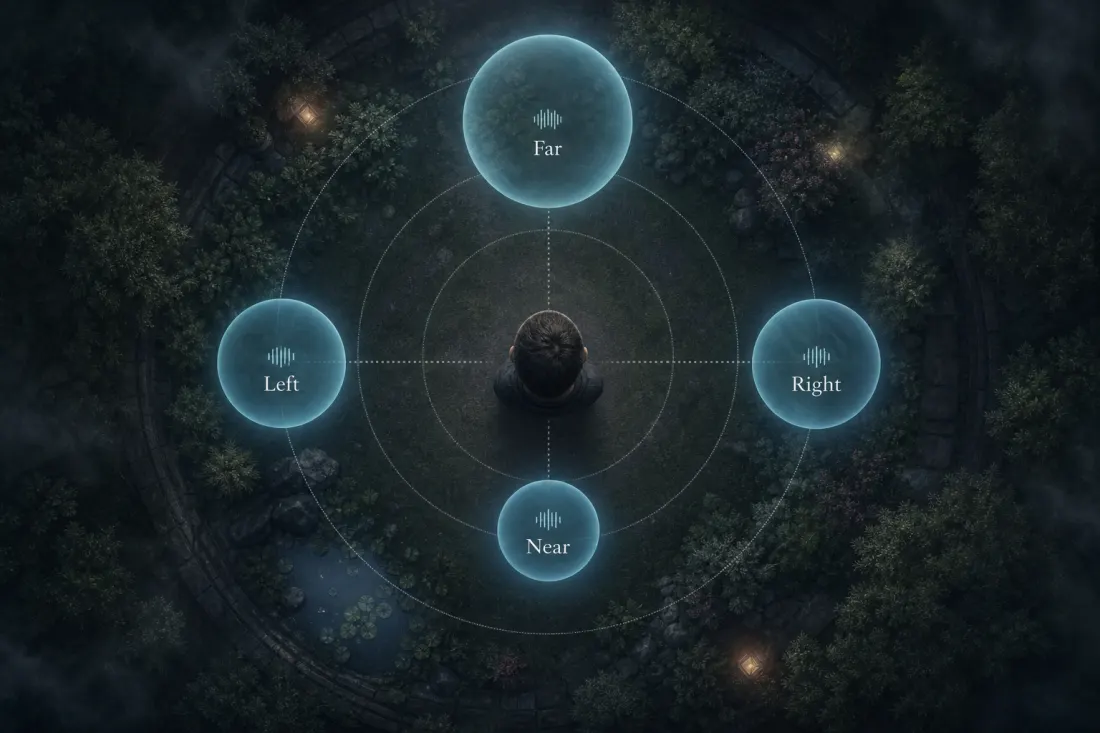
Spatial separation matters: Bregman's scene analysis shows multiple distant sources parse as environment; one monolithic file parses as foreground object.[14] Hongisto's speech intelligibility work reminds us intelligible speech near the bed defeats masking purpose even when nominally masked.[25] Keep speech-like layers out of the audible core.
When masking is the wrong tool
Chronic insomnia driven by conditioned arousal needs CBT-I first-line — Harvey's cognitive model highlights bed-associated wakefulness that masking alone cannot untrain.[7] Hyperacusis, migraine phonophobia, and misophonia may worsen with any added sound. Tinnitus sufferers may find noise beds increase noticeability of ringing. Always stop if symptoms escalate.
Signal-to-noise ratio and why spikes wake you
Sleep continuity depends on the ratio between background level and sudden events — a door slam 20 dB above baseline triggers orienting even in stage 2 sleep.[1][15] Masking raises baseline gently so the same slam is only 5 dB above floor — often sub-threshold for full awakening. The goal is not loudness; it is reduced contrast.
Urban bedrooms face intermittent traffic, sirens, and neighbour noise with statistics unlike white noise. Layered gardens approximate "irregular regularity" — continuous bed plus distant nature — closer to how Stanchina's ICU masking reduced arousals than a pure tone generator.[22][24]
Companion listening in Sound Bubbles
Research above concerns clinical and laboratory sound — not a playlist guarantee. Sound Bubbles offers adjustable living gardens: spatial layers, coloured noise beds, Medical & Wellbeing rooms, and easy mute. Use the recommended gardens below as environmental support alongside medical care when appropriate.[20]
Not treatment. See clinicians for diagnosis, medication, CBT, neurologic music therapy, or tinnitus programmes. Keep volume comfortable; stop if symptoms worsen.
Why this supports Sound Bubbles — not just "any ambient app"
Most ambient apps deliver one file. The studies above rarely study "a loop." They study continuous floors against irregular noise, unintelligible speech against memory tasks, nature scenes against stress markers, spatial streams against glued mashups, and slow environmental change against habituation.[9][14][22][23][24]
Sound Bubbles maps onto those findings deliberately: brown/noise beds for masking floors, nature and library layers for restorative structure, distance/Falloff for speech intelligibility control, and TimeLine motion so the garden keeps the statistics of a place instead of the statistics of a four-minute loop.[12][15][16][25] That is the practical reason the product feels different after the first hour — and the scientific reason the difference matters.
How to apply this inside Sound Bubbles
- Open a related garden (or New Garden) and press Start playing so audio unlocks.[9]
- Expand Shape your soundscape → Sounds: set Master Volume, then Falloff while watching the audible-core guide.[10]
- Select a bubble; drag and scroll depth. Prefer raising one bubble's Volume over blasting the whole room.[11]
- Add library rain, nature, or noise layers; keep speech-like content distant — or remove it — when you need reading or coding focus.[12]
- TimeLine: choose Drift, Tide, or Orbit when you want the garden to keep evolving without grabbing attention.[13]
- Brown Noise tab: shape a warm floor, optionally Release as bubble so it becomes spatial.[14]
- Save gardens that still feel kind after an hour — public gardens should stay soft, not startling.[15]
Limits, safety, and honest uncertainty
We do not claim Sound Bubbles replaces CBT-I, building acoustics, or clinical sleep studies.[2][7] What the product does offer is a listening architecture that matches how hearing and attention actually work: layered sources, spatial distance, and slow change instead of one brittle loop.[18][19]
If sound worsens symptoms, stop. If you need medical advice, see a clinician. If you want a softer room, open a garden, place the bubbles kindly, and stay honest about what sound can — and cannot — do.[20][21]
How this article was researched
We combine first-hand experience placing and tuning Sound Bubbles gardens with citations from peer-reviewed journals, reviews, and institutional pages (including NIH/NCBI, sleep and hearing literature, acoustics, and attention research). Where evidence is mixed or early, we say so. On wellbeing topics we stay cautious: these are companion soundscapes, not cures.
References
Sources cited in this article. Prefer primary literature and institutional guidance; Sound Bubbles is not a medical device and these citations do not imply clinical endorsement.
- (2005). The influence of white noise on sleep in subjects exposed to ICU noise. Sleep Medicine. doi:10.1016/j.sleep.2004.12.004
- (2021). Noise as a sleep aid: A systematic review. Sleep Medicine Reviews. doi:10.1016/j.smrv.2020.101385
- (2009). Night noise guidelines for Europe. WHO Regional Office for Europe.
- (2014). Auditory and non-auditory effects of noise on health. The Lancet. doi:10.1016/S0140-6736(13)61613-X
- (2012). Sleep disruption due to hospital noise. Annals of Internal Medicine.
- (2008). Autonomic arousals related to traffic noise during sleep. Sleep Medicine.
- (2014). Environmental noise and sleep disturbances: A threat to health?. Sleep Science. doi:10.1016/j.slsci.2014.11.003
- (2017). Broadband sound administration improves sleep onset latency in healthy subjects. Frontiers in Neurology. doi:10.3389/fneur.2017.00586
- (2009). Habituation revisited. Neurobiology of Learning and Memory. doi:10.1016/j.nlm.2008.09.015
- (2009). Habituation: a history. Neurobiology of Learning and Memory.
- (1963). Perception and the conditioned reflex. Pergamon Press.
- (2010). The free-energy principle. Nature Reviews Neuroscience. doi:10.1038/nrn2787
- (2013). Whatever next? Predictive brains. Behavioral and Brain Sciences. doi:10.1017/S0140525X12000477
- (1990). Auditory Scene Analysis. MIT Press.
- (2012). An Introduction to the Psychology of Hearing. Brill.
- (2024). Colors of noise. Encyclopedic.
- (2013). Acoustical terminology (masking). ANSI.
- (2014). Auditory and non-auditory effects of noise on health. The Lancet. doi:10.1016/S0140-6736(13)61613-X
- (2021). World report on hearing. WHO.
- (2023). Noise and hearing loss prevention. CDC.
- (2005). White noise on sleep with ICU noise exposure. Sleep Medicine. doi:10.1016/j.sleep.2004.12.004
- (2001). Auditory distraction and short-term memory. Human Factors. doi:10.1518/001872001775992390
- (2010). Stress recovery with nature sound. IJERPH. doi:10.3390/ijerph7031036
- (2005). Speech intelligibility and work performance. Indoor Air. doi:10.1111/j.1600-0668.2005.00391.x