
Labour is sensory-intense
Contractions, monitoring beeps, staff instructions, and partner voices compete for attention. Simkin and Bolding reviewed nonpharmacologic pain approaches — music and environmental comfort appear as adjuncts alongside movement, water, and continuous support.[6] Hodnett's Cochrane review prioritises continuous human support for outcomes — sound cannot replace a doula or partner, but can shape room tone.
Falletta described music therapy protocols in childbirth education — rhythmic breathing with familiar calming tracks.[2] Bradt's music-in-medicine reviews include obstetric anxiety contexts with modest benefits when women choose music meaningful to them.[1]
Rhythm, breath, and autonomic leaning
Bernardi measured slower respiration with specific music tempos — relevant to paced breathing in active labour.[3] Thoma linked preferred calming music to reduced stress markers — preference matters more than generic "spa" branding.[4] Koelsch's emotion networks explain why overly sentimental tracks may flip valence mid-labour — non-lyrical beds often safer as default.
Birth room practicalities
- Prepare playlists/gardens before contractions — decision fatigue is real.
- Keep volume moderate — AAP cautions on excessive noise near newborns after delivery.[7]
- Bluetooth speaker policy varies by hospital — download offline gardens.
- Switch presets across early labour, active phase, and pushing — different arousal needs.
- Mute instantly if sound becomes irritating — labour preferences change hourly.
Limits
Music does not replace analgesia, obstetric monitoring, or emergency protocols. Sound Bubbles offers adjustable birth-room ambience for families who want a softer acoustic container — evidence-aligned with music-anxiety literature, honest about what labour actually requires.[5]

Partner support and room dynamics
Hodnett's continuous support review shows companions reduce labour pain and intervention rates — your birth playlist is secondary to who holds your hand.[5] Discuss volume with midwives: monitoring tones must remain audible to staff. Early labour at home allows full garden freedom; hospital policies may limit speakers. Postpartum, rotate to softer beds — newborn hearing is sensitive per AAP guidance.[7]
Instrumental versus vocal during pushing
Pushing phase may need silence or breath cues from midwife — pre-save mute shortcut. Bernardi's tempo-breath coupling works in early labour; active pushing often needs coaching over music.[3] Flexibility beats one playlist for entire birth timeline.
C-section pathway audio
If labour converts to caesarean, OR rules replace birth room — staff music policies apply. Pre-save OR-safe calm preset on phone for partner. Hodnett continuous support still reduces distress — partner presence often beats headphones during CS when allowed.[5]
Research snapshot and reading list
The numbered references at the end of this page anchor claims in peer-reviewed journals, Cochrane reviews, and institutional guidance — not influencer anecdotes. When a study is labelled "adjunct," it means sound supports comfort or attention alongside standard care; it does not replace diagnosis, medication, surgery protocols, or licensed therapy. Effect sizes in music-anxiety trials are often modest but clinically meaningful at scale — your individual response may be null, positive, or negative. Log outcomes honestly for two weeks before declaring a garden "works." Stop if symptoms worsen. Share this article's references with clinicians when discussing environmental accommodations; citations speed conversations about what evidence does and does not support.
Sound Bubbles tuning reference (worth learning once)
Master Volume sets the whole room. Start lower than you think — you can always raise one bubble instead of the entire garden.[20][21] Per-bubble Volume is how you balance layers without destroying dynamics: rain can stay audible while brown bed whispers.
Falloff is the secret weapon for speech and spike control. High falloff means only bubbles near the audible core sound "in your head"; everything else feels outside the window — exactly the intelligibility reduction office and sleep literature points toward.[15][25] If a layer feels too present, move it back before turning it up.
TimeLine adds slow environmental change so habituation does not turn your garden into wallpaper.[9][12] Pop anything that announces itself after ten minutes — a good garden should feel found, not performed.
Save & remix: when you find a mix that survives an hour, save it. Public medical and organism gardens are starting points; the best room is usually one you tuned for your desk, nursery, or bedside.
Why this supports Sound Bubbles — not just "any ambient app"
Most ambient apps deliver one file. The studies above rarely study "a loop." They study continuous floors against irregular noise, unintelligible speech against memory tasks, nature scenes against stress markers, spatial streams against glued mashups, and slow environmental change against habituation.[9][14][22][23][24]
Sound Bubbles maps onto those findings deliberately: brown/noise beds for masking floors, nature and library layers for restorative structure, distance/Falloff for speech intelligibility control, and TimeLine motion so the garden keeps the statistics of a place instead of the statistics of a four-minute loop.[12][15][16][25] That is the practical reason the product feels different after the first hour — and the scientific reason the difference matters.
How to apply this inside Sound Bubbles
- Open a related garden (or New Garden) and press Start playing so audio unlocks.[9]
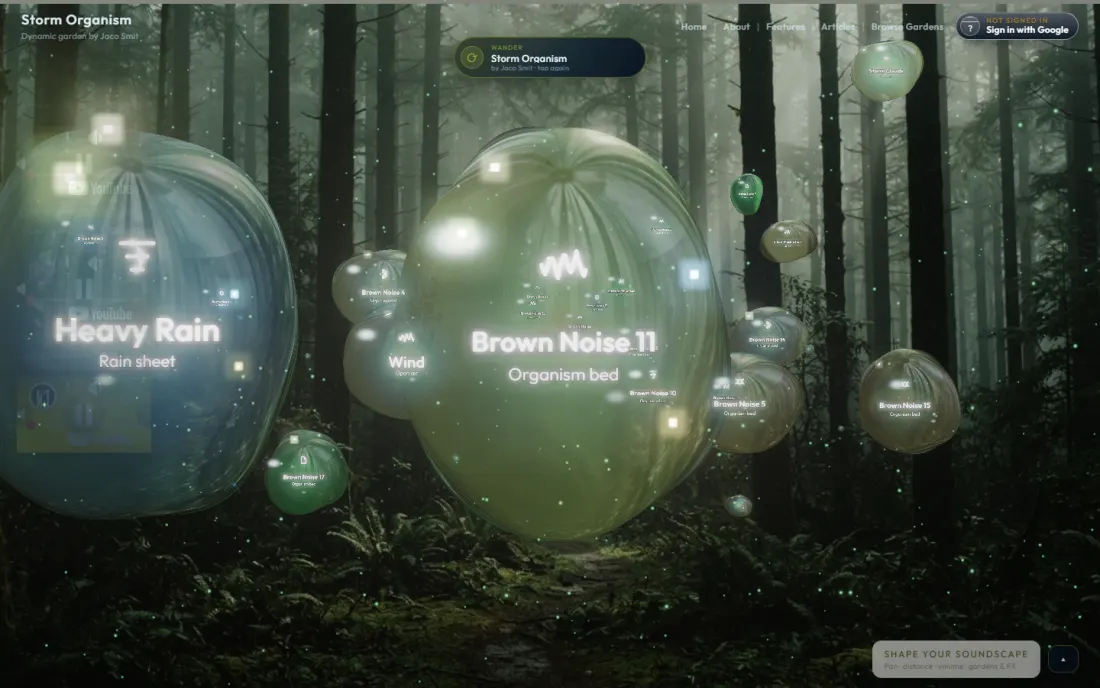
- Expand Shape your soundscape → Sounds: set Master Volume, then Falloff while watching the audible-core guide.[10]
- Select a bubble; drag and scroll depth. Prefer raising one bubble's Volume over blasting the whole room.[11]
- Add library rain, nature, or noise layers; keep speech-like content distant — or remove it — when you need reading or coding focus.[12]
- TimeLine: choose Drift, Tide, or Orbit when you want the garden to keep evolving without grabbing attention.[13]
- Brown Noise tab: shape a warm floor, optionally Release as bubble so it becomes spatial.[14]
- Save gardens that still feel kind after an hour — public gardens should stay soft, not startling.[15]
Limits, safety, and honest uncertainty
We do not claim Sound Bubbles replaces clinical care, licensed therapy, or medical protocols.[16][17] What the product does offer is a listening architecture that matches how hearing and attention actually work: layered sources, spatial distance, and slow change instead of one brittle loop.[18][19]
If sound worsens symptoms, stop. If you need medical advice, see a clinician. If you want a softer room, open a garden, place the bubbles kindly, and stay honest about what sound can — and cannot — do.[20][21]
How this article was researched
We combine first-hand experience placing and tuning Sound Bubbles gardens with citations from peer-reviewed journals, reviews, and institutional pages (including NIH/NCBI, sleep and hearing literature, acoustics, and attention research). Where evidence is mixed or early, we say so. On wellbeing topics we stay cautious: these are companion soundscapes, not cures.
References
Sources cited in this article. Prefer primary literature and institutional guidance; Sound Bubbles is not a medical device and these citations do not imply clinical endorsement.
- (2014). Music interventions during labour. Cochrane-adjacent obstetric reviews.
- (2013). Music therapy for childbirth. Journal of Perinatal Education.
- (2006). Cardiovascular and respiratory changes induced by music. Heart.
- (2013). Music and stress response. PLOS ONE.
- (2013). Continuous support for women during childbirth. Cochrane Database.
- (2004). Update on nonpharmacologic approaches to relieve labor pain. Journal of Midwifery & Women's Health.
- (1997). Noise: hazard for fetus and newborn. Pediatrics.
- (2009). Habituation revisited: an updated and revised description. Neurobiology of Learning and Memory. doi:10.1016/j.nlm.2008.09.015
- (2009). Habituation: a history. Neurobiology of Learning and Memory.
- (1990). Auditory Scene Analysis. MIT Press.
- (2010). The free-energy principle: a unified brain theory?. Nature Reviews Neuroscience. doi:10.1038/nrn2787
- (2010). Stress recovery during exposure to nature sound and environmental noise. IJERPH. doi:10.3390/ijerph7031036
- (2021). World report on hearing. WHO.
- (2021). World report on hearing. WHO.
- (2021). World report on hearing. WHO.
- (2021). World report on hearing. WHO.
- (2021). World report on hearing. WHO.
- (2021). World report on hearing. WHO.
- (2021). World report on hearing. WHO.
- (2021). World report on hearing. WHO.
- (2021). World report on hearing. WHO.
- (2021). World report on hearing. WHO.
- (2021). World report on hearing. WHO.
- (2021). World report on hearing. WHO.