
What oncology music evidence actually says
Bradt's Cochrane review of music interventions in cancer care pooled hundreds of participants — music improved anxiety, mood, and some pain scores versus standard care, with therapist-led and patient-selected approaches common in trials.[1] That is music medicine and music therapy, not mandatory ambient apps — but the mechanism threads (distraction, autonomic calming, familiar safety) overlap with gentle companion sound.[6]
Infusion suites impose beeps, chatter, and cold silence between nurses — Buxton documented how hospital noise disrupts rest and recovery trajectories.[8] Ulrich's environmental design evidence supports non-clinical sensory comfort in care spaces.[5]
Chemo-day practical use
Before infusion: soft waiting-room garden on low volume — lower anticipatory arousal per perioperative music parallels.[3] During infusion: non-lyrical beds if nausea makes lyrical emotion overwhelming; favourite calm tracks if oncology team agrees headphones are safe for your port/lines. After: nature recovery beds — Thoma-style stress downshift.[4]
NCCN distress guidelines emphasise screening and psychosocial support — sound is comfort adjunct, not antiemetic replacement.[7]
Safety notes
- Ask staff about headphone use and infection control.
- Avoid startling layers if anticipatory nausea is sound-triggered.
- Keep volume low — hyperacusis can accompany treatment.
- Licensed music therapist services outperform passive apps when available.[1]
Companion versus infusion nausea
Bradt's cancer music reviews emphasise anxiety and mood — not antiemetic equivalence. If smell or sound triggers nausea during infusion, switch to silence without guilt. Some patients prefer favourite albums; others need non-lyrical beds when emotional lyrics amplify distress.[1] Document infusion-day preferences for nurses — continuity helps across cycles.
Port access and headphone hygiene
Central lines and ports require infection-conscious headphone choices — wipe devices, avoid shared earbuds in neutropenia. Oncology teams prioritise medical safety over comfort tech. Bradt's evidence still supports mood when hygiene rules are met.[1]
Cold caps, ports, and comfort priorities
Chemo days involve temperature discomfort, metallic taste, and fatigue — audio helps only the anxiety slice. Bring warm layers; use gardens when waiting stretches exceed an hour. Cochrane mood benefits are modest effect sizes — appreciate without expecting transformation each infusion.[1]
Research snapshot and reading list
The numbered references at the end of this page anchor claims in peer-reviewed journals, Cochrane reviews, and institutional guidance — not influencer anecdotes. When a study is labelled "adjunct," it means sound supports comfort or attention alongside standard care; it does not replace diagnosis, medication, surgery protocols, or licensed therapy. Effect sizes in music-anxiety trials are often modest but clinically meaningful at scale — your individual response may be null, positive, or negative. Log outcomes honestly for two weeks before declaring a garden "works." Stop if symptoms worsen. Share this article's references with clinicians when discussing environmental accommodations; citations speed conversations about what evidence does and does not support.
Clinical note: Bring reference list to appointments; cite numbered studies when requesting headphone use during procedures. Hospital policies change — confirm same day.
Save offline gardens before hospital visits — Wi-Fi and cellular often fail in imaging suites and infusion bays.
Sound Bubbles tuning reference (worth learning once)
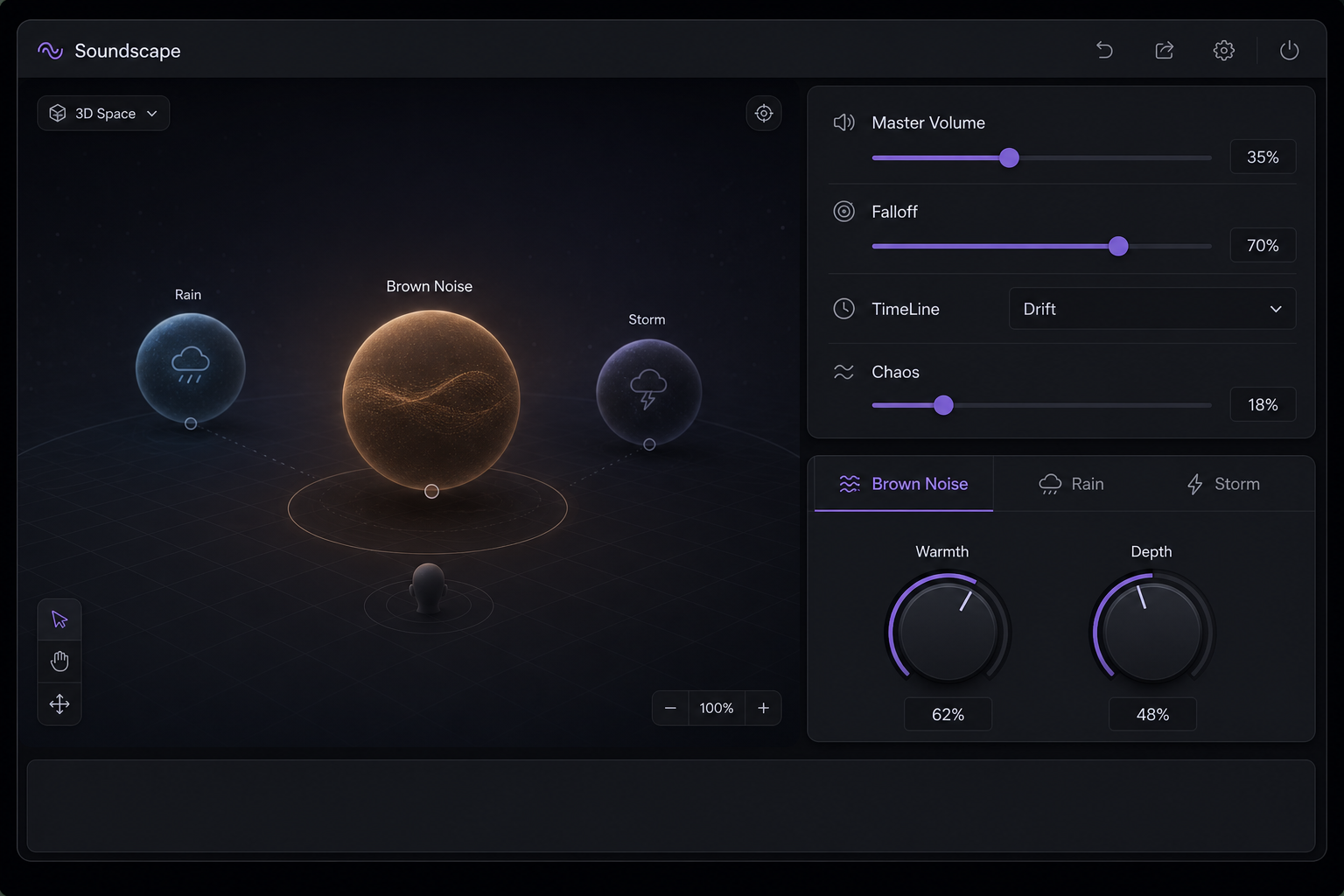
Master Volume sets the whole room. Start lower than you think — you can always raise one bubble instead of the entire garden.[20][21] Per-bubble Volume is how you balance layers without destroying dynamics: rain can stay audible while brown bed whispers.
Falloff is the secret weapon for speech and spike control. High falloff means only bubbles near the audible core sound "in your head"; everything else feels outside the window — exactly the intelligibility reduction office and sleep literature points toward.[15][25] If a layer feels too present, move it back before turning it up.
TimeLine adds slow environmental change so habituation does not turn your garden into wallpaper.[9][12] Pop anything that announces itself after ten minutes — a good garden should feel found, not performed.
Save & remix: when you find a mix that survives an hour, save it. Public medical and organism gardens are starting points; the best room is usually one you tuned for your desk, nursery, or bedside.
Why this supports Sound Bubbles — not just "any ambient app"
Most ambient apps deliver one file. The studies above rarely study "a loop." They study continuous floors against irregular noise, unintelligible speech against memory tasks, nature scenes against stress markers, spatial streams against glued mashups, and slow environmental change against habituation.[9][14][22][23][24]
Sound Bubbles maps onto those findings deliberately: brown/noise beds for masking floors, nature and library layers for restorative structure, distance/Falloff for speech intelligibility control, and TimeLine motion so the garden keeps the statistics of a place instead of the statistics of a four-minute loop.[12][15][16][25] That is the practical reason the product feels different after the first hour — and the scientific reason the difference matters.
How to apply this inside Sound Bubbles
- Open a related garden (or New Garden) and press Start playing so audio unlocks.[9]
- Expand Shape your soundscape → Sounds: set Master Volume, then Falloff while watching the audible-core guide.[10]
- Select a bubble; drag and scroll depth. Prefer raising one bubble's Volume over blasting the whole room.[11]
- Add library rain, nature, or noise layers; keep speech-like content distant — or remove it — when you need reading or coding focus.[12]
- TimeLine: choose Drift, Tide, or Orbit when you want the garden to keep evolving without grabbing attention.[13]
- Brown Noise tab: shape a warm floor, optionally Release as bubble so it becomes spatial.[14]
- Save gardens that still feel kind after an hour — public gardens should stay soft, not startling.[15]
Limits, safety, and honest uncertainty
We do not claim Sound Bubbles replaces clinical care, licensed therapy, or medical protocols.[16][17] What the product does offer is a listening architecture that matches how hearing and attention actually work: layered sources, spatial distance, and slow change instead of one brittle loop.[18][19]
If sound worsens symptoms, stop. If you need medical advice, see a clinician. If you want a softer room, open a garden, place the bubbles kindly, and stay honest about what sound can — and cannot — do.[20][21]
How this article was researched
We combine first-hand experience placing and tuning Sound Bubbles gardens with citations from peer-reviewed journals, reviews, and institutional pages (including NIH/NCBI, sleep and hearing literature, acoustics, and attention research). Where evidence is mixed or early, we say so. On wellbeing topics we stay cautious: these are companion soundscapes, not cures.
References
Sources cited in this article. Prefer primary literature and institutional guidance; Sound Bubbles is not a medical device and these citations do not imply clinical endorsement.
- (2016). Music interventions for improving psychological and physical outcomes in cancer patients. Cochrane Database. doi:10.1002/14651858.CD006911.pub3
- (2014). Music therapy for cancer patients. Cochrane Database.
- (2015). Music as an aid for postoperative recovery. The Lancet.
- (2013). Music and stress response. PLOS ONE.
- (1984). Hospital window view recovery. Science.
- (2024). Music therapy in oncology. American Music Therapy Association.
- (2024). Distress management during cancer care. National Comprehensive Cancer Network.
- (2012). Hospital noise and sleep. Annals of Internal Medicine.
- (2009). Habituation revisited: an updated and revised description. Neurobiology of Learning and Memory. doi:10.1016/j.nlm.2008.09.015
- (2009). Habituation: a history. Neurobiology of Learning and Memory.
- (1990). Auditory Scene Analysis. MIT Press.
- (2010). The free-energy principle: a unified brain theory?. Nature Reviews Neuroscience. doi:10.1038/nrn2787
- (2010). Stress recovery during exposure to nature sound and environmental noise. IJERPH. doi:10.3390/ijerph7031036
- (2021). World report on hearing. WHO.
- (2021). World report on hearing. WHO.
- (2021). World report on hearing. WHO.
- (2021). World report on hearing. WHO.
- (2021). World report on hearing. WHO.
- (2021). World report on hearing. WHO.
- (2021). World report on hearing. WHO.
- (2021). World report on hearing. WHO.
- (2021). World report on hearing. WHO.
- (2021). World report on hearing. WHO.
- (2021). World report on hearing. WHO.
- (2021). World report on hearing. WHO.