From free energy to everyday listening
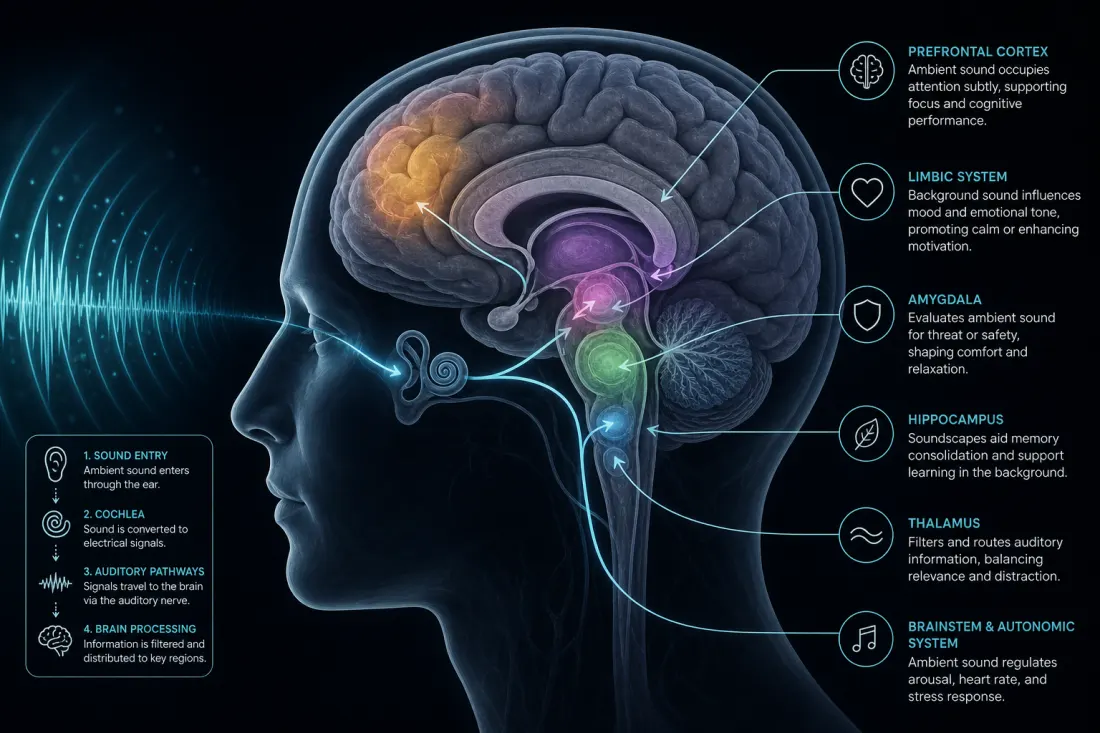
Friston's free-energy principle casts brains as systems minimising surprise (prediction error) about sensory states.[1] Clark translated the idea into "predictive brains" for situated agents: perception is controlled hallucination corrected by precision-weighted error signals.[2] Sedley and Heerema-McKenney reviewed how auditory pathways implement predictive coding — from cochlear processing to belt cortex.[3]
You do not hear raw pressure; you hear your best model of sources in a scene, revised millisecond by millisecond. Bregman's auditory scene analysis supplies the grouping rules that predictions operate over — streams, not pixels.[8]
Mismatch negativity — error signals you never notice
When a repeating tone violates pitch, duration, or location, auditory cortex emits mismatch negativity (MMN) — an ERP deflection reflecting automatic prediction error. Näätänen and Schröger established MMN as a workhorse measure of auditory memory traces and models.[4][5] Newborns show streaming biases consistent with early predictive structure (Winkler et al.), suggesting prediction is not a late cortical luxury.[6]
MMN amplitude scales with salience and uncertainty: deviants that matter for behaviour get precision-weighted upward — linking predictive coding to attention capture.[10]
Music, pleasure, and expected surprise
Predictive coding is not anti-surprise — controlled surprise delights. Gold et al. showed musical reward prediction errors correlate with pleasure onset; the brain enjoys competent violations within learned style rules.[7] Koelsch's emotion reviews map expectancy fulfilment and breach onto limbic reward circuits.[11] Norman-Haignere et al. found harmonic structure tuned in neural populations — predictions specialised for periodic complex tones in music and speech.[12]
Ambient wellbeing sound usually wants low error: rain should stay rain, brown noise should stay brown. Pleasure-focused music wants structured error; conflating the two explains many bad "focus playlists" with random chimes.
Habituation as precision down-weighting
Rankin's habituation synthesis describes decreased response to repeated innocuous stimuli — functionally, the brain lowers precision on predictable input.[9] Sokolov's orienting response is the opposite pole: novel input gets high precision, triggering body-level capture.[10]
Identical four-minute loops fail twice: first habituation lowers calming effect; then a seam or repeat boundary spikes error — you hear the file, not the forest. Slow environmental change keeps predictions valid without brittle repetition.
Pathology angles — tinnitus as persistent error?
Rauschecker et al. proposed limbic-auditory loops in tinnitus where phantom predictions fail to resolve — error without an external deviant to explain away.[16] Predictive accounts are speculative clinically but explain why masking and enrichment sometimes help: they supply external structure that lowers precision on internal error. Not a cure claim — a model guiding research.
Sleep, tinnitus, and precision at night
Sleep reduces but does not abolish prediction updating. Unexpected sounds spike precision briefly, provoking micro-arousals — Stanchina's ICU masking study shows how external randomness interrupts sleep even when subjective wakefulness is brief.[14] Tinnitus may reflect persistent high-precision internal error (Rauschecker et al.); masking supplies external structure to compete with phantom predictions.[16]
Riedy's review notes some sleepers benefit from continuous noise; others experience increased error when the masker itself becomes unpredictable through looping.[20] Choose scenes with stable rules and slow change — predictive comfort, not surprise choreography.
Clark's predictive brains framing: perception is controlled hallucination corrected by precision-weighted error signals.[2] In hearing, that means you experience what you expect until evidence forces an update — a door slam is a forced update at 3am.[19]
Sedley and Heerema-McKenney mapped predictive coding across auditory cortex hierarchies — higher levels predict phonemes and streams, lower levels predict fine timing.[3] When any level surprises, error propagates up; chronic surprise equals fatigue, a common report in open offices and tinnitus clinics alike.[16]
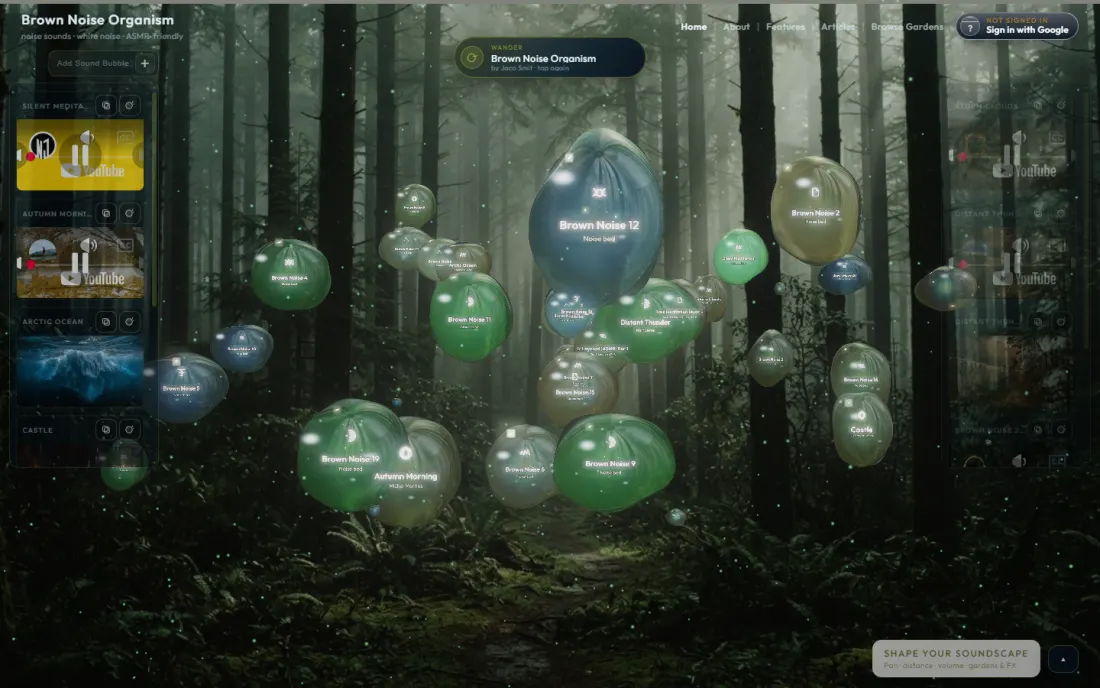
Sound Bubbles as low-error gardens
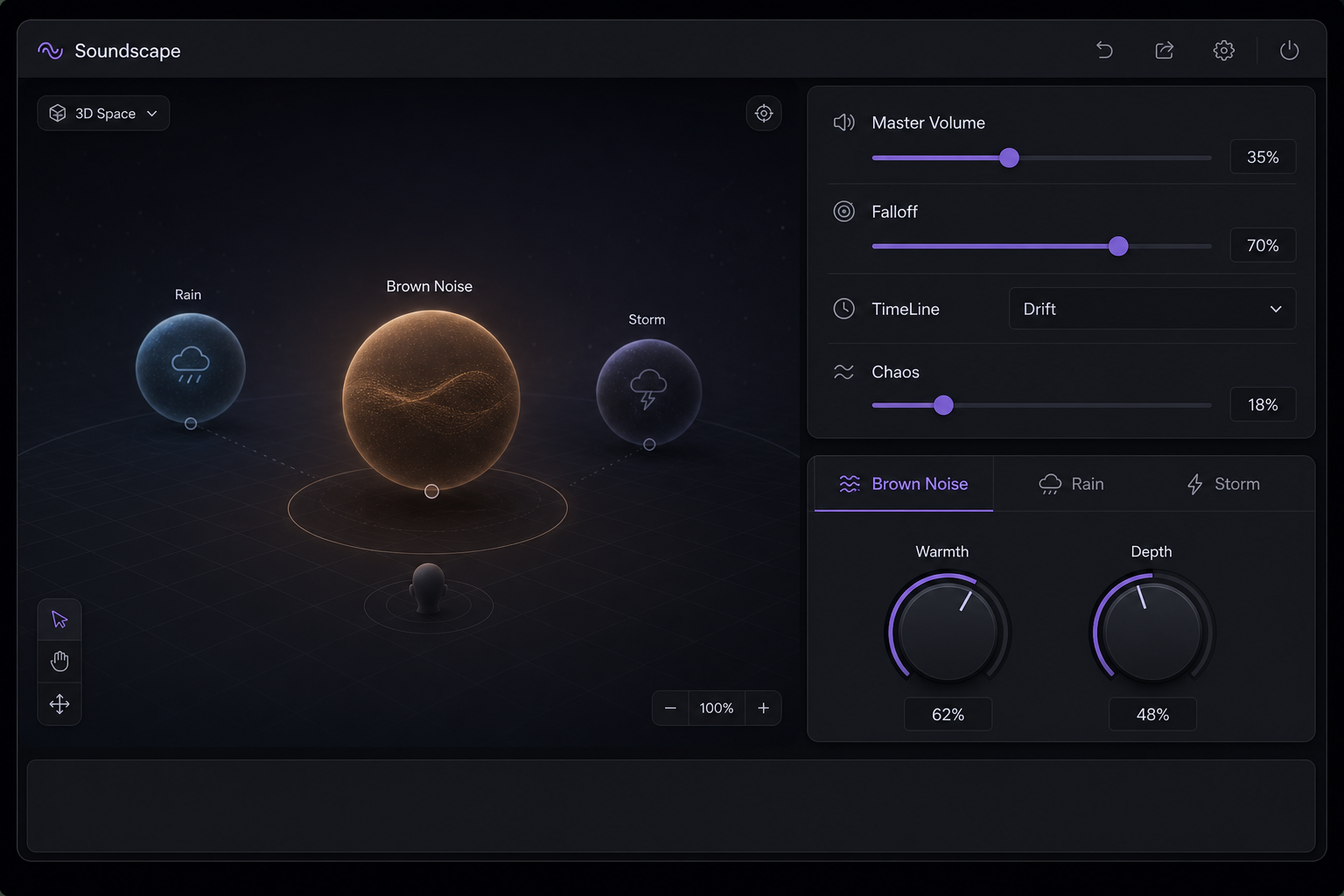
Design choices map onto predictive comfort:
- Continuous brown floors — stable statistics, low surprise after initial onset.[14]
- Spatial bubbles — sources stay in consistent places, matching spatial predictions.[8]
- TimeLine Drift/Tide — micro-variation without boundary spikes.[9]
- No random notification-like transients — avoids precision spikes during sleep or focus.[14]
Stanchina et al. showed continuous noise reduced arousal to ICU spikes — externally supplied predictability buffering erratic hospital errors.[14] Riedy's sleep-noise review notes individual variation: some brains weight prediction error differently at night.[20]
Alvarsson et al. linked natural soundscapes to faster stress recovery — natural scenes carry learnable statistics evolved over millennia.[15]
What predictive coding does not mean
It does not validate "manifestation frequencies" or claim thoughts create cochlear output. It is a computational description of neural inference. Cherry's selective listening shows top-down goals reshape which errors matter — not unlimited mind control over hearing.[13]
Practical listening
- Prefer scenes with stable rules you can learn in one sitting.[8]
- Avoid loops with audible seams — they are pure prediction-error bombs.[9]
- Mask external chaos with a gentle floor before error accumulates.[14]
- For pleasure listening, choose music that earns its surprises; for sleep, earn none.[7]
- Protect ears; damaged periphery feeds noisy errors upstream.[17][18]
Gold et al.'s musical pleasure work shows prediction error can be rewarding when stakes are aesthetic, not survival — explaining ASMR whispers and drop-build EDM. Wellbeing gardens should sit on the low-error side of that spectrum unless listeners explicitly want musical surprise.[7]
Koelsch's emotion reviews tie expectancy to autonomic coupling — heart rate and breathing follow predictive structure in music, another reason tempo-stable ambient beds feel physically calming.[11]
From lab to living room
Predictive coding began as computational neuroscience; consumer audio can borrow the design insight without claiming to "retrain" Bayesian brains. Keep scenes stable, avoid seam bombs, separate streams in space, and prefer brown/nature statistics evolved over millennia.[8][15]
Musical pleasure via controlled prediction error (Gold et al.) belongs in intentional listening sessions — not sleep gardens.[7] Match error budget to context: high for concerts, near-zero for 3am.[20]
Näätänen and Schröger's MMN reviews remain the bridge between millisecond ERPs and user-experience choices — deviants are never "free."[4][5]
Summary
Hearing is predictive: Friston and Clark's frameworks, MMN lab signatures, and Gold's musical surprise map the same error machinery with different stakes.[1][2][7] Wellbeing audio should minimise error at night; art audio may choreograph it by consent.
Sound Bubbles targets low-error gardens — stable brown beds, spatial consistency, slow TimeLine change — so listeners stay comfortable past the first hour.[14]
Clark's situated-agent framing: prediction error is bodily, not abstract — why slam sounds hit the gut before the spreadsheet.[2]
Sedley and Heerema-McKenney tie predictive coding to clinical audiology tests — MMN is not only academic.[3]
Friston's free-energy frame is not wellness jargon — it is a precise claim about why seams and sirens hurt.[1]
Norman-Haignere harmonic tuning shows prediction is spectral as well as temporal — timbre always matters here too now.[12]
Limits
Predictive coding remains debated in detail — precision mechanisms, layer counts, and clinical translation are active research. Use the model to choose kinder sound environments, not to replace audiology or mental-health care.[19]
How this article was researched
We combine first-hand experience placing and tuning Sound Bubbles gardens with citations from peer-reviewed journals, reviews, and institutional pages (including NIH/NCBI, sleep and hearing literature, acoustics, and attention research). Where evidence is mixed or early, we say so. On wellbeing topics we stay cautious: these are companion soundscapes, not cures.
References
Sources cited in this article. Prefer primary literature and institutional guidance; Sound Bubbles is not a medical device and these citations do not imply clinical endorsement.
- (2010). The free-energy principle: a unified brain theory?. Nature Reviews Neuroscience. doi:10.1038/nrn2787
- (2013). Whatever next? Predictive brains, situated agents. Behavioral and Brain Sciences. doi:10.1017/S0140525X12000477
- (2019). Predictive coding in the auditory system. Handbook of Clinical Neurology context.
- (2007). The mismatch negativity (MMN) in basic research of central auditory processing. Clinical Neurophysiology. doi:10.1016/j.clinph.2007.04.026
- (2007). Mismatch negativity. Journal of Psychophysiology.
- (2003). Newborn infants can organize auditory streams. Proceedings of the National Academy of Sciences. doi:10.1073/pnas.2434696100
- (2019). Musical reward prediction errors signal the onset of musical pleasure. Proceedings of the National Academy of Sciences. doi:10.1073/pnas.1901249116
- (1990). Auditory Scene Analysis. MIT Press.
- (2009). Habituation revisited. Neurobiology of Learning and Memory. doi:10.1016/j.nlm.2008.09.015
- (1963). Orienting response and novelty detection. Pergamon Press.
- (2014). Brain correlates of music-evoked emotions. Nature Reviews Neuroscience. doi:10.1038/nrn3666
- (2022). Neural population tuning reveals harmonic structure in music and speech. Nature Neuroscience. doi:10.1038/s41593-022-01114-5
- (1953). Some experiments on the recognition of speech, with one and with two ears. Journal of the Acoustical Society of America. doi:10.1121/1.1901869
- (2005). The influence of white noise on sleep in subjects exposed to ICU noise. Sleep Medicine. doi:10.1016/j.sleep.2004.12.004
- (2010). Stress recovery during exposure to nature sound and environmental noise. IJERPH. doi:10.3390/ijerph7031036
- (2010). Tuning out the noise: limbic-auditory interactions in tinnitus. Neuron. doi:10.1016/j.neuron.2010.04.032
- (2021). World report on hearing. WHO.
- (2023). Noise and hearing loss prevention. CDC.
- (2024). Hearing and communication. NIH.
- (2021). Noise as a sleep aid: A systematic review. Sleep Medicine Reviews. doi:10.1016/j.smrv.2020.101385