Perioperative and inpatient evidence
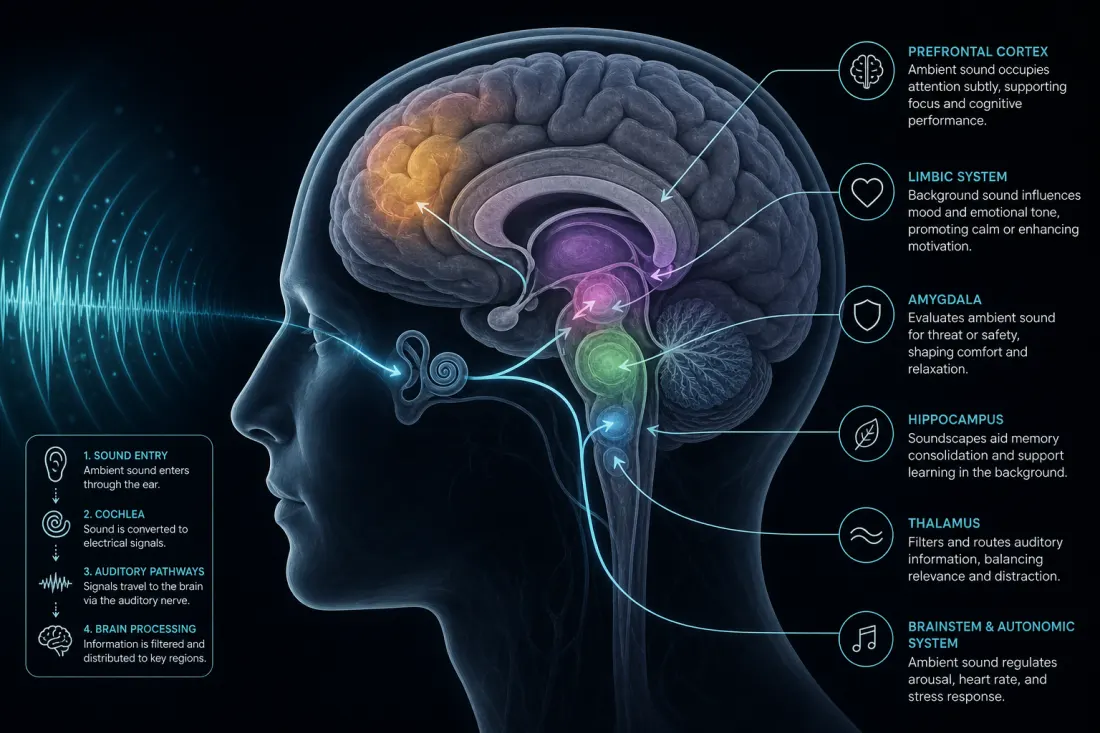
Hole et al. meta-analysed music for postoperative recovery in adults — reduced pain and anxiety, decreased analgesia use in many comparisons, published in The Lancet.[1] Bradt's Cochrane reviews on music in cancer care and preoperative anxiety document anxiety and mood benefits across hundreds of patients in pooled trials.[2][3]
Hospital noise disrupts sleep — Buxton and colleagues link inpatient noise to sleep fragmentation; music and masking strategies sit beside architectural and protocol fixes.[5][8] Ulrich's environmental design evidence supports non-clinical sensory environments that reduce stress without cognitive hijack.[4]
Music therapy vs hospital radio
Trained music therapists individualise live or recorded interventions — tempo, familiarity, lyrics, trauma triggers.[6] Passive playlists help some patients; they are not equivalent to licensed therapy. Waiting-room companion audio should stay soft, non-lyrical, and easy to mute.
Companion listening in Sound Bubbles
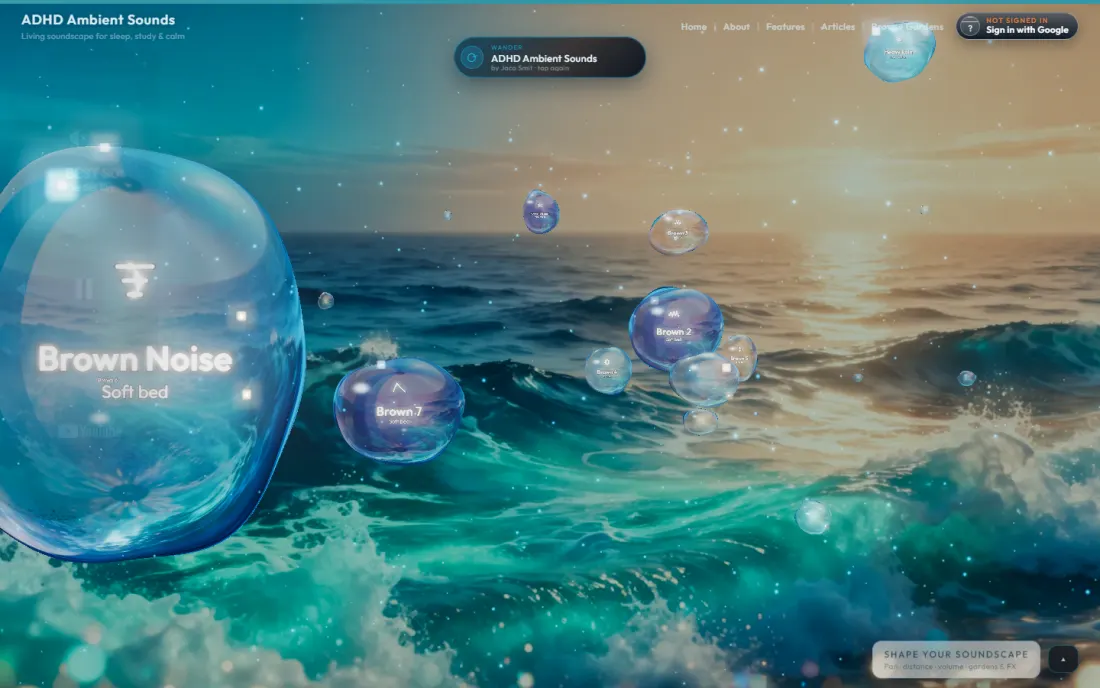
Research above concerns clinical and laboratory sound — not a playlist guarantee. Sound Bubbles offers adjustable living gardens: spatial layers, coloured noise beds, Medical & Wellbeing rooms, and easy mute. Use the recommended gardens below as environmental support alongside medical care when appropriate.[20]
Not treatment. See clinicians for diagnosis, medication, CBT, neurologic music therapy, or tinnitus programmes. Keep volume comfortable; stop if symptoms worsen.
Why this supports Sound Bubbles — not just “any ambient app”
Most ambient apps deliver one file. The studies above rarely study “a loop.” They study continuous floors against irregular noise, unintelligible speech against memory tasks, nature scenes against stress markers, spatial streams against glued mashups, and slow environmental change against habituation.[9][14][22][23][24]
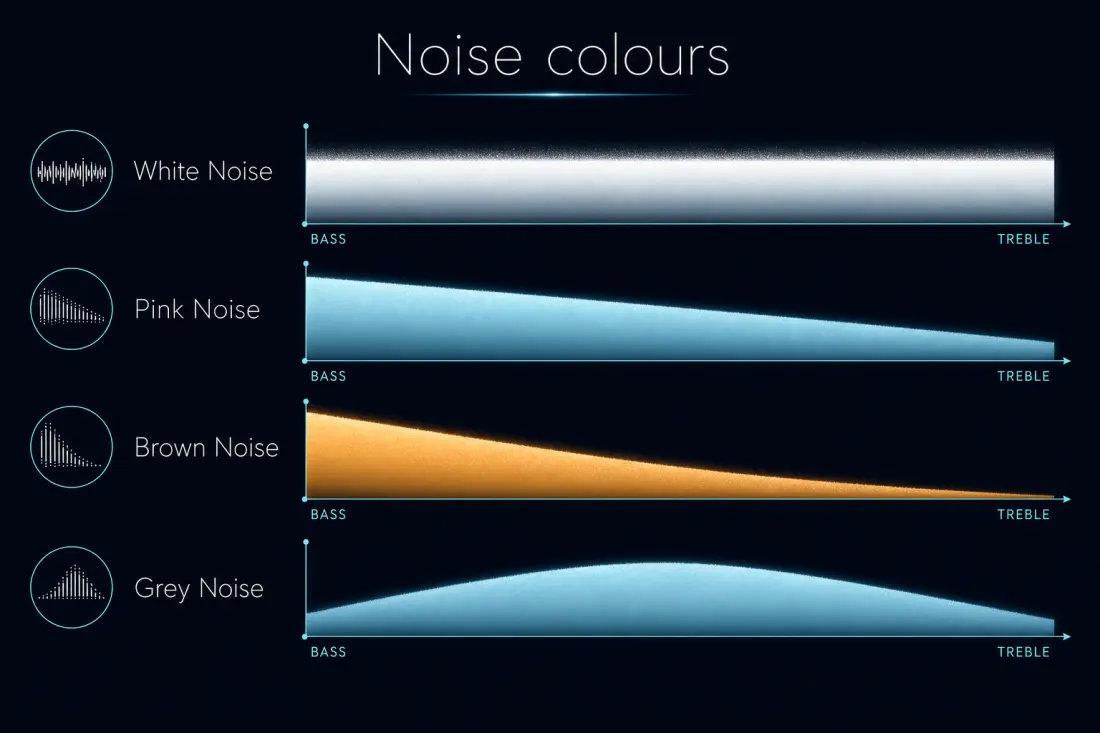
Sound Bubbles maps onto those findings deliberately: brown/noise beds for masking floors, nature and library layers for restorative structure, distance/Falloff for speech intelligibility control, and TimeLine motion so the garden keeps the statistics of a place instead of the statistics of a four-minute loop.[12][15][16][25] That is the practical reason the product feels different after the first hour — and the scientific reason the difference matters.
Recommended gardens — open in one click
These gardens match what this article describes. Each link opens the garden in the player — press Start playing and adjust Falloff if anything feels too close.
- Waiting Room Ambient SoundsHospitalNeutral companion floors — Hole/Bradt perioperative anxiety targets.Open garden →
- Hospital Waiting Room AmbienceHard-wait comfort — non-clinical, non-TV.Open garden →
- Ambient Sounds for Therapy OfficesCare-space soft beds — adjunct to licensed therapy.Open garden →
- Gentle Sounds for Migraine RecoveryUltra-quiet recovery — inpatient sensitivity overlap.Open garden →
- Spa SoundscapesPost-procedure calm framing — music medicine adjacency.Open garden →
Browse all gardens · remix any public garden · save your own when you find the mix that fits.
How to apply this inside Sound Bubbles
- Open a related garden (or New Garden) and press Start playing so audio unlocks.[9]
- Expand Shape your soundscape → Sounds: set Master Volume, then Falloff while watching the audible-core guide.[10]
- Select a bubble; drag and scroll depth. Prefer raising one bubble’s Volume over blasting the whole room.[11]
- Add library rain, nature, or noise layers; keep speech-like content distant — or remove it — when you need reading or coding focus.[12]
- TimeLine: choose Drift, Tide, or Orbit when you want the garden to keep evolving without grabbing attention.[13]
- Brown Noise tab: shape a warm floor, optionally Release as bubble so it becomes spatial.[14]
- Save gardens that still feel kind after an hour — public gardens should stay soft, not startling.[15]
Limits, safety, and honest uncertainty
We do not claim Sound Bubbles replaces CBT-I, tinnitus counselling, ADHD care, paediatric guidance, or migraine treatment.[16][17] What the product does offer is a listening architecture that matches how hearing and attention actually work: layered sources, spatial distance, and slow change instead of one brittle loop.[18][19]
If sound worsens symptoms, stop. If you need medical advice, see a clinician. If you want a softer room, open a garden, place the bubbles kindly, and stay honest about what sound can — and cannot — do.[20][21]
How this article was researched
We combine first-hand experience placing and tuning Sound Bubbles gardens with citations from peer-reviewed journals, reviews, and institutional pages (including NIH/NCBI, sleep and hearing literature, acoustics, and attention research). Where evidence is mixed or early, we say so. On wellbeing topics we stay cautious: these are companion soundscapes, not cures.
References
Sources cited in this article. Prefer primary literature and institutional guidance; Sound Bubbles is not a medical device and these citations do not imply clinical endorsement.
- (2015). Music as an aid for postoperative recovery in adults: a systematic review and meta-analysis. The Lancet. doi:10.1016/S0140-6736(15)60169-6
- (2016). Music interventions for improving psychological and physical outcomes in cancer patients. Cochrane Database of Systematic Reviews. doi:10.1002/14651858.CD006911.pub3
- (2013). Music interventions for preoperative anxiety. Cochrane Database of Systematic Reviews. doi:10.1002/14651858.CD006908.pub2
- (1984). View through a window may influence recovery from surgery. Science. doi:10.1126/science.6143402
- (2012). Sleep disruption due to hospital noise. Annals of Internal Medicine.
- (2024). What is music therapy?. American Music Therapy Association.
- (1999). Guidelines for community noise (WHO). WHO.
- (2009). Habituation revisited: an updated and revised description. Neurobiology of Learning and Memory. doi:10.1016/j.nlm.2008.09.015
- (2009). Habituation: a history. Neurobiology of Learning and Memory.
- (1963). Perception and the conditioned reflex (orienting response). Pergamon Press.
- (2010). The free-energy principle: a unified brain theory?. Nature Reviews Neuroscience. doi:10.1038/nrn2787
- (2013). Whatever next? Predictive brains, situated agents. Behavioral and Brain Sciences. doi:10.1017/S0140525X12000477
- (1990). Auditory Scene Analysis. MIT Press.
- (2012). An Introduction to the Psychology of Hearing (masking & loudness). Brill.
- (2024). Colors of noise (white, pink, brown definitions). Encyclopedic / signal processing.
- (1999). Psychoacoustics: Facts and Models. Springer.
- (2013). American National Standard acoustical terminology (masking). ANSI.
- (2014). Auditory and non-auditory effects of noise on health. The Lancet. doi:10.1016/S0140-6736(13)61613-X
- (2021). World report on hearing. WHO.
- (2023). Noise and hearing loss prevention. CDC.
- (2005). The influence of white noise on sleep in subjects exposed to ICU noise. Sleep Medicine. doi:10.1016/j.sleep.2004.12.004
- (2001). Auditory distraction and short-term memory: Phenomena and practical implications. Human Factors. doi:10.1518/001872001775992390
- (2010). Stress recovery during exposure to nature sound and environmental noise. IJERPH. doi:10.3390/ijerph7031036
- (2005). A model predicting the effect of speech of varying intelligibility on work performance. Indoor Air. doi:10.1111/j.1600-0668.2005.00391.x