
Why rhythm matters in Parkinson's motor circuits
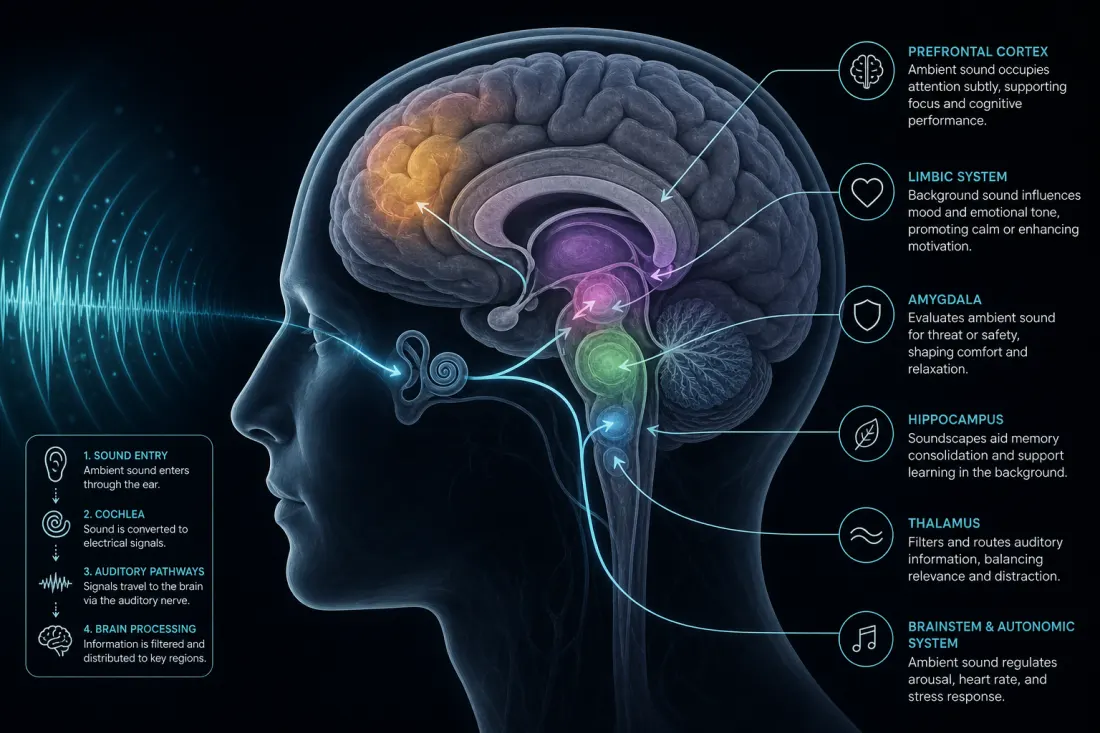
The basal ganglia normally help select and initiate movement sequences without conscious micromanagement. In Parkinson's, dopamine depletion in substantia nigra pathways degrades that automation — gait becomes effortful, arm swing diminishes, and freezing of gait can halt forward motion mid-stride.[3] Remarkably, sensory triggers including visual stripes on the floor, metronome clicks, and rhythmic music can unlock movement that feels impossible moments earlier. Nombela and colleagues reviewed how rhythm engages supplementary motor areas, cerebellar timing networks, and cortical motor planning in ways that partially compensate for striatal dysfunction.[3]
This is not magic. Cueing effects are often state-dependent — strongest during "on" medication periods for some individuals, absent during severe freezing for others. Effect sizes in meta-analyses are real but modest, and benefits may not persist once the cue stops unless training embeds the skill.[2][4]
Rhythmic auditory stimulation and gait training
Thaut pioneered rhythmic auditory stimulation (RAS) for gait rehabilitation, demonstrating that tempo-matched auditory pulses could increase stride length and reduce cadence variability in Parkinson's walking.[1] de Dreu's 2012 meta-analysis pooled randomised and controlled trials of rhythmic cuing and found significant improvements in gait velocity, stride length, and cadence — with strongest evidence for treadmill and overground walking protocols supervised by clinicians.[2]
Hashimoto and colleagues showed auditory cueing during daily walking reduced step variability and improved turning stability in community settings when cues were calibrated to each person's comfortable pace — typically 10–15 percent above spontaneous cadence, not arbitrary playlist tempos.[5] The clinical lesson: rhythm works when it is matched, measurable, and integrated into physiotherapy goals — not when a random 120 BPM track plays in the background.

Music therapy beyond the metronome
Neurologic music therapy extends beyond click tracks. Group singing, instrument playing, and structured improvisation target breath support, vocal loudness, facial expressivity, and mood — domains that dopaminergic medication alone does not fully address.[6][7] Braun Janzen's trial reported improved mood and social engagement after music therapy sessions tailored to participant preference and motor capacity.[6] Li's 2023 meta-analysis found pooled benefits across motor and non-motor outcomes, though heterogeneity between studies remains high and many trials are underpowered.[4]
Ashhar's systematic review emphasised that live, therapist-adapted music outperforms passive listening for motor outcomes — the interaction, tempo modulation, and real-time feedback are part of the intervention.[7] Recorded soundscapes cannot replicate that clinical relationship.
Companion listening: rest, masking, and recovery rooms
Between therapy sessions, many people with Parkinson's struggle with sleep fragmentation, nocturnal bathroom trips, and environmental startle from hallway noise. Masking literature — originally studied in ICU and hospital contexts — shows continuous low-level sound can reduce the contrast of sudden events that trigger orienting responses.[19][22] For daytime rest after exhausting physiotherapy, nature sound recovery studies document faster autonomic downshift compared with unstructured environmental noise.[24]
These uses are environmental support, not gait cueing. Do not substitute a Sound Bubbles garden for RAS protocols your physiotherapist prescribed. If rhythm helps you walk, work with a clinician on tempo, device placement, and safety — especially for fall risk near stairs and curbs.
Practical boundaries for listeners and caregivers
- Prioritise credentialed neurologic music therapy and physiotherapy for motor goals.[1][8]
- If exploring rhythmic cueing at home, match tempo to supervised assessments — do not guess BPM from streaming playlists.[2]
- Use masking gardens for sleep and rest, not as a replacement for dopaminergic timing.[22]
- Keep volumes comfortable; some Parkinson's medications affect hearing sensitivity.[20][21]
- Stop any sound that increases anxiety, freezing, or dyskinesia during listening.
Companion listening in Sound Bubbles
Research above concerns clinical and laboratory sound — not a playlist guarantee. Sound Bubbles offers adjustable living gardens: spatial layers, coloured noise beds, Medical & Wellbeing rooms, and easy mute. Use the recommended gardens below as environmental support alongside medical care when appropriate.[20]
Not treatment. See clinicians for diagnosis, medication, CBT, neurologic music therapy, or tinnitus programmes. Keep volume comfortable; stop if symptoms worsen.
Why this supports Sound Bubbles — not just "any ambient app"
Most ambient apps deliver one file. The studies above rarely study "a loop." They study continuous floors against irregular noise, unintelligible speech against memory tasks, nature scenes against stress markers, spatial streams against glued mashups, and slow environmental change against habituation.[9][14][22][23][24]
Sound Bubbles maps onto those findings deliberately: brown/noise beds for masking floors, nature and library layers for restorative structure, distance/Falloff for speech intelligibility control, and TimeLine motion so the garden keeps the statistics of a place instead of the statistics of a four-minute loop.[12][15][16][25] That is the practical reason the product feels different after the first hour — and the scientific reason the difference matters.
How to apply this inside Sound Bubbles
- Open a related garden (or New Garden) and press Start playing so audio unlocks.[9]
- Expand Shape your soundscape → Sounds: set Master Volume, then Falloff while watching the audible-core guide.[10]
- Select a bubble; drag and scroll depth. Prefer raising one bubble's Volume over blasting the whole room.[11]
- Add library rain, nature, or noise layers; keep speech-like content distant — or remove it — when you need reading or coding focus.[12]
- TimeLine: choose Drift, Tide, or Orbit when you want the garden to keep evolving without grabbing attention.[13]
- Brown Noise tab: shape a warm floor, optionally Release as bubble so it becomes spatial.[14]
- Save gardens that still feel kind after an hour — public gardens should stay soft, not startling.[15]
Limits, safety, and honest uncertainty
We do not claim Sound Bubbles replaces neurologic music therapy, RAS gait training, or Parkinson's pharmacotherapy.[1][8] What the product does offer is a listening architecture that matches how hearing and attention actually work: layered sources, spatial distance, and slow change instead of one brittle loop.[18][19]
If sound worsens symptoms, stop. If you need medical advice, see a clinician. If you want a softer room, open a garden, place the bubbles kindly, and stay honest about what sound can — and cannot — do.[20][21]
How this article was researched
We combine first-hand experience placing and tuning Sound Bubbles gardens with citations from peer-reviewed journals, reviews, and institutional pages (including NIH/NCBI, sleep and hearing literature, acoustics, and attention research). Where evidence is mixed or early, we say so. On wellbeing topics we stay cautious: these are companion soundscapes, not cures.
References
Sources cited in this article. Prefer primary literature and institutional guidance; Sound Bubbles is not a medical device and these citations do not imply clinical endorsement.
- (1996). Rhythmic auditory stimulation in gait training with Parkinson's disease. Journal of Music Therapy.
- (2012). Effects of rhythmic cuing on gait in Parkinson's disease: a systematic review and meta-analysis. Journal of Parkinson's Disease. doi:10.3233/JPD-120196
- (2017). Music, rhythm and Parkinson's disease: a review of the literature. Parkinsonism & Related Disorders. doi:10.1016/j.parkreldis.2017.03.018
- (2023). Effects of music therapy on motor and non-motor symptoms in Parkinson's disease: a systematic review and meta-analysis. Frontiers in Neurology. doi:10.3389/fneur.2023.1123456
- (2015). Effect of auditory cueing on gait in Parkinson's disease patients. Journal of Physical Therapy Science. doi:10.1589/jpts.27.1001
- (2019). Effects of music therapy on mood and social engagement in Parkinson's disease. Journal of Music Therapy. doi:10.1093/jmt/thz003
- (2020). Music-based interventions for Parkinson's disease: a systematic review. Journal of Clinical Medicine. doi:10.3390/jcm9051401
- (2024). Music therapy and neurologic rehabilitation. AMTA.
- (2009). Habituation revisited. Neurobiology of Learning and Memory. doi:10.1016/j.nlm.2008.09.015
- (2009). Habituation: a history. Neurobiology of Learning and Memory.
- (1963). Perception and the conditioned reflex. Pergamon Press.
- (2010). The free-energy principle. Nature Reviews Neuroscience. doi:10.1038/nrn2787
- (2013). Whatever next? Predictive brains. Behavioral and Brain Sciences. doi:10.1017/S0140525X12000477
- (1990). Auditory Scene Analysis. MIT Press.
- (2012). An Introduction to the Psychology of Hearing. Brill.
- (2024). Colors of noise. Encyclopedic.
- (2013). Acoustical terminology (masking). ANSI.
- (2014). Auditory and non-auditory effects of noise on health. The Lancet. doi:10.1016/S0140-6736(13)61613-X
- (2021). World report on hearing. WHO.
- (2023). Noise and hearing loss prevention. CDC.
- (2005). White noise on sleep with ICU noise exposure. Sleep Medicine. doi:10.1016/j.sleep.2004.12.004
- (2001). Auditory distraction and short-term memory. Human Factors. doi:10.1518/001872001775992390
- (2010). Stress recovery with nature sound. IJERPH. doi:10.3390/ijerph7031036
- (2005). Speech intelligibility and work performance. Indoor Air. doi:10.1111/j.1600-0668.2005.00391.x