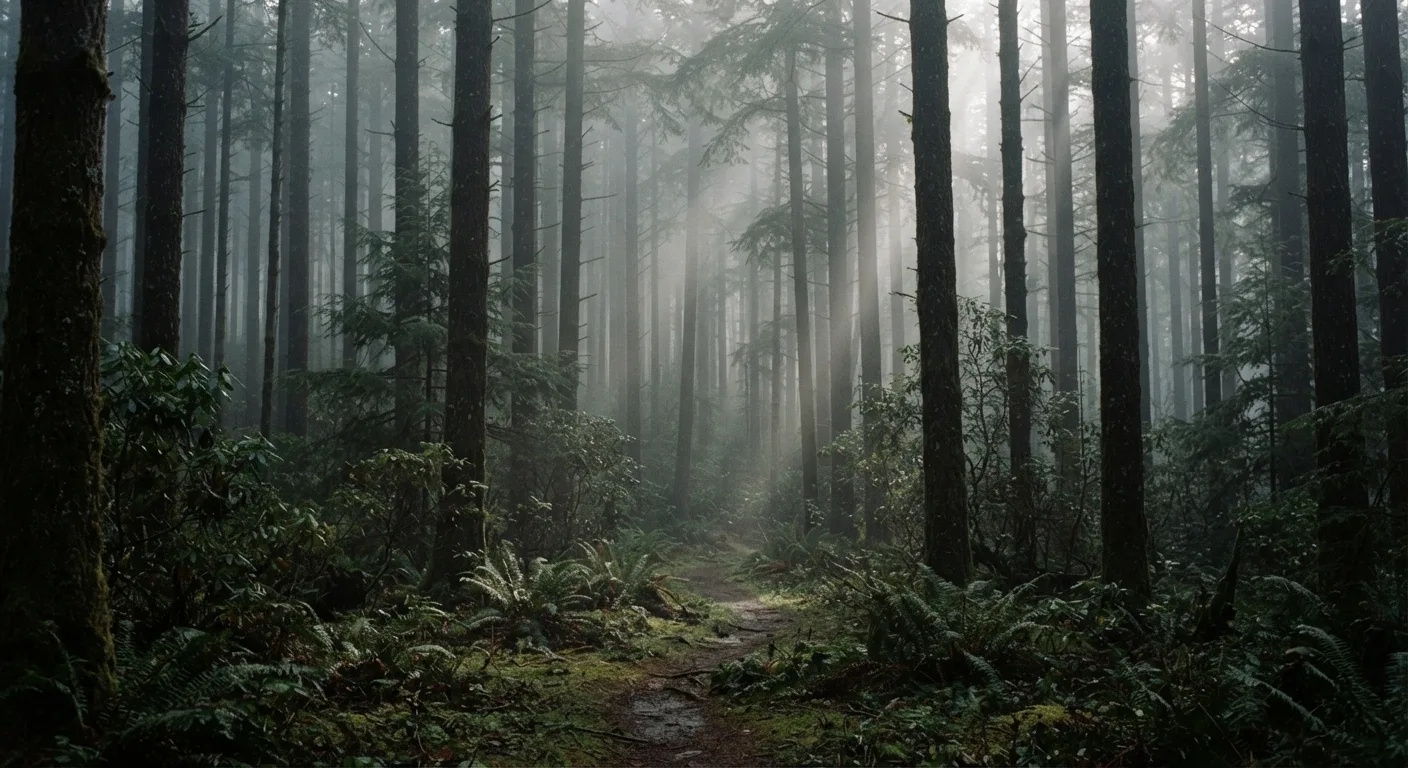

What makes a forest sound different from a city
Urban noise tends toward continuous, high-energy bands: tyre hiss near 1 kHz, HVAC drones, and sudden impulsive events (horns, sirens). Forests distribute energy differently. Krause documented that healthy habitats exhibit rich acoustic niches — species partition frequency and time so overlapping calls remain separable.[3] Farina extended the niche hypothesis to entire ecosystems: dawn choruses stack by pitch and rhythm, reducing masking while maximising information.[4]
Canopy structure acts as a natural filter. Attenborough and colleagues modelling temperate woodland showed mid-frequency attenuation from leaf mass while low frequencies bend around trunks — the classic "forest muffling" hikers describe.[5] Reverberation time in dense foliage stays short compared with stone cathedrals; early reflections arrive from many directions at low level, producing diffuse ambience rather than slap echoes.[6]
Geophony, biophony, and anthrophony
Krause's tripartite framework separates geophony (wind, water, thunder), biophony (animals and plants), and anthrophony (human machines).[3] Mature forests often dominate biophony at dawn and dusk, geophony at midday wind, with anthrophony hopefully minimal. Degraded forests show collapsed niches — fewer species, more noise — measurable with acoustic indices.[2]
Pijanowski et al. argued soundscape monitoring scales from single plots to continents, linking acoustic diversity to conservation policy.[1] For listeners at home, the lesson is structural: forests feel alive because many independent streams evolve on different timescales — exactly the auditory scene analysis problem Bregman described.[7]
Temporal statistics — why loops fail
Real forest audio never repeats its micro-pattern. Rankin's habituation research explains why identical rain loops bore then irritate: prediction succeeds, precision drops, seam dishabituation spikes.[8] Natural scenes carry fractal timing — rustle bursts follow 1/f-like amplitude distributions Gingras et al. found in rainforest recordings.[9] Brains tuned to outdoor statistics treat such variation as "still safe, still outside."
Alvarsson et al. compared autonomic recovery after stress with nature sounds versus road noise — nature won on skin conductance and heart rate within minutes.[10] Gould van Praag et al. saw different default-mode connectivity for naturalistic versus artificial soundscapes — outward, place-like listening for nature.[11] Forest acoustics may work partly because they parse as non-threatening places with separable sources.
Frequency layers in a typical woodland
Low band (below 200 Hz): wind in crowns, distant thunder, stream rumble — often felt as much as heard through vestibular coupling.[12] Mid band (200 Hz–2 kHz): songbirds, squirrel chatter, footfall on litter — where human speech competes, so designers keep this band gentle during focus. High band (2–8 kHz): insect stridulation, leaf hiss, distant sibilance — bright but usually low level in healthy forests.
Moore's psychoacoustics texts note masking rises when maskers share spectrum and rhythm with targets.[13] Forests spread energy across niches, lowering informational masking versus a single urban drone. Litovsky's binaural work adds that spatial cues from two ears help segregate simultaneous bird calls — forests are inherently 3D scenes.[14]
Season, weather, and biome variation
Spring dawn chorus increases biophony density; winter strips high-frequency leaf rustle, exposing creaking branches and crisp footfalls. Tropical rainforests run continuous insect beds; boreal forests emphasise wind and conifer resonance. Sunderland's acoustic ecology review stresses that no single "forest sound" exists — biome and season dominate.[15]
Humidity changes absorption: high moisture attenuates high frequencies faster, softening the scene — why misty woods feel muffled and intimate. Temperature gradients bend sound paths (refraction), occasionally carrying distant calls farther than geometry suggests — the "forest whispers" hikers report.[5]
Health and restoration without medical claims
Ulrich's stress recovery theory predicted natural scenes reduce sympathetic arousal faster than urban ones — sound is a major channel even when eyes are closed.[16] Annerstedt et al. found virtual nature sound with imagery lowered cortisol in laboratory stress protocols.[17] WHO's environmental noise guidelines emphasise reducing harmful anthrophony; they do not prescribe forest audio as medicine, but they acknowledge restorative contexts matter.[18]
NIH NCCIH cautions that sound-based wellness approaches vary individually — companion listening complements, not replaces, clinical care.[19] Basner et al. remind us chronic noise exposure harms cardiovascular health even when subjectively habituated — forest listening at home does not undo traffic damage without environmental change.[20]
Designing forest-like sound — Sound Bubbles
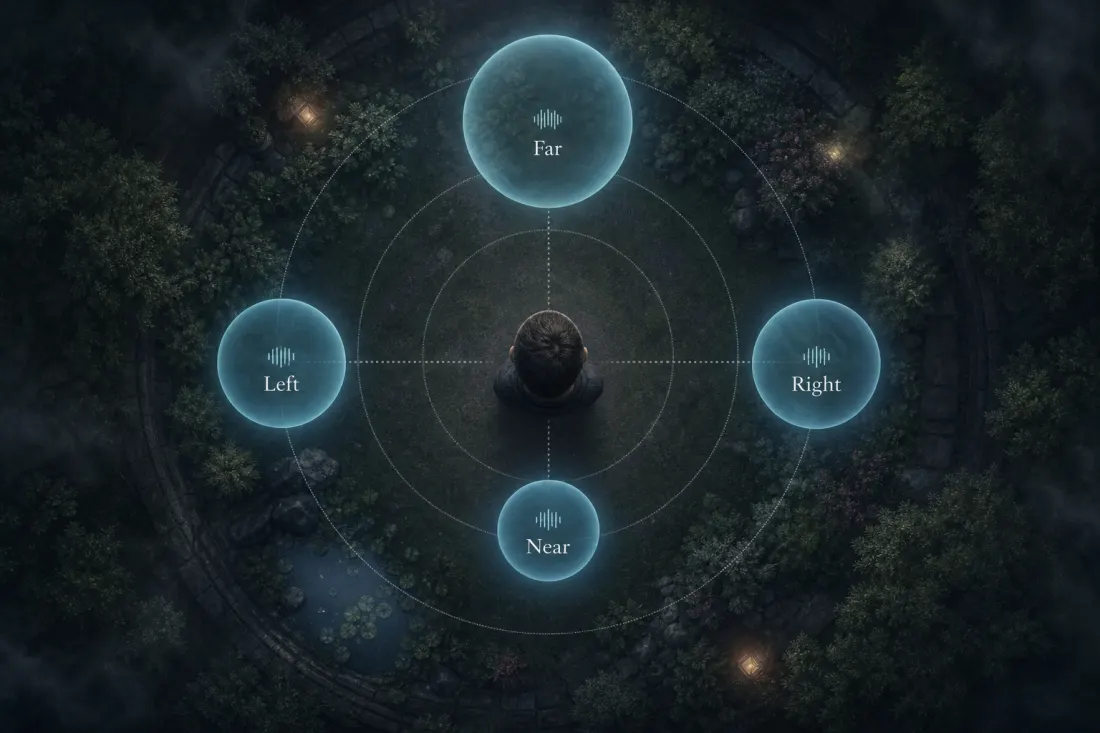
Most ambient apps flatten forests into one MP3 loop. Sound Bubbles instead separates streams into spatial bubbles with Falloff and TimeLine motion:
- Broadband brown or pink beds mimic wind-floor geophony without static seams.[8][9]
- Bird and insect layers sit at distinct depths — encouraging Bregman-style stream segregation.[7]
- Slow Drift or Tide modes preserve fractal timing without startling onsets.[8]
- Low-frequency emphasis optional for "enclosed glen" feel without boomy headphones.[12]
Banbury et al. showed intelligible speech destroys working memory even when "ignored" — forest gardens should avoid talk-like layers during deep work.[21] Keep character sounds distant and non-semantic.
Practical listening tactics
- Start with a soft geophony floor, add one biophony layer at a time — avoid mashups.[7]
- Enable TimeLine motion; static loops habituate within an hour for many listeners.[8]
- Match season to mood: bright insect beds for summer focus, sparse wind for winter calm.[15]
- Keep volume low; loud maskers fatigue cochlea and attention.[13][22]
- Pair with breaks outdoors when possible — real forests still outperform speakers for restoration.[10]
Recording ethics and conservation
Field recordists increasingly face habitat loss — acoustic indices help document what disappears when forests fragment.[1][2] Sound Bubbles uses synthesis and licensed beds partly to avoid stressing wildlife with repeated playback in sensitive sites. Krause's quiet planet advocacy ties preserved soundscapes to preserved ecosystems.[3]
Forest acoustics in product design
App developers sometimes ship one 30-second loop labelled "forest." Rankin's dishabituation criterion predicts seam detection by night two.[8] Acoustic ecology suggests designers target index distributions (richness, evenness) rather than single iconic birds.[2] Sound Bubbles gardens aim for statistic-level similarity to outdoor scenes, not postcard snapshots.
McDermott's auditory scene review ties natural listening to neural codes for discrete sources — mono collapse destroys that structure.[23] Spatial bubbles preserve separable streams per ear, approximating how real woods occupy horizontal space.[14]
Summary
Forest acoustics combine geophony, biophony, and canopy filtering into rich, non-repeating soundscapes that support stream segregation, low masking, and stress recovery for many listeners.[1][3][10] The science is acoustic ecology plus psychoacoustics — not mysticism.
Sound Bubbles approximates forest statistics with layered bubbles, motion, and distance — companion sound for focus and rest, not wilderness replacement or therapy.[7][8]
Limits
Virtual forest audio cannot replicate full multisensory restoration (smell, air, light, proprioception).[16] Individual differences in sensory processing, hyperacusis, and tinnitus alter tolerance — adjust levels and spectra accordingly.[24][25] Use forest soundscapes as design-informed companions, not cures for environmental noise harm.[20]
How this article was researched
We combine first-hand experience placing and tuning Sound Bubbles gardens with citations from peer-reviewed journals, reviews, and institutional pages (including NIH/NCBI, sleep and hearing literature, acoustics, and attention research). Where evidence is mixed or early, we say so. On wellbeing topics we stay cautious: these are companion soundscapes, not cures.
References
Sources cited in this article. Prefer primary literature and institutional guidance; Sound Bubbles is not a medical device and these citations do not imply clinical endorsement.
- (2011). Soundscape ecology: the science of sound in the landscape. BioScience. doi:10.1525/bio.2011.61.3.5
- (2014). Acoustic indices for biodiversity assessment. Methods in Ecology and Evolution. doi:10.1111/2041-210X.12230
- (2012). The Great Animal Orchestra. Little Brown.
- (2014). Soundscape Ecology: Principles, Patterns, Methods and Applications. Springer.
- (1971). Noise propagation in deciduous and evergreen forest. Journal of the Acoustical Society of America. doi:10.1121/1.1912189
- (2009). Room Acoustics. CRC Press.
- (1990). Auditory Scene Analysis. MIT Press.
- (2009). Habituation revisited. Neurobiology of Learning and Memory. doi:10.1016/j.nlm.2008.09.015
- (2013). Amplitude fluctuations in rainforest soundscapes. Journal of the Acoustical Society of America. doi:10.1121/1.4816555
- (2010). Stress recovery during exposure to nature sound and environmental noise. IJERPH. doi:10.3390/ijerph7031036
- (2017). Mind-wandering and default mode network connectivity with naturalistic versus artificial sounds. Scientific Reports. doi:10.1038/s41598-017-07890-8
- (2003). Vibration sensitivity and the lower limit of pitch. Journal of the Acoustical Society of America. doi:10.1121/1.1568949
- (2012). An Introduction to the Psychology of Hearing. Brill.
- (2012). The binaural advantage in reverberation and noise. Journal of the Acoustical Society of America. doi:10.1121/1.4754420
- (2013). Acoustic ecology and the world soundscape project. Water History.
- (1981). Natural versus urban scenes: some psychophysiological effects. Environment and Behavior. doi:10.1177/0013916581131001
- (2013). Inducing physiological stress recovery with sounds of nature. Physiology & Behavior. doi:10.1016/j.physbeh.2013.03.014
- (2018). Environmental noise guidelines for Europe. WHO.
- (2024). Sound and music based interventions — evidence overview. NIH.
- (2014). Auditory and non-auditory effects of noise on health. The Lancet. doi:10.1016/S0140-6736(13)61613-X
- (2001). Auditory distraction and short-term memory. Human Factors. doi:10.1518/001872001775992390
- (2021). World report on hearing. WHO.
- (2013). Auditory scene analysis. Neuron. doi:10.1016/j.neuron.2013.07.018
- (2024). Hyperacusis — increased sensitivity to sound. NIH.
- (2013). Sensory sensitivity in autism. Journal of Autism and Developmental Disorders.