
What makes dawn chorus work — ecologically
Ornithological dawn peaks are territory and mate signalling under rising light — high event rate but distributed across space and species.[2] Rattenborg's comparative sleep work reminds us birds themselves sleep; chorus timing is photoperiod-gated, not random noise.[2] Ulrich's hospital window study predated modern soundscape labs but showed natural morning cues affect recovery physiology — context matters as much as spectrum.[8]
Alvarsson exposed stressed volunteers to nature sound including bird-like spectra at controlled levels and measured faster autonomic recovery than traffic noise.[1] The level and informational content were laboratory-controlled — not "any birds anywhere."
Placement principle: outside, not on-axis
Bregman's auditory scene analysis predicts listeners parse sources by interaural differences, onset asynchrony, and spectral separation.[3] Birds placed at head-center in stereo feel like they are in the skull; birds with offset position and falloff simulate window arrival.[14] Hongisto modelled speech intelligibility loss with proximity — the same inverse-distance logic applies to bird chirps competing with reading.[5]
Rule of thumb: if you can pick out individual species as foreground, placement is too close or volume too high for focus work.[4]
Masking role: birds over brown, not silence
Urban bedrooms often lack real chorus; recorded birds substitute ecology. Stanchina showed continuous beds raise threshold against unpredictable spikes — distant birds plus brown floor mask hallway clicks without needing silence.[7] Silence maximises contrast for every domestic event; gentle floor smooths the night.[18][22]
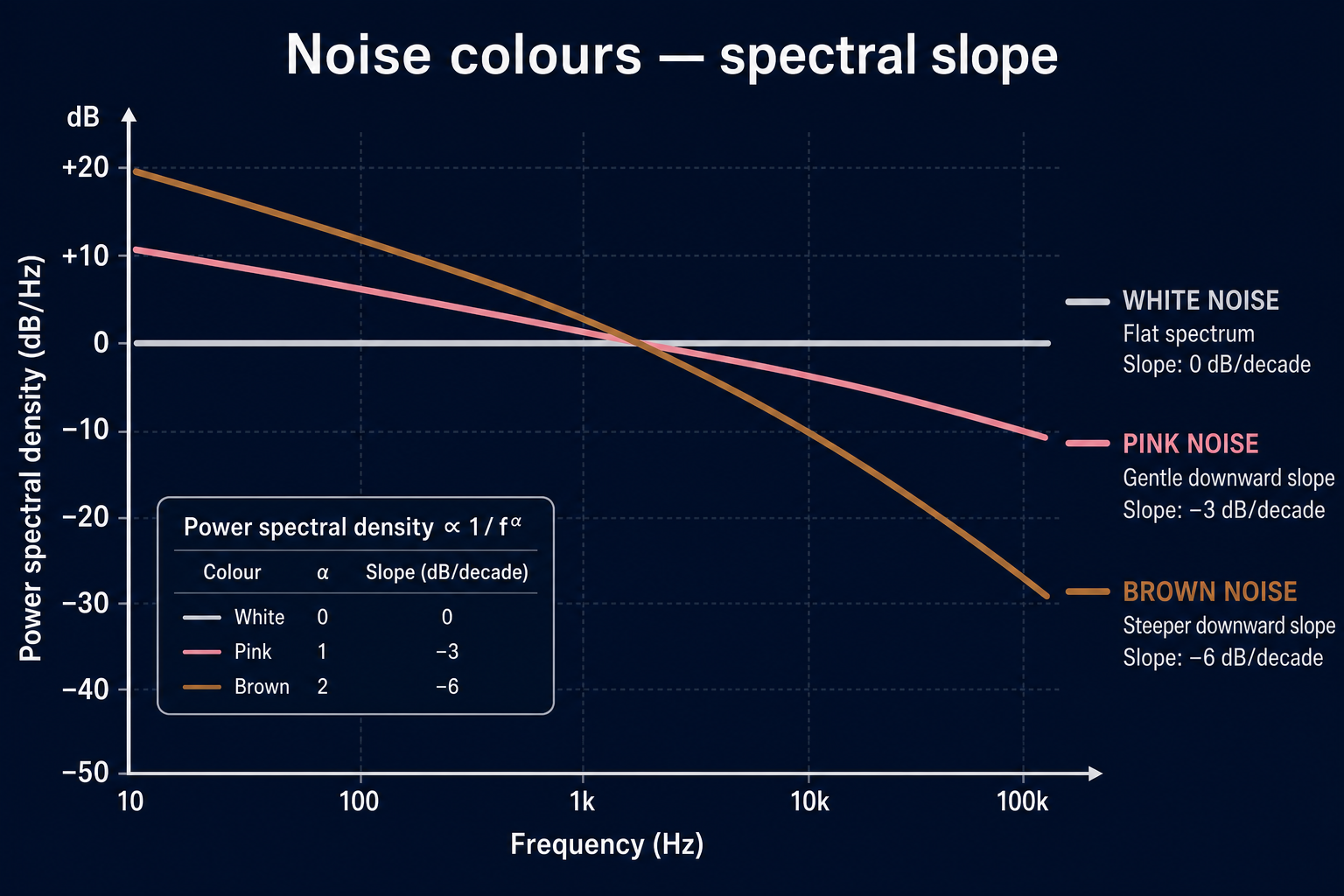
Brown or pink under birds also anchors low-frequency rumble so mid chirps float above — matching natural outdoor ratio where traffic rumble would otherwise dominate.[15][16]
Habituation and the loop seam problem
Rankin's updated habituation framework emphasises stimulus novelty and predictability.[6] Identical dawn loops become predictable; cortical gain drops until a loop boundary triggers orienting.[9][11] Real dawn never repeats a four-minute file; TimeLine drift supplies slow change without adding salient transients.[13]
For morning wake ramps, gradually raise bird bubble volume over 15–20 minutes rather than jumping to full level — parallel to gentle photic dawn, without claiming circadian entrainment from audio alone.[2]
Task fit: when birds help vs hurt
Helps: creative drafting, low-demand admin, morning mood priming, masking traffic after habituation.[1][6]
Hurts: serial memory tasks, proofreading, coding with verbal inner speech — Banbury's irrelevant speech effect is about phonological loop capture; birds are not speech but sharp chirps still deviate.[4]
Sleep: birds are usually wrong overnight unless extremely distant and low — semantic-free but high-frequency chirps can fragment light sleep.[7] Prefer rain or brown for sleep; birds for wake windows.
Multi-bird spacing in Sound Bubbles
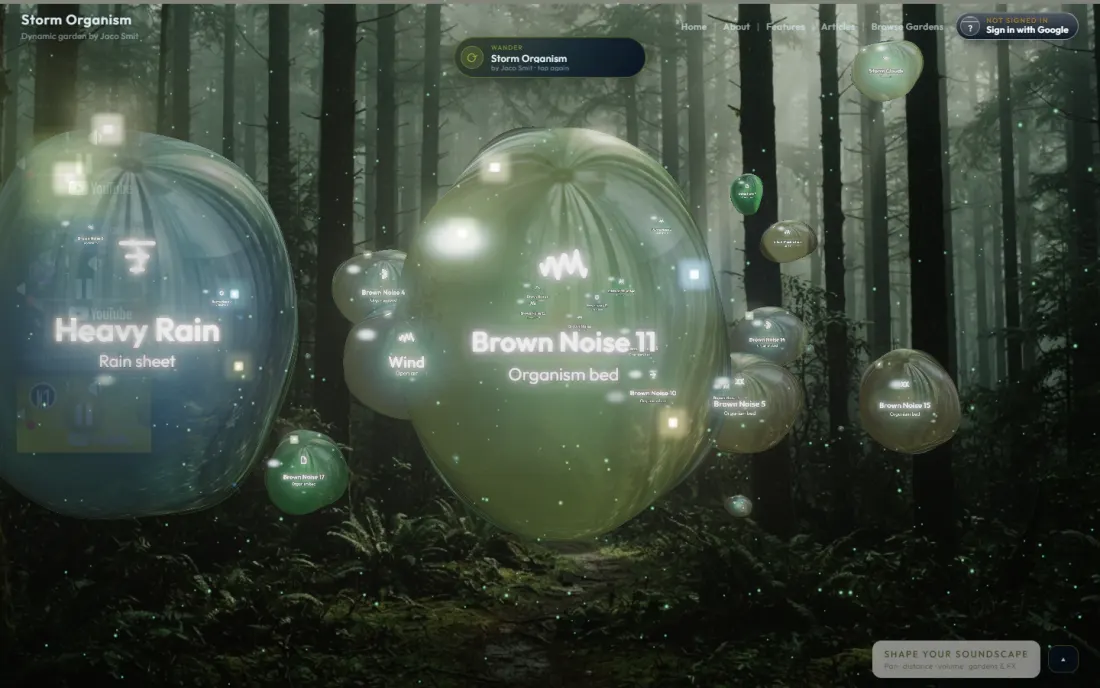
Separate species into distinct bubbles at different azimuths — Bregman streaming keeps them as environmental crowd, not one chirping megaphone.[3] Avoid stacking three loud songbirds at centre; use one lead species forward-left, another rear-right, third distant centre-low.[14]
Keep master volume below conversational level for multi-hour work; WHO recreational guidance still applies.[20]
Partner and open-office etiquette
Birds bleed through open-back headphones and speakers — negotiate shared spaces. Hongisto's performance curves predict neighbour speech plus your birds equals double distraction.[25] Headphones contain birds for focus; speakers project ecological fiction to the whole room.
Checklist
- Brown bed first at whisper level.[15]
- Bird bubble offset with high falloff — "outside window."[14]
- TimeLine Drift on to delay habituation.[9]
- Drop birds entirely for serial verbal tasks.[4]
- Re-evaluate after one week — rotate species or positions.[6]
Limits
Recorded dawn chorus does not treat depression, circadian phase disorders, or seasonal affective patterns — light therapy and clinical care lead those domains. Birds are acoustic scenery and mild arousal support, not zeitgebers comparable to melanopsin stimulation.[8] Sound Bubbles gardens remain companion listening.[20]
Companion listening in Sound Bubbles
Research above concerns clinical and laboratory sound — not a playlist guarantee. Sound Bubbles offers adjustable living gardens: spatial layers, coloured noise beds, Medical & Wellbeing rooms, and easy mute. Use recommended gardens as environmental support alongside medical care when appropriate.[20]
Not treatment. See clinicians for diagnosis, medication, CBT, neurologic music therapy, or tinnitus programmes. Keep volume comfortable; stop if symptoms worsen.
Why this supports Sound Bubbles — not just "any ambient app"
Most ambient apps deliver one file. The studies above rarely study "a loop." They study continuous floors against irregular noise, unintelligible speech against memory tasks, nature scenes against stress markers, spatial streams against glued mashups, and slow environmental change against habituation.[9][14][22][23][24]
Sound Bubbles maps onto those findings deliberately: brown/noise beds for masking floors, nature and library layers for restorative structure, distance/Falloff for speech intelligibility control, and TimeLine motion so the garden keeps the statistics of a place instead of the statistics of a four-minute loop.[12][15][16][25] That is the practical reason the product feels different after the first hour — and the scientific reason the difference matters.
How to apply this inside Sound Bubbles
- Open a related garden (or New Garden) and press Start playing so audio unlocks.[9]
- Expand Shape your soundscape → Sounds: set Master Volume, then Falloff while watching the audible-core guide.[10]
- Select a bubble; drag and scroll depth. Prefer raising one bubble's Volume over blasting the whole room.[11]
- Add library rain, nature, or noise layers; keep speech-like content distant — or remove it — when you need reading or coding focus.[12]
- TimeLine: choose Drift, Tide, or Orbit when you want the garden to keep evolving without grabbing attention.[13]
- Brown Noise tab: shape a warm floor, optionally Release as bubble so it becomes spatial.[14]
- Save gardens that still feel kind after an hour — public gardens should stay soft, not startling.[15]
Limits, safety, and honest uncertainty
We do not claim Sound Bubbles replaces clinical care, sleep medicine, occupational health programmes, or psychiatric treatment.[1][7] What the product does offer is a listening architecture that matches how hearing and attention actually work: layered sources, spatial distance, and slow change instead of one brittle loop.[18][19]
If sound worsens symptoms, stop. If you need medical advice, see a clinician. If you want a softer room, open a garden, place the bubbles kindly, and stay honest about what sound can — and cannot — do.[20][21]
How this article was researched
We combine first-hand experience placing and tuning Sound Bubbles gardens with citations from peer-reviewed journals, reviews, and institutional pages (including NIH/NCBI, sleep and hearing literature, acoustics, and attention research). Where evidence is mixed or early, we say so. On wellbeing topics we stay cautious: these are companion soundscapes, not cures.
References
Sources cited in this article. Prefer primary literature and institutional guidance; Sound Bubbles is not a medical device and these citations do not imply clinical endorsement.
- (2010). Stress recovery with nature sound. IJERPH. doi:10.3390/ijerph7031036
- (2009). Sleep in birds and mammals. Neuroscience & Biobehavioral Reviews.
- (1990). Auditory Scene Analysis. MIT Press.
- (2001). Auditory distraction and short-term memory. Human Factors. doi:10.1518/001872001775992390
- (2005). Speech intelligibility and work performance. Indoor Air. doi:10.1111/j.1600-0668.2005.00391.x
- (2009). Habituation revisited. Neurobiology of Learning and Memory. doi:10.1016/j.nlm.2008.09.015
- (2005). White noise on sleep with ICU noise exposure. Sleep Medicine. doi:10.1016/j.sleep.2004.12.004
- (1984). View through a window may influence recovery. Science. doi:10.1126/science.6143402
- (2009). Habituation revisited. Neurobiology of Learning and Memory. doi:10.1016/j.nlm.2008.09.015
- (2009). Habituation: a history. Neurobiology of Learning and Memory.
- (1963). Perception and the conditioned reflex. Pergamon Press.
- (2010). The free-energy principle. Nature Reviews Neuroscience. doi:10.1038/nrn2787
- (2013). Whatever next? Predictive brains. Behavioral and Brain Sciences. doi:10.1017/S0140525X12000477
- (1990). Auditory Scene Analysis. MIT Press.
- (2012). An Introduction to the Psychology of Hearing. Brill.
- (2024). Colors of noise. Encyclopedic.
- (2013). Acoustical terminology (masking). ANSI.
- (2014). Auditory and non-auditory effects of noise on health. The Lancet. doi:10.1016/S0140-6736(13)61613-X
- (2021). World report on hearing. WHO.
- (2023). Noise and hearing loss prevention. CDC.
- (2005). White noise on sleep with ICU noise exposure. Sleep Medicine. doi:10.1016/j.sleep.2004.12.004
- (2001). Auditory distraction and short-term memory. Human Factors. doi:10.1518/001872001775992390
- (2010). Stress recovery with nature sound. IJERPH. doi:10.3390/ijerph7031036
- (2005). Speech intelligibility and work performance. Indoor Air. doi:10.1111/j.1600-0668.2005.00391.x