

Three ways sound interacts with chronic pain
Music analgesia engages limbic and reward circuits, diverts attention from pain salience, and may modulate endogenous opioid release during preferred listening.[3][6] Huang's meta-analysis of music interventions for pain in adults found significant reductions across procedural and chronic pain contexts — with larger effects when patients chose music and when sessions lasted longer than thirty minutes.[1]
Environmental masking does not treat pain directly; it reduces sleep fragmentation and startle from acoustic spikes that amplify next-day pain scores via sleep loss. Basner's health noise review documents sleep and cardiovascular pathways linking night noise to worse daytime function.[19] Stanchina showed masking ICU noise improved sleep continuity — relevant for hospitalised pain patients and noisy home bedrooms alike.[22]
Stress recovery via nature soundscapes accelerates autonomic downshift after laboratory stressors in Alvarsson's work — indirect pain benefit when anxiety and muscle guarding drive symptom flares.[24]
What systematic reviews conclude
Bradt's Cochrane review on music for medical procedures found reliable anxiety and pain reductions during acute interventions — extrapolation to daily chronic pain requires caution but supports music as a low-risk adjunct.[2] Lunde's pain-focused review emphasised heterogeneity: genre, delivery mode, and therapist presence all matter.[5] Hole's Lancet meta-analysis on postoperative music documented reduced pain medication use and faster recovery — strongest in perioperative windows.[6]
Garza-Villarreal's fibromyalgia trial and related chronic pain studies suggest passive listening can move pain scales modestly, but effect sizes shrink without preference matching and habituation to identical tracks may erode benefit over weeks.[4] Slow environmental change — spatial gardens with evolving statistics — aligns with habituation literature suggesting varied acoustic scenes maintain engagement longer than single loops.[9][14]

Sleep, pain, and night noise
Pain and insomnia co-occur in most chronic pain syndromes. Harvey's cognitive model of insomnia highlights hypervigilance to bedroom stimuli — every creak becomes threat-related when pain dominates attention.[19] A gentle masking floor lowers contrast between baseline quiet and sudden events, potentially reducing orienting responses that restart pain rumination cycles. WHO night-noise guidance treats environmental sound as a modifiable sleep determinant.[19]
Brown and pink noise beds mask without the bright fatigue some chronic pain patients report from white noise.[15][16] Keep volumes low; loud masking itself becomes a stressor and risks hearing fatigue over eight-hour nights.[20][21]
Practical boundaries
- Sound supports multimodal care — it does not replace diagnosis of treatable sources (inflammatory arthritis, nerve compression, etc.).[7]
- During acute flares, silence may beat any garden; respect phonophobia and hyperacusis.[19]
- Music with emotional triggers can worsen mood-dependent pain; prefer neutral or personally calming selections.[3]
- Track pain diaries alongside listening habits to identify helpful versus harmful patterns.
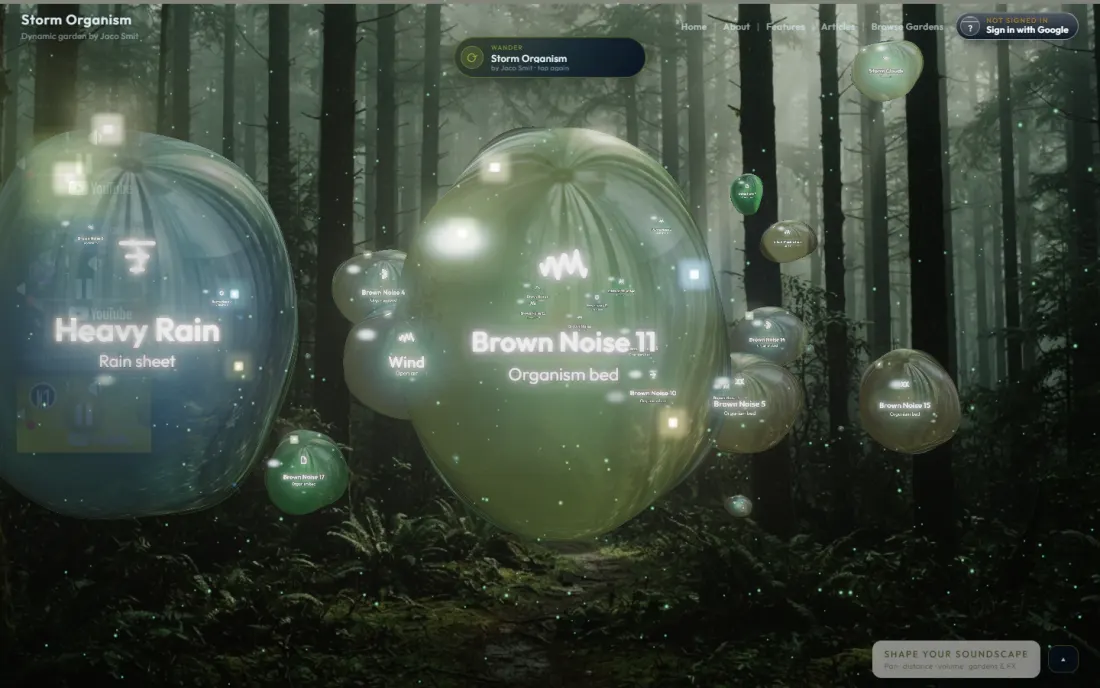
Multimodal pain care and where sound fits
Chronic pain management increasingly emphasises biopsychosocial models: medication, physiotherapy, psychology, sleep hygiene, and activity pacing together outperform any single modality.[1][7] Sound belongs in the environmental column — reducing night-time startle, supporting relaxation practice, making waiting rooms tolerable — not as a standalone analgesic claim.
Gate-control and neuromatrix frameworks explain why attention and affect modulate pain perception; music and pleasant soundscapes can shift those variables without eliminating nociceptive input.[6] Honest framing prevents disappointment: sound may lower the distress component of pain even when tissue pathology persists. Coordinate with your pain team rather than substituting apps for prescribed care.
Hospital music therapy meta-analyses report modest but repeatable anxiety and pain-score reductions in perioperative settings — useful precedent for waiting-room and recovery listening, though chronic pain populations differ.[4][5] Home listeners should favour low-arousal beds during rest and reserve active music engagement for moments when distraction is welcome, not mandatory.
Companion listening in Sound Bubbles
Research above concerns clinical and laboratory sound — not a playlist guarantee. Sound Bubbles offers adjustable living gardens: spatial layers, coloured noise beds, Medical & Wellbeing rooms, and easy mute. Use the recommended gardens below as environmental support alongside medical care when appropriate.[20]
Not treatment. See clinicians for diagnosis, medication, CBT, neurologic music therapy, or tinnitus programmes. Keep volume comfortable; stop if symptoms worsen.
Why this supports Sound Bubbles — not just "any ambient app"
Most ambient apps deliver one file. The studies above rarely study "a loop." They study continuous floors against irregular noise, unintelligible speech against memory tasks, nature scenes against stress markers, spatial streams against glued mashups, and slow environmental change against habituation.[9][14][22][23][24]
Sound Bubbles maps onto those findings deliberately: brown/noise beds for masking floors, nature and library layers for restorative structure, distance/Falloff for speech intelligibility control, and TimeLine motion so the garden keeps the statistics of a place instead of the statistics of a four-minute loop.[12][15][16][25] That is the practical reason the product feels different after the first hour — and the scientific reason the difference matters.
How to apply this inside Sound Bubbles
- Open a related garden (or New Garden) and press Start playing so audio unlocks.[9]
- Expand Shape your soundscape → Sounds: set Master Volume, then Falloff while watching the audible-core guide.[10]
- Select a bubble; drag and scroll depth. Prefer raising one bubble's Volume over blasting the whole room.[11]
- Add library rain, nature, or noise layers; keep speech-like content distant — or remove it — when you need reading or coding focus.[12]
- TimeLine: choose Drift, Tide, or Orbit when you want the garden to keep evolving without grabbing attention.[13]
- Brown Noise tab: shape a warm floor, optionally Release as bubble so it becomes spatial.[14]
- Save gardens that still feel kind after an hour — public gardens should stay soft, not startling.[15]
Limits, safety, and honest uncertainty
We do not claim Sound Bubbles replaces pain medicine, music therapy, or chronic pain rehabilitation.[1][7] What the product does offer is a listening architecture that matches how hearing and attention actually work: layered sources, spatial distance, and slow change instead of one brittle loop.[18][19]
If sound worsens symptoms, stop. If you need medical advice, see a clinician. If you want a softer room, open a garden, place the bubbles kindly, and stay honest about what sound can — and cannot — do.[20][21]
How this article was researched
We combine first-hand experience placing and tuning Sound Bubbles gardens with citations from peer-reviewed journals, reviews, and institutional pages (including NIH/NCBI, sleep and hearing literature, acoustics, and attention research). Where evidence is mixed or early, we say so. On wellbeing topics we stay cautious: these are companion soundscapes, not cures.
References
Sources cited in this article. Prefer primary literature and institutional guidance; Sound Bubbles is not a medical device and these citations do not imply clinical endorsement.
- (2020). Music interventions for pain relief in adults: a systematic review and meta-analysis. Pain Management Nursing. doi:10.1016/j.pmn.2019.12.001
- (2013). Music for pain and anxiety in adults undergoing medical procedures. Cochrane Database of Systematic Reviews. doi:10.1002/14651858.CD006908.pub2
- (2013). Emotional foundations of music as a non-pharmacological pain management tool. Brain Research Bulletin. doi:10.1016/j.brainresbull.2013.04.005
- (2014). Music-induced analgesia in chronic pain conditions. Arthritis & Rheumatology. doi:10.1002/art.38384
- (2019). The effect of music on pain: a systematic review. Pain Management Nursing. doi:10.1016/j.pmn.2019.01.001
- (2015). Music as an aid for postoperative recovery in adults: a systematic review and meta-analysis. The Lancet. doi:10.1016/S0140-6736(15)60169-6
- (2024). Music and pain management: clinical context. IASP.
- (2009). Habituation revisited. Neurobiology of Learning and Memory. doi:10.1016/j.nlm.2008.09.015
- (2009). Habituation: a history. Neurobiology of Learning and Memory.
- (1963). Perception and the conditioned reflex. Pergamon Press.
- (2010). The free-energy principle. Nature Reviews Neuroscience. doi:10.1038/nrn2787
- (2013). Whatever next? Predictive brains. Behavioral and Brain Sciences. doi:10.1017/S0140525X12000477
- (1990). Auditory Scene Analysis. MIT Press.
- (2012). An Introduction to the Psychology of Hearing. Brill.
- (2024). Colors of noise. Encyclopedic.
- (2013). Acoustical terminology (masking). ANSI.
- (2014). Auditory and non-auditory effects of noise on health. The Lancet. doi:10.1016/S0140-6736(13)61613-X
- (2021). World report on hearing. WHO.
- (2023). Noise and hearing loss prevention. CDC.
- (2005). White noise on sleep with ICU noise exposure. Sleep Medicine. doi:10.1016/j.sleep.2004.12.004
- (2001). Auditory distraction and short-term memory. Human Factors. doi:10.1518/001872001775992390
- (2010). Stress recovery with nature sound. IJERPH. doi:10.3390/ijerph7031036
- (2005). Speech intelligibility and work performance. Indoor Air. doi:10.1111/j.1600-0668.2005.00391.x