
Central sensitisation and why sound strategy matters
Fibromyalgia involves central nervous system amplification of nociceptive signals — light pressure, temperature shifts, and auditory stimuli can all register as threatening.[2] Sleep disruption worsens pain thresholds in a bidirectional loop: poor sleep increases next-day pain scores; pain fragments sleep architecture.[3] Environmental noise at night — traffic, partner snoring, building HVAC — correlates with autonomic arousals that prevent deep sleep stages in general population studies, and fibromyalgia patients often report lower tolerance for the same acoustic events.[19][22]
That does not mean all sound is harmful. It means sound must be chosen with the same care as light and temperature: continuous, predictable, low-contrast environments often feel safer than silence punctuated by unpredictable spikes.
What fibromyalgia music trials have found
Garza-Villarreal's randomised controlled trial assigned fibromyalgia patients to music listening sessions versus control conditions and reported significant reductions in pain intensity and functional interference — one of the stronger FM-specific music analgesia studies.[1] Onieva-Zarafoneta's systematic review pooled music therapy and music medicine trials, concluding music interventions show promise for pain and quality of life though study quality varies and long-term follow-up is limited.[2]
Lunde's review focused specifically on pain outcomes, finding consistent short-term analgesic effects across several small trials — effect sizes meaningful for daily function but not replacing multimodal pain programmes.[3] Bernatzky's theoretical work links music analgesia to limbic modulation, attentional diversion, and endogenous opioid pathways — explaining why actively engaging music may outperform passive noise for some listeners.[6]
de Witte's stress-reduction meta-analysis supports broader autonomic benefits from music therapy formats that include therapist guidance and preference matching.[5] Passive ambient listening may capture part of that benefit for rest and sleep onset; it does not replicate structured music therapy.
Sleep, masking, and night-time flares
Non-restorative sleep is a diagnostic pillar of fibromyalgia. Masking disruptive environmental noise — raising a gentle acoustic floor so sudden events lose salience — is supported by ICU noise masking studies and sleep noise systematic reviews, though FM-specific RCTs are sparse.[19][22] Pink and brown noise beds sit lower in perceived harshness than white noise for many listeners, which matters when central sensitisation makes bright hiss feel like another pain signal.[15][16]
Nature sound recovery research documents faster parasympathetic rebound after stress when listeners hear biophilic soundscapes versus urban noise recordings.[24] For pre-sleep wind-down, distant rain and soft brown floors may support transition toward sleep without lyrical content hijacking rumination — a common FM complaint during insomnia.
Building a fibromyalgia-safe listening plan
- Start at low volume; FM sensitisation can turn moderate sound into overload within minutes.[19]
- Prefer non-lyrical, non-spiky sound during flares — lyrics activate narrative memory; sharp transients trigger orienting.[9][23]
- Use masking for sleep continuity, not as sole pain treatment.[22]
- Track pain and sleep scores across nights; stop any garden that correlates with worse mornings.
- Coordinate with your clinician if considering sound alongside gabapentinoids, sleep meds, or CBT-I.[7]

Exercise, pacing, and when to skip sound
Graded exercise and pacing programmes remain cornerstone FM management alongside pharmacotherapy and CBT for pain.[7] On high-pain days, even favourite music can feel intrusive — central sensitisation does not negotiate. Silence or ear protection may outperform masking until flare intensity drops. On moderate days, low-arousal gardens can accompany gentle stretching or meditation without competing for attention. The pattern is symptom-contingent: sound as optional support, never as obligation.
Patient-led fibromyalgia networks emphasise tracking triggers across sleep, weather, stress, and sensory load. If your log shows worse mornings after overnight brown noise, remove it for a week and compare — individual response trumps population averages.[2][3]
Companion listening in Sound Bubbles
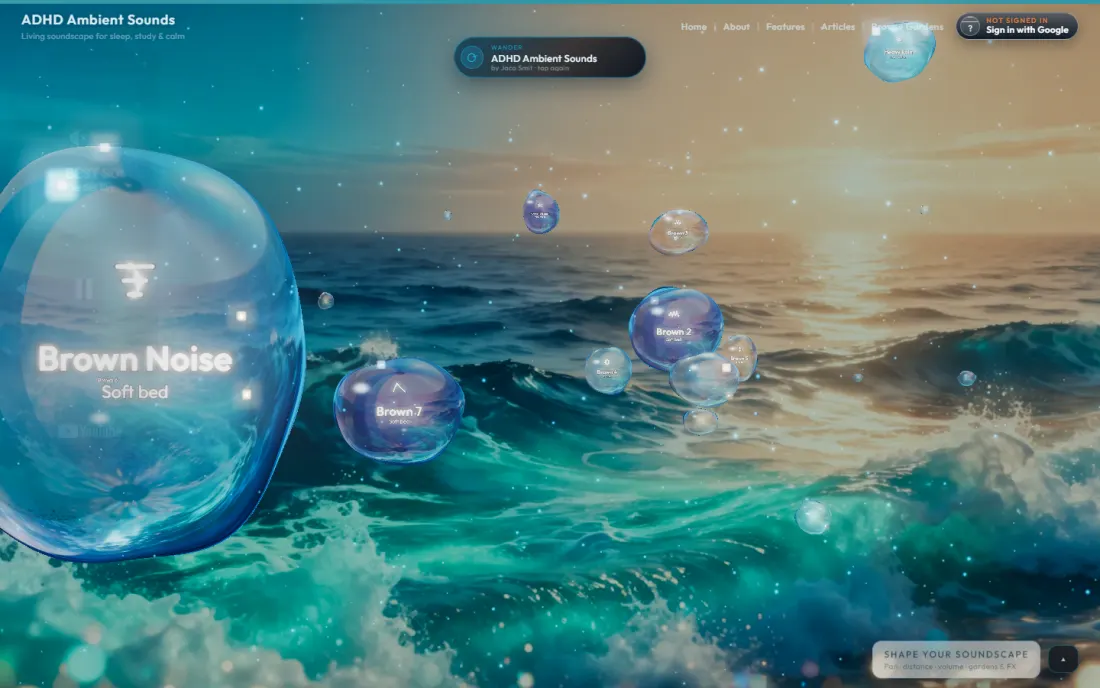
Research above concerns clinical and laboratory sound — not a playlist guarantee. Sound Bubbles offers adjustable living gardens: spatial layers, coloured noise beds, Medical & Wellbeing rooms, and easy mute. Use the recommended gardens below as environmental support alongside medical care when appropriate.[20]
Not treatment. See clinicians for diagnosis, medication, CBT, neurologic music therapy, or tinnitus programmes. Keep volume comfortable; stop if symptoms worsen.
Why this supports Sound Bubbles — not just "any ambient app"
Most ambient apps deliver one file. The studies above rarely study "a loop." They study continuous floors against irregular noise, unintelligible speech against memory tasks, nature scenes against stress markers, spatial streams against glued mashups, and slow environmental change against habituation.[9][14][22][23][24]
Sound Bubbles maps onto those findings deliberately: brown/noise beds for masking floors, nature and library layers for restorative structure, distance/Falloff for speech intelligibility control, and TimeLine motion so the garden keeps the statistics of a place instead of the statistics of a four-minute loop.[12][15][16][25] That is the practical reason the product feels different after the first hour — and the scientific reason the difference matters.
How to apply this inside Sound Bubbles
- Open a related garden (or New Garden) and press Start playing so audio unlocks.[9]
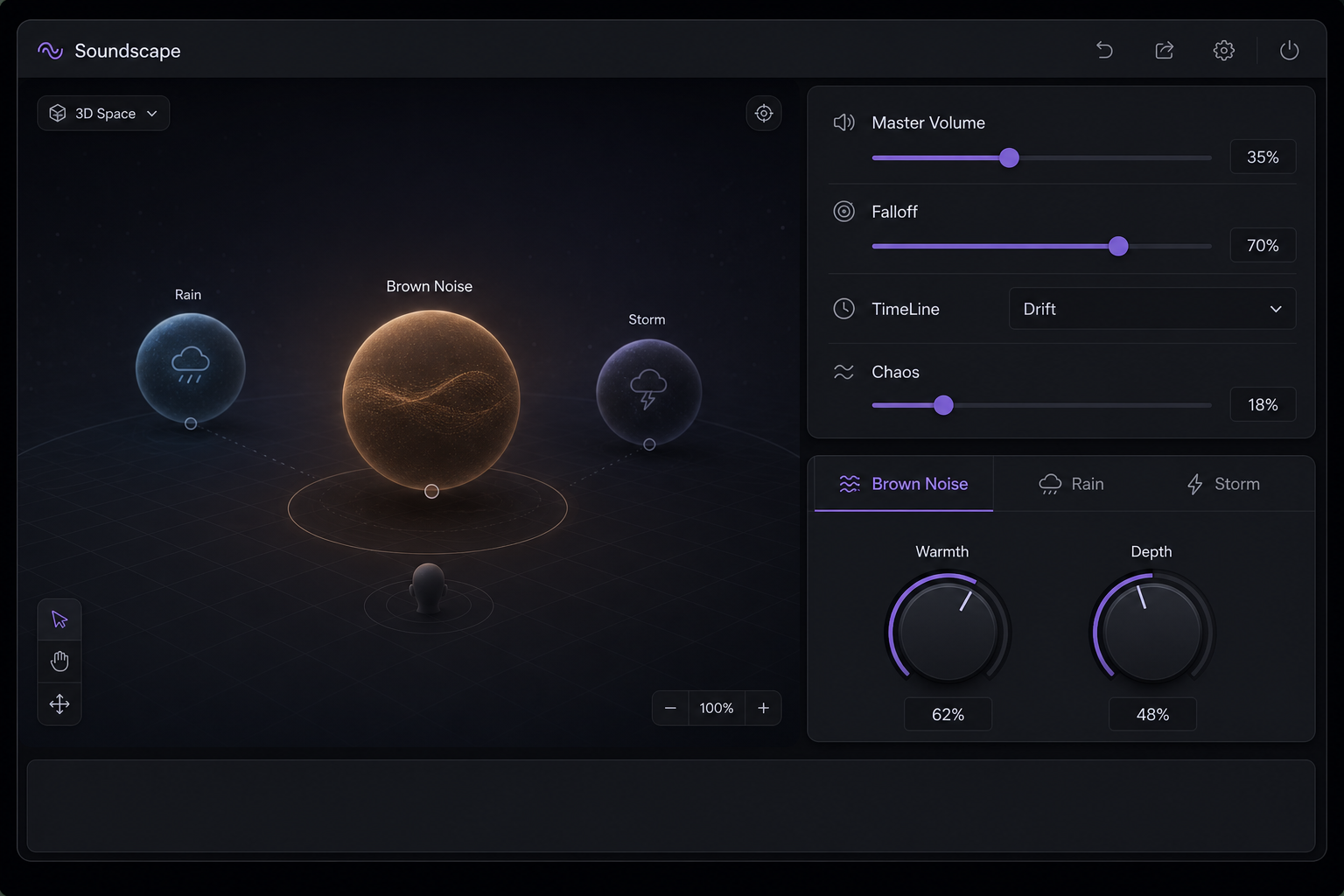
- Expand Shape your soundscape → Sounds: set Master Volume, then Falloff while watching the audible-core guide.[10]
- Select a bubble; drag and scroll depth. Prefer raising one bubble's Volume over blasting the whole room.[11]
- Add library rain, nature, or noise layers; keep speech-like content distant — or remove it — when you need reading or coding focus.[12]
- TimeLine: choose Drift, Tide, or Orbit when you want the garden to keep evolving without grabbing attention.[13]
- Brown Noise tab: shape a warm floor, optionally Release as bubble so it becomes spatial.[14]
- Save gardens that still feel kind after an hour — public gardens should stay soft, not startling.[15]
Limits, safety, and honest uncertainty
We do not claim Sound Bubbles replaces fibromyalgia medical care, music therapy, or pain rehabilitation programmes.[1][7] What the product does offer is a listening architecture that matches how hearing and attention actually work: layered sources, spatial distance, and slow change instead of one brittle loop.[18][19]
If sound worsens symptoms, stop. If you need medical advice, see a clinician. If you want a softer room, open a garden, place the bubbles kindly, and stay honest about what sound can — and cannot — do.[20][21]
How this article was researched
We combine first-hand experience placing and tuning Sound Bubbles gardens with citations from peer-reviewed journals, reviews, and institutional pages (including NIH/NCBI, sleep and hearing literature, acoustics, and attention research). Where evidence is mixed or early, we say so. On wellbeing topics we stay cautious: these are companion soundscapes, not cures.
References
Sources cited in this article. Prefer primary literature and institutional guidance; Sound Bubbles is not a medical device and these citations do not imply clinical endorsement.
- (2014). Music-induced analgesia in fibromyalgia: a randomized controlled trial. Arthritis & Rheumatology. doi:10.1002/art.38384
- (2018). Effectiveness of music therapy in fibromyalgia: a systematic review. Complementary Therapies in Medicine. doi:10.1016/j.ctim.2018.09.019
- (2019). The effect of music on pain in fibromyalgia: a systematic review. Pain Management Nursing. doi:10.1016/j.pmn.2019.01.001
- (2013). Music for stress and anxiety reduction in healthy adults: a systematic review and meta-analysis. Health Psychology Review. doi:10.1080/17437199.2013.802137
- (2020). Music therapy for stress reduction: a systematic review and meta-analysis. Health Psychology Review. doi:10.1080/17437199.2020.1719094
- (2013). Emotional foundations of music as a non-pharmacological pain management tool. Brain Research Bulletin. doi:10.1016/j.brainresbull.2013.04.005
- (2024). Managing fibromyalgia: complementary approaches. NFA.
- (2009). Habituation revisited. Neurobiology of Learning and Memory. doi:10.1016/j.nlm.2008.09.015
- (2009). Habituation: a history. Neurobiology of Learning and Memory.
- (1963). Perception and the conditioned reflex. Pergamon Press.
- (2010). The free-energy principle. Nature Reviews Neuroscience. doi:10.1038/nrn2787
- (2013). Whatever next? Predictive brains. Behavioral and Brain Sciences. doi:10.1017/S0140525X12000477
- (1990). Auditory Scene Analysis. MIT Press.
- (2012). An Introduction to the Psychology of Hearing. Brill.
- (2024). Colors of noise. Encyclopedic.
- (2013). Acoustical terminology (masking). ANSI.
- (2014). Auditory and non-auditory effects of noise on health. The Lancet. doi:10.1016/S0140-6736(13)61613-X
- (2021). World report on hearing. WHO.
- (2023). Noise and hearing loss prevention. CDC.
- (2005). White noise on sleep with ICU noise exposure. Sleep Medicine. doi:10.1016/j.sleep.2004.12.004
- (2001). Auditory distraction and short-term memory. Human Factors. doi:10.1518/001872001775992390
- (2010). Stress recovery with nature sound. IJERPH. doi:10.3390/ijerph7031036
- (2005). Speech intelligibility and work performance. Indoor Air. doi:10.1111/j.1600-0668.2005.00391.x