Build by asking questions — not by copying a pretty screenshot
The fastest way to hate your own garden is to clone someone else's because it looked cosy in a thumbnail. Your ears are not their ears. Your room is not their room. Your nervous system may love low rumble and hate bright hiss — or need more motion than a sleep purist would tolerate. Start with a short questionnaire, then let the answers drive every knob.
Question 1 — Treble sensitivity: Do high-pitched sounds annoy you? Crickets, kettle hiss, bright white noise, sharp bird calls, crackling fire with lots of treble? If yes, bias toward brown floors, darker rain sheets, lower-pitched wildlife, and bubbles placed farther back. Psychoacoustics and equal-loudness curves explain why bright spectra fatigue faster at the same SPL — your discomfort is not weakness, it is physics.[1][2][3]
Question 2 — Bass weight: Do lower sounds work for you? Some people want sub-heavy brown beds that feel like a weighted blanket; others feel chest pressure and prefer pink-grey middle floors. There is no virtue in "more bass" — only fit.[4][5]
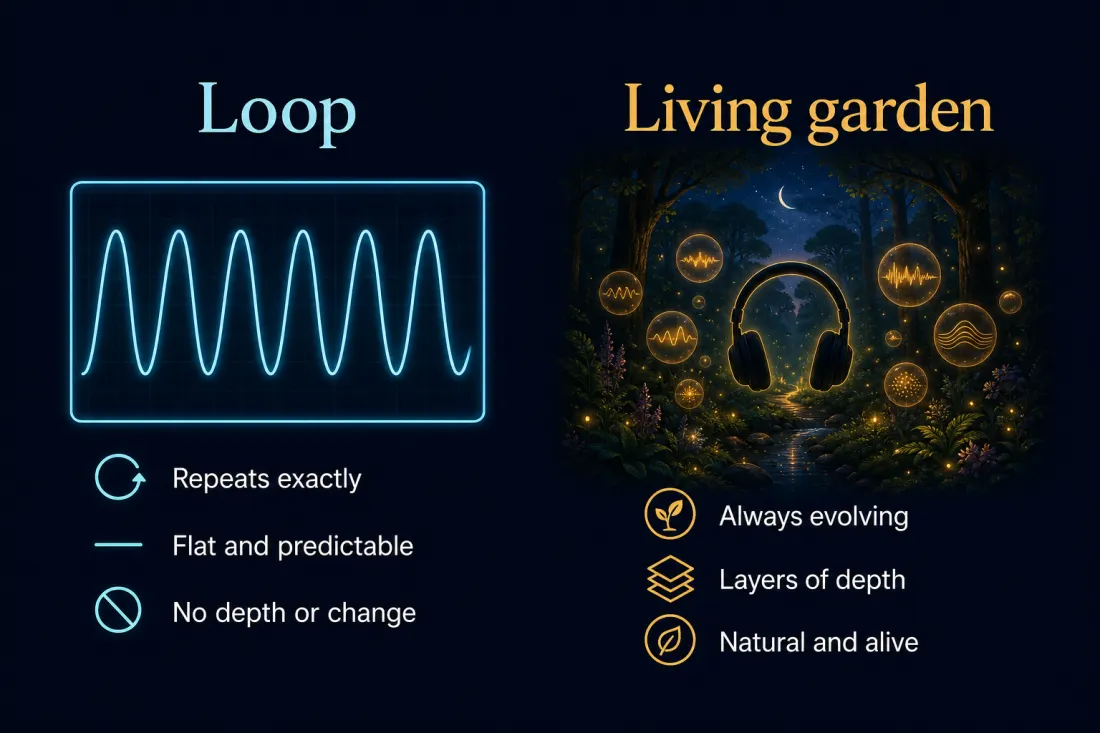
Question 3 — Repetition: Does repetition annoy you? If a loop becomes wallpaper in twenty minutes, you need independent layers and slow TimeLine drift — not another "ten hour" file. Habituation and predictive-processing accounts both predict seam-detection and boredom when statistics freeze.[6][7][9][10][19]
Question 4 — Surprise: Do sudden spikes wreck you? Anxiety, migraine, sensory overload, and misophonia all sharpen orienting to sharp onsets.[6][8] If yes, pop dramatic thunder, close-up crackle, and chirpy wildlife; keep Chaos low.
Question 5 — Speech sensitivity: Are you trying to read, code, or sleep? Irrelevant speech disrupts serial recall even when you "ignore" it.[16][17][18] If yes, no intelligible café talk near the core — mask it far or remove it.
Question 6 — The hour test: What sounds do you actually like for hours, not for a cosy ninety seconds? Your first thought might be fireplace — wonderful in memory — but the wrong fireplace recording becomes a crackle metronome. Trust the hour test, not the vibe test.
The hour test — why first impressions lie
Ambient culture trains you to judge sound in the first minute: "Oh, fireplace, I love cabins." Minute twelve tells the truth. One bubble with a harsh crackle loop, too much treble, and no spatial distance will grate. A cricket placed at default volume and distance can feel cute for thirty seconds and unbearable by minute forty — especially if it is a high species timbre that never rests.[11][20]
Fireplace gone wrong: crackle bubble too near, too loud, bright pops every few seconds, no brown floor underneath → your brain tracks the pops as events, not weather. Fireplace done right: brown bed far and soft; one fireplace layer mid-distance at low volume; optional distant wind; TimeLine Drift on low Chaos so the flame statistics shift slowly.
Cricket gone wrong: one cricket bubble loud, close, high-pitched, looping the same chirp → a tiny alarm in your ear. Cricket done right: choose a lower, softer cricket from the library; place it far; lower per-bubble Volume until you have to listen for it; add a second species farther still if you want life without a solo performer. Scene analysis research predicts multiple distant insect streams parse as environment; one near stream parses as a target.[11][29]
Rule: if you notice a layer twice in ten minutes, it is too loud, too near, or too interesting. Fix distance and volume before deleting — then pop if it still charisma-grabs.
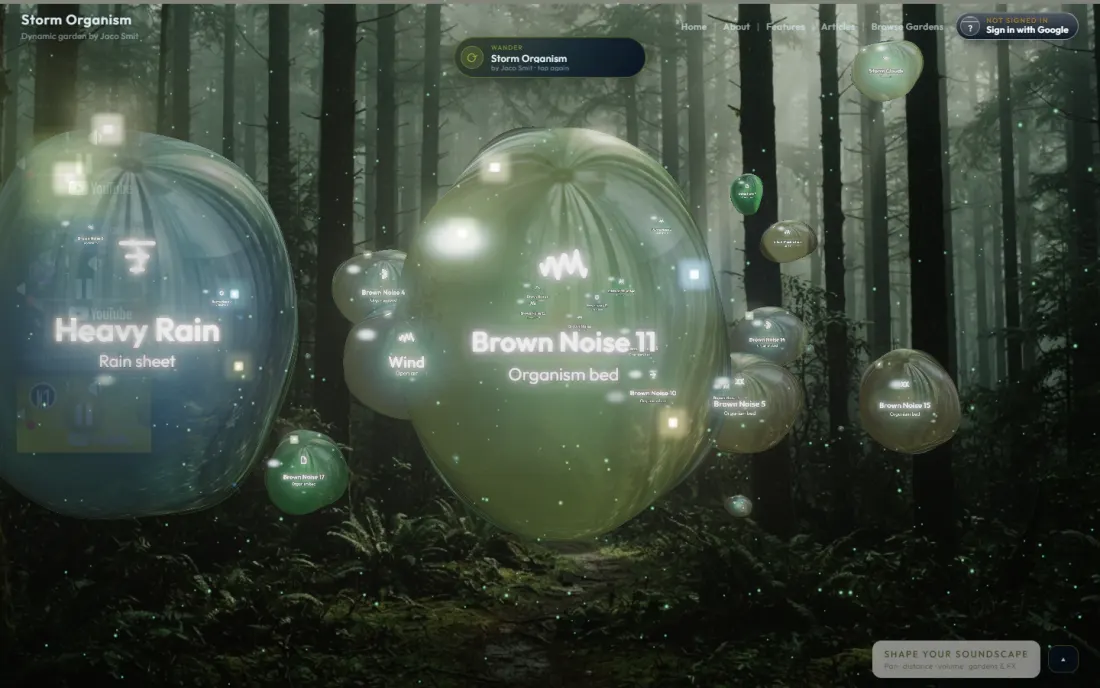
Step 1 — Tune your brown noise floor first
Before you add romance (fire, birds, ocean drama), build the floor. Masking literature centres on continuous broadband that lowers contrast against spikes — traffic, doors, hallway talk.[5][16][26] In Sound Bubbles that usually means the Brown Noise tab, then optionally Release as bubble so the floor participates in space like rain and wind.[11]
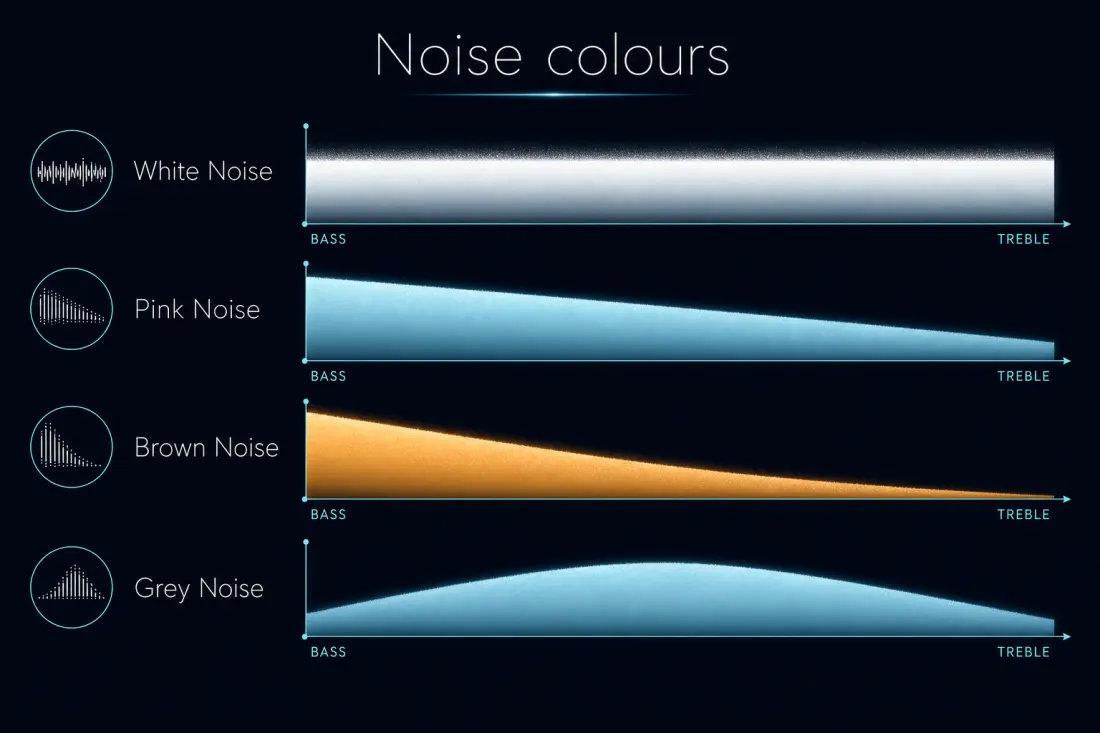
Spectrum: Brown leans dark — often best for treble-sensitive ears and long sessions. Pink sits between brown and white. White/grey read brighter — useful for office masking when hiss does not fatigue you. Layer Cake Organism exists to A/B colours in one session.[1][4]
Warmth and level: Start Master Volume lower than instinct. Shape brown until traffic loses contrast without the bed becoming the main character. If the floor feels "in your face," scroll depth back or lower that bubble's Volume — do not crank Master.[21][22]
One floor at a time: Add a single brown (or grey) bubble, audition ten minutes in silence, then add the next layer. Stacking five interesting layers before the floor is stable is how gardens turn into mush.
Step 2 — Select sounds by frequency, not by thumbnail mood
Library browsing by vibe is fun; building by spectrum is how you survive hour three. When you audition wildlife, weather, and texture:
- Prefer lower cricket and insect beds over piercing chirps when treble annoys you.
- Prefer sheet rain and distant storm over close drip loops that become metronomes.
- Prefer muffled fireplace and camp beds over sharp crackle close-mics.
- Prefer distant bird chorus over single heroic seagull or crow near the core.
- Prefer stream and HVAC rumble over clinking dishes when you need focus.
Equal-loudness and masking bandwidth work explain the pattern: energy parked in irritating bands grabs attention; energy in low-mid continuous bands often reads as "room" instead of "alarm."[2][3][5]
When two sounds feel equally "on brand," pick the darker, slower, less eventful one. You can always add sparkle later; removing fatigue is harder once your brain has tagged a bubble as annoying.
Step 3 — Volume is per-bubble surgery, not one master push
Master Volume is the room's ceiling. Per-bubble Volume is how you mix without destroying dynamics. A classic failure mode: everything at 80% because the rain felt weak — now cricket, fire, and brown all compete.[1]
Mixing order that works:
- Set Master conservatively.
- Bring floor bubble to masking threshold — barely enough to soften spikes.
- Add one character layer at 30–50% of what you think you need.
- Walk away five minutes; return and notice what grabbed you.
- Lower the grabby layer before raising Master.
A cricket far away at low volume is ambience. The same cricket at 90% near the core is a pet in your ear canal. Begault and spatial hearing work remind us level and distance create presence — not level alone.[12][14][15]
Step 4 — Distance and Falloff fix "in your face" layers
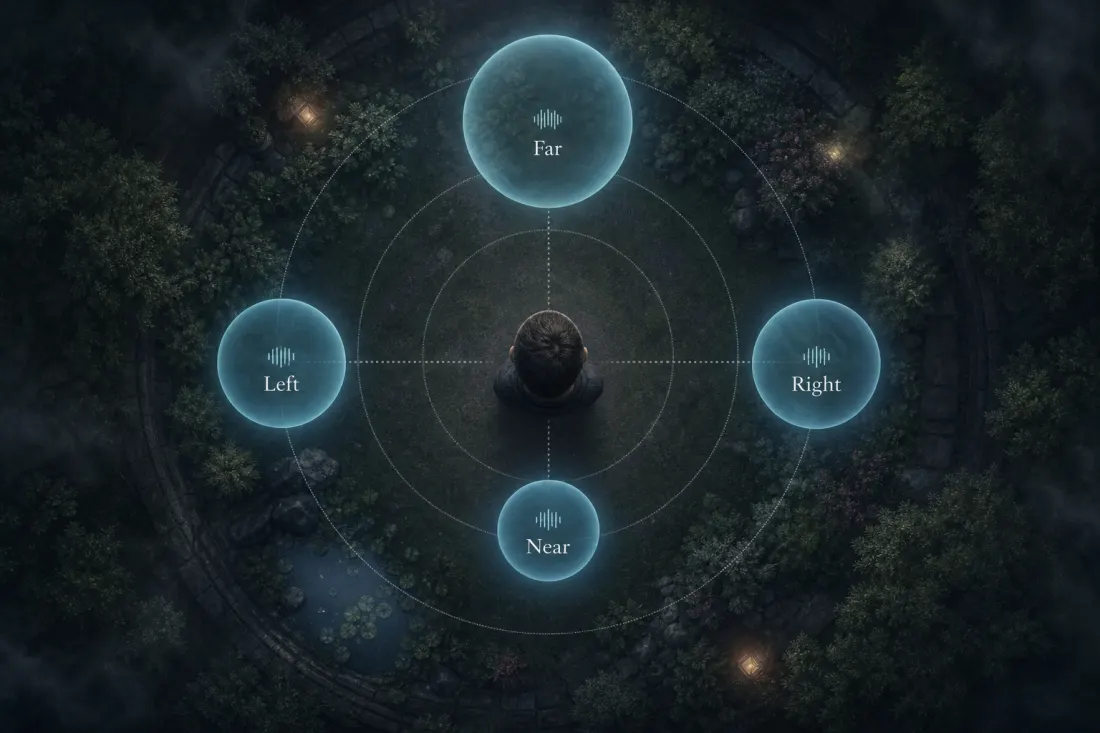
Drag back. Scroll depth. Raise Falloff so only near bubbles feel "in-room." High falloff is how you keep café murmur outside the window instead of at your desk.[13][16]
Default placement grammar: floors farthest; rain/stream mid; birds and insects far; bells and thunder very far unless you explicitly want weather drama; speech-like content farthest or popped.[17][20]
If moving a bubble back makes it disappear, lower competing layers before bringing it forward. Ninety percent of "in your face" problems are relative balance, not absolute distance.
Step 5 — Repetition, TimeLine, and when to pop
Independent bubbles with Drift, Tide, or Orbit paths keep statistics changing slowly — enough to defeat wallpaper, not enough to become a second task.[6][9] Chaos controls how unpredictable motion feels: low for sleep and focus; slightly higher if you need novelty for restless attention.[25][47]
Pop is not failure. Pop is editing. A garden is a living draft. If fireplace crackle wins a creativity session but ruins sleep, save two gardens — do not compromise one room into misery.
Step 6 — The full build session (45–60 minutes, once)
- New Garden or remix a close public garden → Start playing.
- Answer the six questions on paper — treble, bass, repetition, surprise, speech, hour test.
- Brown Noise tab → shape floor → Release as bubble → place far → ten-minute floor audition.
- Add one character layer that passed the hour test in your head — low volume, mid-far.
- Falloff pass: raise until only the nearest bed feels close.
- TimeLine: Drift or Tide; Chaos low unless you need stimulation.
- Walk away 15 minutes; return — pop or push back anything charismatic.
- Second character layer only if the first stayed invisible.
- Hour audition while doing your real task (read, sleep prep, code).
- Save. Name it for the job: "Desk grey mask + far rain", not "Cozy vibes 3".
Your build worksheet — copy this before you touch the library
Write answers down. Vague vibes produce vague gardens.
- Treble: High pitch annoys me? Y / N → if Y, brown-first, dark rain, far insects.
- Bass: Low rumble comforts me? Y / N → if N, avoid Floor Weight; try pink-grey.
- Repetition: Loops bore or irritate me? Y / N → if Y, Drift/Tide + pop charismatics.
- Surprise: Sudden sounds spike me? Y / N → if Y, low Chaos, no close thunder.
- Speech: I need focus or sleep? Y / N → if Y, no near café talk.
- Hour test: Sounds I can hear for hours: _______________
- Sounds that fail after 10 min: _______________
Room recipes — starting points, not finished rooms
All-night bedroom: brown floor far → sheet rain mid → optional one distant insect species at whisper volume → Falloff high → Drift, Chaos low.[6][26]
Deep work desk: grey or brown mask mid-far → distant rain or HVAC → pop all speech → Falloff high.[16][17]
Creative draft (not editing): moderate café or forest mid-far → brown floor soft → slightly higher Chaos acceptable.[25]
Cabin fantasy without pain: fireplace mid-far at 25–40% volume → brown bed far → wind farther → never two crackle layers near.[11]
Summer night: two different cricket/insect bubbles, both far, both quiet — never one hero cricket.[20]
Garden killers — and the fix that actually works
Killer: Everything centred in the canvas. Fix: scroll depth until the room has a back wall.[12]
Killer: Master Volume at "I can finally hear it." Fix: reset Master down; raise only the one layer that needs it.
Killer: Five character layers before a floor exists. Fix: mute all but brown; rebuild one at a time.
Killer: High cricket, close cricket, loud cricket. Fix: swap library sample for lower species; push back; cut volume in half.
Killer: Fireplace as the bed. Fix: brown carries continuity; fire is spice.
Killer: "It worked yesterday" at double volume. Fix: hearing adapts; return to yesterday's settings.[1]
Killer: Refusing to pop a pretty bubble. Fix: pop is editing; save a remix without it.
Library audition protocol (15 minutes)
- Open New Garden with only your brown floor running.
- Browse library; add one candidate bubble.
- Do not adjust for 60 seconds — notice immediate irritation.
- Set Volume to 35%; scroll to back third of depth.
- Wait five minutes while reading or working.
- If you looked at the player to complain, pop it.
- If you forgot it exists, keep it and name the bubble in your notes.
- Repeat for next candidate — max three new layers per session.
Save, remix, and version your rooms
Sign in and Save Garden when a mix survives an hour. Publish a /g/ link only when you would send it to a friend without warning them about spikes. Remix public organisms by popping half their cast — that is faster than blank-canvas building and teaches placement by ear.
Name gardens by function: Night brown + far rain, Desk grey mask, Read porcelain floor. Names shape future edits; "Cozy" tells you nothing six months later.
Interesting detail from the research
Irrelevant sound studies and soundscape standards agree on a split that maps perfectly to bubble mixing: continuous low-information beds support sustained tasks; intermittent high-information events steal working memory and orienting.[8][18][20] Your fireplace and cricket are not "good" or "bad" — they are either floor/weather (low information, far) or events (high information, near). Build accordingly.
Sound Bubbles tuning reference (worth learning once)
Master Volume sets the whole room. Start lower than you think — you can always raise one bubble instead of the entire garden.[21][22] Per-bubble Volume is how you balance layers without destroying dynamics: rain can stay audible while brown bed whispers.
Falloff is the secret weapon for speech and spike control. High falloff means only bubbles near the audible core sound “in your head”; everything else feels outside the window — exactly the intelligibility reduction office and sleep literature points toward.[1][16] If a layer feels too present, move it back before turning it up.
TimeLine adds slow environmental change so habituation does not turn your garden into wallpaper.[6][9] Pop anything that announces itself after ten minutes — a good garden should feel found, not performed.
Save & remix: when you find a mix that survives an hour, save it. Public medical and organism gardens are starting points; the best room is usually one you tuned for your desk, nursery, or bedside.
Why this supports Sound Bubbles — not just “any ambient app”
Most ambient apps deliver one file. The studies above rarely study “a loop.” They study continuous floors against irregular noise, unintelligible speech against memory tasks, nature scenes against stress markers, spatial streams against glued mashups, and slow environmental change against habituation.[6][11][17][26][27]
Sound Bubbles maps onto those findings deliberately: brown/noise beds for masking floors, nature and library layers for restorative structure, distance/Falloff for speech intelligibility control, and TimeLine motion so the garden keeps the statistics of a place instead of the statistics of a four-minute loop.[1][4][9][16] That is the practical reason the product feels different after the first hour — and the scientific reason the difference matters.
Recommended gardens — open in one click
These gardens match what this article describes. Each link opens the garden in the player — press Start playing and adjust Falloff if anything feels too close.
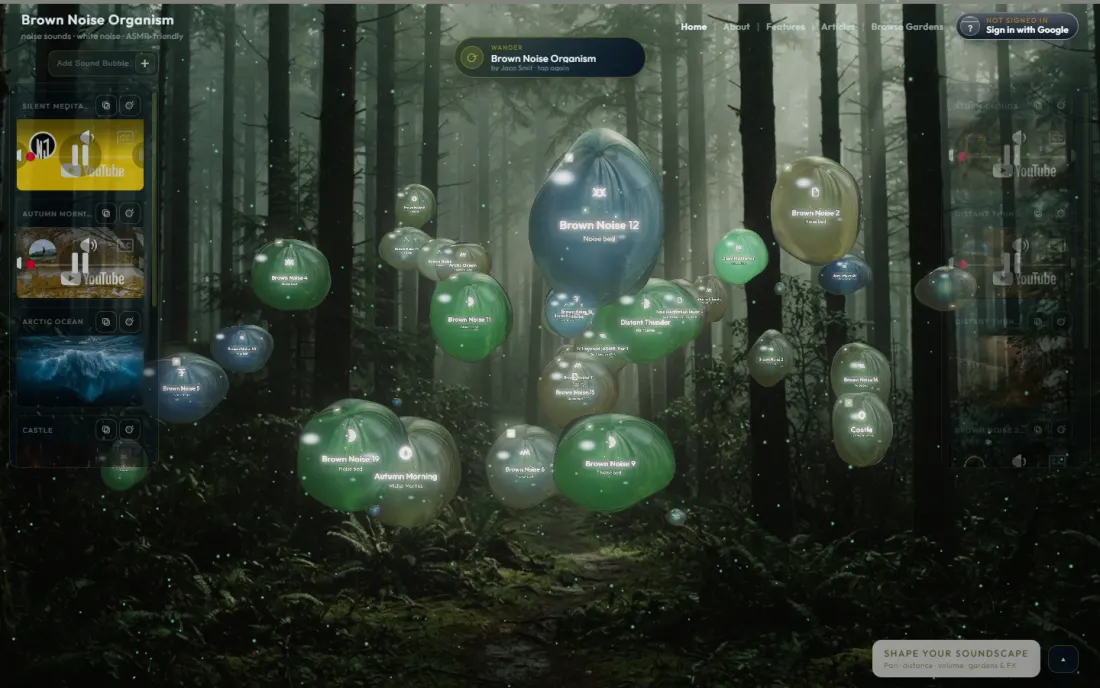
- Brown Noise OrganismRemix labThirty bubbles to pop, push back, and learn from — fastest way to understand floor vs character.Open garden →
- Layer Cake OrganismSpectrum A/BBrown, pink, white, grey as separate bubbles — answer treble/bass questions by ear.Open garden →
- Rain OrganismSheet rain vs brown floor — practice the one-layer-at-a-time build order.Open garden →
- Grey Fog OrganismNeutral office mask — desk garden starter when brown feels too heavy.Open garden →
- Forest OrganismBirds and stream at different depths — cricket/fireplace distance lessons without building from zero.Open garden →
- Living Drift OrganismTimeLine drift audition — repetition-sensitive listeners test Drift here.Open garden →
- Night Bed OrganismHour-test bedroom reference — boring in the best way; copy the floor grammar.Open garden →
- Clean Mask OrganismBright mask for speech-heavy offices — pair with high Falloff when coding.Open garden →
Browse all gardens · remix any public garden · save your own when you find the mix that fits.
How to apply this inside Sound Bubbles
- Open a related garden (or New Garden) and press Start playing so audio unlocks.[9]
- Expand Shape your soundscape → Sounds: set Master Volume, then Falloff while watching the audible-core guide.[10]
- Select a bubble; drag and scroll depth. Prefer raising one bubble’s Volume over blasting the whole room.[11]
- Add library rain, nature, or noise layers; keep speech-like content distant — or remove it — when you need reading or coding focus.[12]
- TimeLine: choose Drift, Tide, or Orbit when you want the garden to keep evolving without grabbing attention.[13]
- Brown Noise tab: shape a warm floor, optionally Release as bubble so it becomes spatial.[14]
- Save gardens that still feel kind after an hour — public gardens should stay soft, not startling.[15]
Limits, safety, and honest uncertainty
We do not claim ambient sound is a cure-all for focus, stress, or sleep.[16] What the product does offer is a listening architecture that matches how hearing and attention actually work: layered sources, spatial distance, and slow change instead of one brittle loop.[18][19]
If sound worsens symptoms, stop. If you need medical advice, see a clinician. If you want a softer room, open a garden, place the bubbles kindly, and stay honest about what sound can — and cannot — do.[20][21]
How this article was researched
We combine first-hand experience placing and tuning Sound Bubbles gardens with citations from peer-reviewed journals, reviews, and institutional pages (including NIH/NCBI, sleep and hearing literature, acoustics, and attention research). Where evidence is mixed or early, we say so. On wellbeing topics we stay cautious: these are companion soundscapes, not cures.
References
Sources cited in this article. Prefer primary literature and institutional guidance; Sound Bubbles is not a medical device and these citations do not imply clinical endorsement.
- (2012). An Introduction to the Psychology of Hearing (masking & loudness). Brill.
- (1999). Psychoacoustics: Facts and Models. Springer.
- (1933). Loudness, its definition, measurement and calculation. Journal of the Acoustical Society of America. doi:10.1121/1.1915637
- (2024). Colors of noise (white, pink, brown definitions). Encyclopedic / signal processing.
- (2013). American National Standard acoustical terminology (masking). ANSI.
- (2009). Habituation revisited: an updated and revised description. Neurobiology of Learning and Memory. doi:10.1016/j.nlm.2008.09.015
- (2009). Habituation: a history. Neurobiology of Learning and Memory.
- (1963). Perception and the conditioned reflex (orienting response). Pergamon Press.
- (2010). The free-energy principle: a unified brain theory?. Nature Reviews Neuroscience. doi:10.1038/nrn2787
- (2013). Whatever next? Predictive brains, situated agents. Behavioral and Brain Sciences. doi:10.1017/S0140525X12000477
- (1990). Auditory Scene Analysis. MIT Press.
- (1997). Spatial Hearing: The Psychophysics of Human Sound Localization. MIT Press.
- (1991). Sound localization by human listeners. Annual Review of Psychology.
- (2012). Spatial hearing and binaural advantage. Acoustics Today / related.
- (2000). 3-D Sound for Virtual Reality and Multimedia. NASA / Academic Press.
- (2005). A model predicting the effect of speech of varying intelligibility on work performance. Indoor Air. doi:10.1111/j.1600-0668.2005.00391.x
- (2001). Auditory distraction and short-term memory: Phenomena and practical implications. Human Factors. doi:10.1518/001872001775992390
- (2015). The impact of background speech on reading and memory. Noise & Health / related work.
- (2006). Sweet Anticipation: Music and the Psychology of Expectation. MIT Press.
- (2014). Acoustics — Soundscape — Part 1: Definition and conceptual framework. ISO 12913-1.
- (2021). World report on hearing. WHO.
- (2023). Noise and hearing loss prevention. CDC.
- (2014). Auditory and non-auditory effects of noise on health. The Lancet. doi:10.1016/S0140-6736(13)61613-X
- (2012). Is noise always bad? Exploring the effects of ambient noise on creative cognition. Journal of Consumer Research. doi:10.1086/665048
- (2005). The influence of white noise on sleep in subjects exposed to ICU noise. Sleep Medicine. doi:10.1016/j.sleep.2004.12.004
- (2010). Stress recovery during exposure to nature sound and environmental noise. IJERPH. doi:10.3390/ijerph7031036
- (1953). Some experiments on the recognition of speech, with one and with two ears. Journal of the Acoustical Society of America. doi:10.1121/1.1907229
- (2010). The effects of background white noise on memory performance in inattentive school children. Behavioral and Brain Functions. doi:10.1186/1744-9081-6-55