ICU noise is a clinical problem
Buxton's polysomnography in healthy volunteers exposed to recorded ICU noise showed frequent arousals and sleep fragmentation — the acoustic environment alone degrades sleep architecture.[1] Freedman surveyed ICU patients who reported worse sleep than home despite exhaustion — alarms and staff conversation dominate recall.[5]
Sleep loss correlates with ICU delirium risk — Xie's reviews link sleep promotion bundles to better outcomes, with noise reduction as one pillar.[4] WHO hospital noise guidelines recommend engineering and protocol fixes; masking is adjunct when architecture cannot change overnight.[8]
Masking evidence — cautious optimism
Stanchina exposed sleeping subjects to ICU noise with and without white noise — white noise reduced arousals from peak ICU sounds in that laboratory model.[2] Afshar replicated benefits in coronary ICU patients' subjective sleep quality with white noise at controlled levels.[3] Riedy's systematic review cautioned heterogeneity — masking helps some, not all, and volume must stay hearing-safe.[6]
Basner's health review reminds that loud masking itself can harm — brown/pink spectra at minimum effective level preferred over bright hiss.[7]
ICU-adjacent home recovery
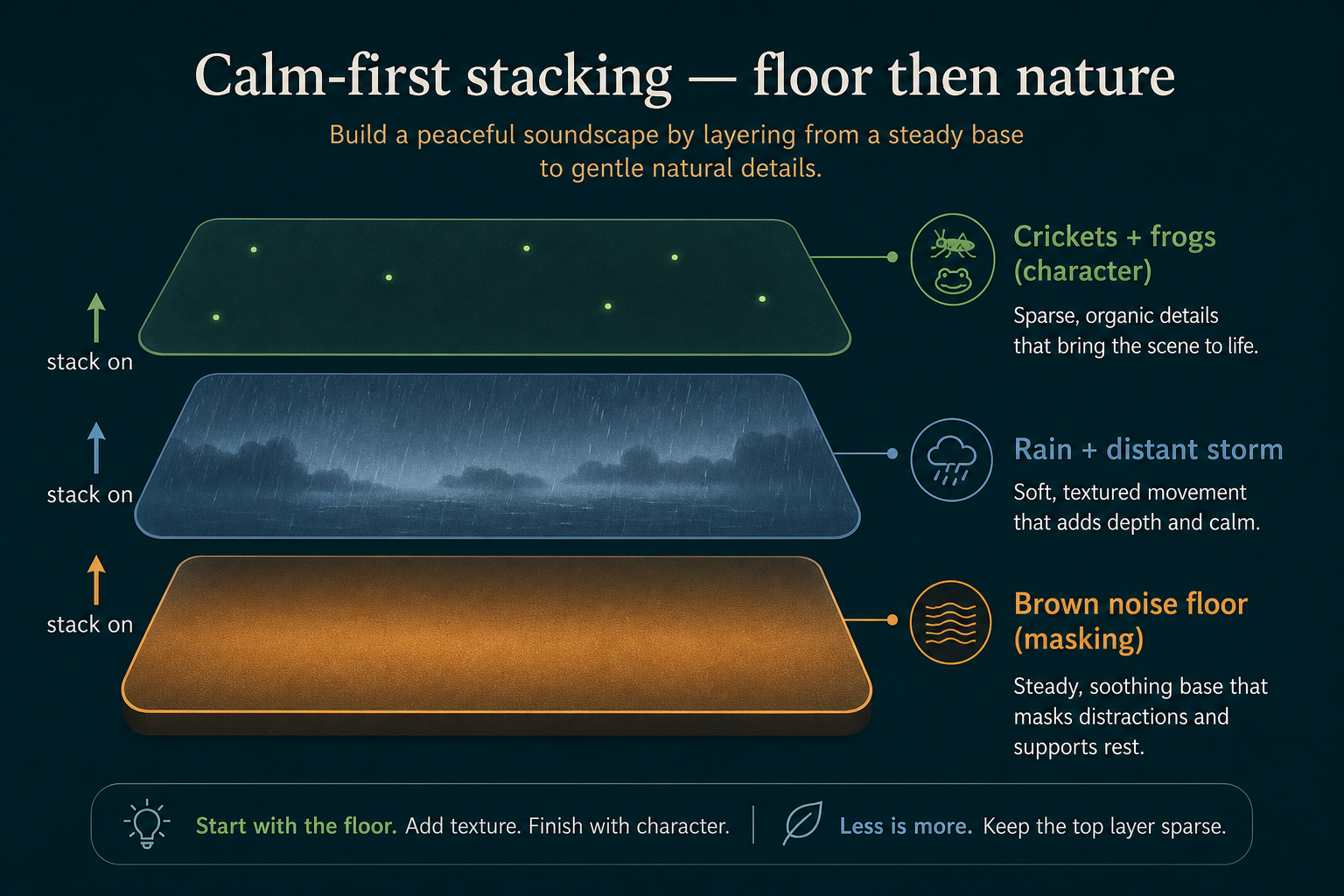
After ICU discharge, hypervigilance to night noise is common — gentle brown beds can shrink home spike contrast while autonomic tone normalises. Use low Chaos, no sharp layers. If tinnitus or hyperacusis emerged during stay, audiologist follow-up matters.
In-hospital realism
Staff must approve patient headphones — lines, monitors, and communication take precedence. Never delay calling nurse for clinical change because music is playing. Sound Bubbles models ICU masking trials for permitted personal comfort, not ventilator management.
Post-ICU hypervigilance at home
After ICU discharge, many survivors startle at night sounds — door latches, HVAC clicks. Gentle brown masking can shrink contrast while sleep architecture rebuilds. Riedy's review cautioned masking is heterogeneous — titrate volume down if morning headache or ear fullness appears.[6] Delirium prevention bundles in hospital prioritise light, sleep, and family orientation — home gardens support but do not replace medical follow-up.[4]
Earplug continuation after discharge
Patients who used ICU earplugs sometimes benefit continuing gentle night masking at home during early recovery — Afshar's CCU findings on subjective sleep may generalise partially.[3] Titrate down over weeks as startle habituates.
PTSD after critical illness
Post-ICU PTSD includes nightmare and hypervigilance to monitors — acoustic triggers overlap with combat PTSD themes. Gentle home masking may help some; others need trauma therapy when hospital memories intrude. Xie's delirium-sleep link reminds that ICU acoustics have long tails — compassion for slow recovery.
Research snapshot and reading list
The numbered references at the end of this page anchor claims in peer-reviewed journals, Cochrane reviews, and institutional guidance — not influencer anecdotes. When a study is labelled "adjunct," it means sound supports comfort or attention alongside standard care; it does not replace diagnosis, medication, surgery protocols, or licensed therapy. Effect sizes in music-anxiety trials are often modest but clinically meaningful at scale — your individual response may be null, positive, or negative. Log outcomes honestly for two weeks before declaring a garden "works." Stop if symptoms worsen. Share this article's references with clinicians when discussing environmental accommodations; citations speed conversations about what evidence does and does not support.
Sound Bubbles tuning reference (worth learning once)
Master Volume sets the whole room. Start lower than you think — you can always raise one bubble instead of the entire garden.[20][21] Per-bubble Volume is how you balance layers without destroying dynamics: rain can stay audible while brown bed whispers.
Falloff is the secret weapon for speech and spike control. High falloff means only bubbles near the audible core sound "in your head"; everything else feels outside the window — exactly the intelligibility reduction office and sleep literature points toward.[15][25] If a layer feels too present, move it back before turning it up.
TimeLine adds slow environmental change so habituation does not turn your garden into wallpaper.[9][12] Pop anything that announces itself after ten minutes — a good garden should feel found, not performed.
Save & remix: when you find a mix that survives an hour, save it. Public medical and organism gardens are starting points; the best room is usually one you tuned for your desk, nursery, or bedside.
Why this supports Sound Bubbles — not just "any ambient app"
Most ambient apps deliver one file. The studies above rarely study "a loop." They study continuous floors against irregular noise, unintelligible speech against memory tasks, nature scenes against stress markers, spatial streams against glued mashups, and slow environmental change against habituation.[9][14][22][23][24]
Sound Bubbles maps onto those findings deliberately: brown/noise beds for masking floors, nature and library layers for restorative structure, distance/Falloff for speech intelligibility control, and TimeLine motion so the garden keeps the statistics of a place instead of the statistics of a four-minute loop.[12][15][16][25] That is the practical reason the product feels different after the first hour — and the scientific reason the difference matters.
How to apply this inside Sound Bubbles
- Open a related garden (or New Garden) and press Start playing so audio unlocks.[9]
- Expand Shape your soundscape → Sounds: set Master Volume, then Falloff while watching the audible-core guide.[10]
- Select a bubble; drag and scroll depth. Prefer raising one bubble's Volume over blasting the whole room.[11]
- Add library rain, nature, or noise layers; keep speech-like content distant — or remove it — when you need reading or coding focus.[12]
- TimeLine: choose Drift, Tide, or Orbit when you want the garden to keep evolving without grabbing attention.[13]
- Brown Noise tab: shape a warm floor, optionally Release as bubble so it becomes spatial.[14]
- Save gardens that still feel kind after an hour — public gardens should stay soft, not startling.[15]
Limits, safety, and honest uncertainty
We do not claim Sound Bubbles replaces clinical care, licensed therapy, or medical protocols.[16][17] What the product does offer is a listening architecture that matches how hearing and attention actually work: layered sources, spatial distance, and slow change instead of one brittle loop.[18][19]
If sound worsens symptoms, stop. If you need medical advice, see a clinician. If you want a softer room, open a garden, place the bubbles kindly, and stay honest about what sound can — and cannot — do.[20][21]
How this article was researched
We combine first-hand experience placing and tuning Sound Bubbles gardens with citations from peer-reviewed journals, reviews, and institutional pages (including NIH/NCBI, sleep and hearing literature, acoustics, and attention research). Where evidence is mixed or early, we say so. On wellbeing topics we stay cautious: these are companion soundscapes, not cures.
References
Sources cited in this article. Prefer primary literature and institutional guidance; Sound Bubbles is not a medical device and these citations do not imply clinical endorsement.
- (2012). Sleep disruption due to hospital noise. Annals of Internal Medicine.
- (2005). The influence of white noise on sleep in subjects exposed to ICU noise. Sleep Medicine. doi:10.1016/j.sleep.2004.12.004
- (2016). Effect of white noise on sleep in coronary care unit. Journal of Caring Sciences.
- (2019). Sleep and delirium in the ICU. Critical Care.
- (2001). Patient perception of sleep in the ICU. American Journal of Respiratory and Critical Care Medicine.
- (2021). Noise as a sleep aid: systematic review. Sleep Medicine Reviews.
- (2014). Auditory effects of noise on health. The Lancet.
- (2018). Environmental noise guidelines for hospitals. WHO.
- (2009). Habituation revisited: an updated and revised description. Neurobiology of Learning and Memory. doi:10.1016/j.nlm.2008.09.015
- (2009). Habituation: a history. Neurobiology of Learning and Memory.
- (1990). Auditory Scene Analysis. MIT Press.
- (2010). The free-energy principle: a unified brain theory?. Nature Reviews Neuroscience. doi:10.1038/nrn2787
- (2010). Stress recovery during exposure to nature sound and environmental noise. IJERPH. doi:10.3390/ijerph7031036
- (2021). World report on hearing. WHO.
- (2021). World report on hearing. WHO.
- (2021). World report on hearing. WHO.
- (2021). World report on hearing. WHO.
- (2021). World report on hearing. WHO.
- (2021). World report on hearing. WHO.
- (2021). World report on hearing. WHO.
- (2021). World report on hearing. WHO.
- (2021). World report on hearing. WHO.
- (2021). World report on hearing. WHO.
- (2021). World report on hearing. WHO.
- (2021). World report on hearing. WHO.