The default mode network in plain language
When you are not focused on an external task, a constellation of brain regions — the default mode network (DMN) — tends to increase activity. Buckner and colleagues mapped its anatomy and argued it supports autobiographical memory, future simulation, and social cognition.[1] Raichle's reviews popularised the idea that the brain has a baseline "idling" mode that is anything but passive: it is the infrastructure of mind-wandering.[3]
Andrews-Hanna emphasised that DMN activity is adaptive when it supports planning and self-understanding, but maladaptive when it fuels rumination loops tied to depression and anxiety.[4] Whether mind-wandering feels restorative or corrosive depends on content, context, and whether attention can return to task without friction.
What naturalistic sound does to the DMN
Gould van Praag and colleagues put participants in fMRI while they listened to naturalistic versus artificial soundscapes. Natural sounds were associated with outward-directed attention patterns and connectivity shifts distinct from artificial scenes — interpreted as reduced rumination-linked DMN coupling during preferred nature audio.[2] The study is not a prescription to "fix" depression with birdsong, but it is rare direct evidence that the statistics of a soundscape nudge large-scale network organisation.
Kaplan's Attention Restoration Theory predicted this direction decades earlier: soft fascination in nature replenishes directed attention without demanding executive effort.[5] Jo and colleagues linked resting-state fluctuations to mind-wandering reports — the DMN is where worry goes when the outside world stops asking questions.[6] A gentle acoustic scene can give the DMN something low-threat to orbit instead of chewing yesterday's conversation.
Artificial loops versus living environments
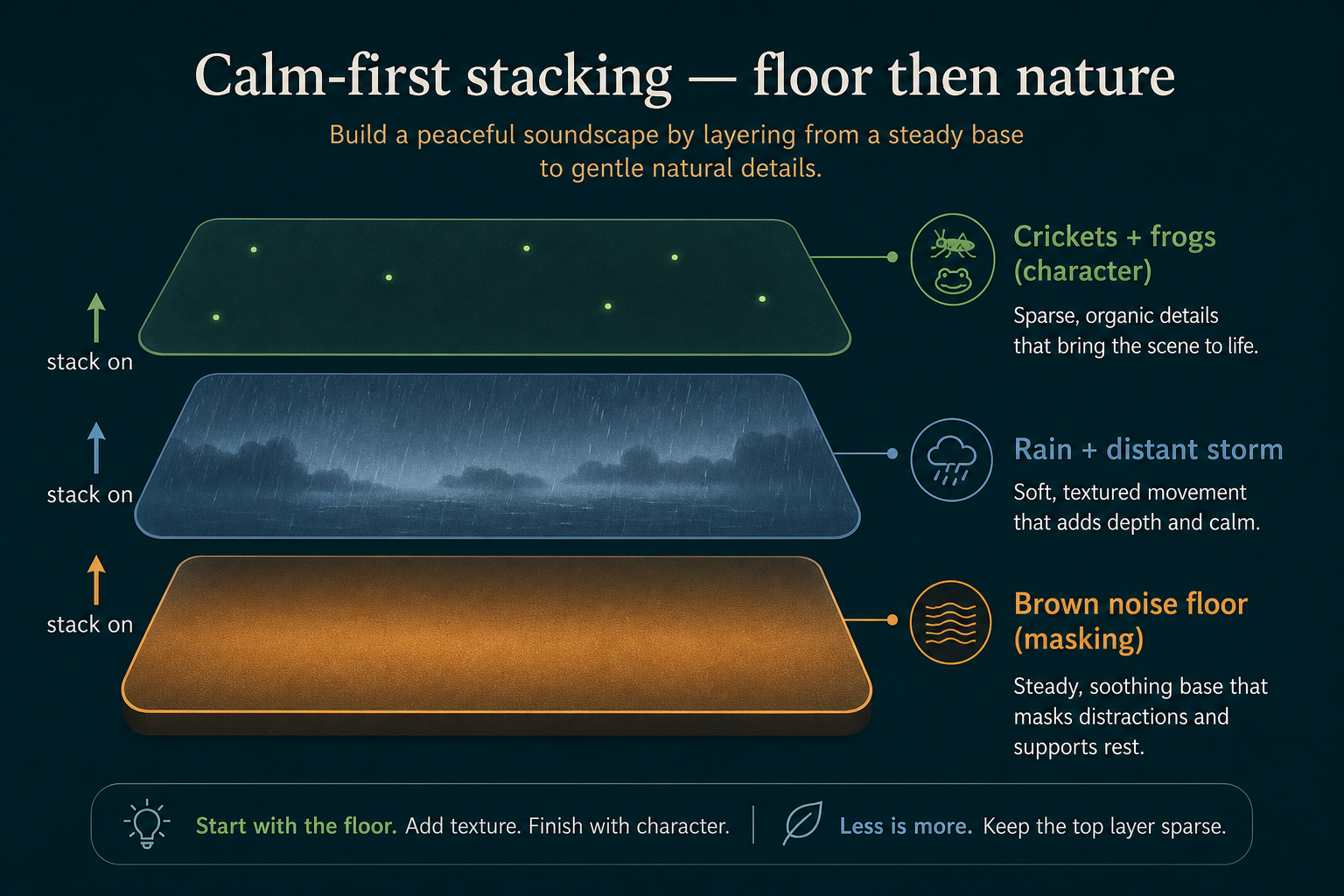
Artificial sound in Gould van Praag's design tended toward synthetic textures; naturalistic streams included spatially rich environmental audio. Predictive-processing accounts suggest overly regular loops become ignored or irritating — neither supports soft fascination.[9][12] Scene analysis explains why separated rain, birds, and brown beds feel like a place: the brain models an environment, not a file.[14]
Meditation research shows experienced practitioners regulate DMN-related circuits differently during focused attention — sound can support or sabotage that regulation depending on surprise and salience.[7] A sharp loop seam is a micro-orienting event that re-recruits DMN-linked self-referential thought: "Why did that click happen? Do I need to fix my app?"
Practical listening for rumination-prone minds
- Prefer nature-organism gardens with soft fascination — motion without narrative.[2][5]
- Keep speech absent when DMN rumination is the enemy — lyrics re-open autobiographical channels.[22]
- Use low Chaos TimeLine — drift without deviants.[9]
- If mind-wandering spikes, lower volume; DMN escalation often tracks arousal.[19]
DMN, sleep onset, and evening gardens
Evening rumination often spikes when external tasks stop and the DMN gains bandwidth. Soft rain or brown beds at low volume can give the brain a neutral acoustic texture — not silence, which some anxious listeners find amplifying. The goal is not to silence mind-wandering but to prevent each thought from chaining into orienting toward house sounds.[2][5] Keep Chaos minimal after 9pm; deviants that feel fine at noon can reopen worry loops at night.
Sound Bubbles tuning reference (worth learning once)
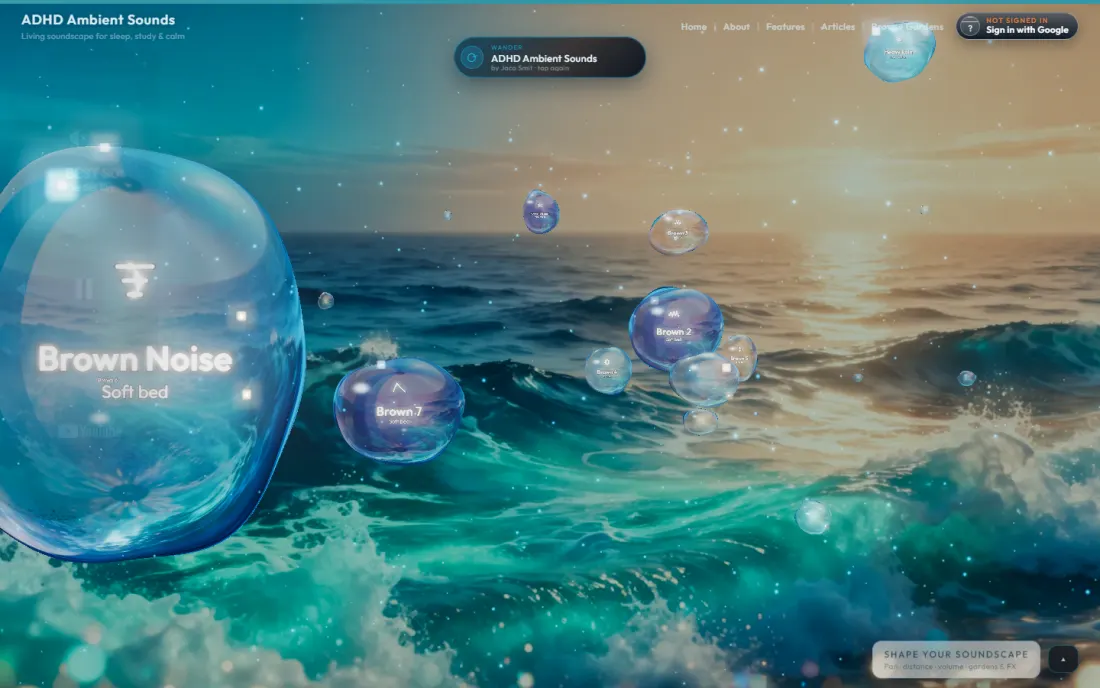
Master Volume sets the whole room. Start lower than you think — you can always raise one bubble instead of the entire garden.[20][21] Per-bubble Volume is how you balance layers without destroying dynamics: rain can stay audible while brown bed whispers.
Falloff is the secret weapon for speech and spike control. High falloff means only bubbles near the audible core sound "in your head"; everything else feels outside the window — exactly the intelligibility reduction office and sleep literature points toward.[15][25] If a layer feels too present, move it back before turning it up.
TimeLine adds slow environmental change so habituation does not turn your garden into wallpaper.[9][12] Pop anything that announces itself after ten minutes — a good garden should feel found, not performed.
Save & remix: when you find a mix that survives an hour, save it. Public medical and organism gardens are starting points; the best room is usually one you tuned for your desk, nursery, or bedside.
Why this supports Sound Bubbles — not just "any ambient app"
Most ambient apps deliver one file. The studies above rarely study "a loop." They study continuous floors against irregular noise, unintelligible speech against memory tasks, nature scenes against stress markers, spatial streams against glued mashups, and slow environmental change against habituation.[9][14][22][23][24]
Sound Bubbles maps onto those findings deliberately: brown/noise beds for masking floors, nature and library layers for restorative structure, distance/Falloff for speech intelligibility control, and TimeLine motion so the garden keeps the statistics of a place instead of the statistics of a four-minute loop.[12][15][16][25] That is the practical reason the product feels different after the first hour — and the scientific reason the difference matters.
How to apply this inside Sound Bubbles
- Open a related garden (or New Garden) and press Start playing so audio unlocks.[9]
- Expand Shape your soundscape → Sounds: set Master Volume, then Falloff while watching the audible-core guide.[10]
- Select a bubble; drag and scroll depth. Prefer raising one bubble's Volume over blasting the whole room.[11]
- Add library rain, nature, or noise layers; keep speech-like content distant — or remove it — when you need reading or coding focus.[12]
- TimeLine: choose Drift, Tide, or Orbit when you want the garden to keep evolving without grabbing attention.[13]
- Brown Noise tab: shape a warm floor, optionally Release as bubble so it becomes spatial.[14]
- Save gardens that still feel kind after an hour — public gardens should stay soft, not startling.[15]
Limits, safety, and honest uncertainty
We do not claim Sound Bubbles replaces clinical care, licensed therapy, or medical protocols.[16][17] What the product does offer is a listening architecture that matches how hearing and attention actually work: layered sources, spatial distance, and slow change instead of one brittle loop.[18][19]
If sound worsens symptoms, stop. If you need medical advice, see a clinician. If you want a softer room, open a garden, place the bubbles kindly, and stay honest about what sound can — and cannot — do.[20][21]
How this article was researched
We combine first-hand experience placing and tuning Sound Bubbles gardens with citations from peer-reviewed journals, reviews, and institutional pages (including NIH/NCBI, sleep and hearing literature, acoustics, and attention research). Where evidence is mixed or early, we say so. On wellbeing topics we stay cautious: these are companion soundscapes, not cures.
References
Sources cited in this article. Prefer primary literature and institutional guidance; Sound Bubbles is not a medical device and these citations do not imply clinical endorsement.
- (2008). The brain's default network: anatomy, function, and relevance to disease. Annals of the New York Academy of Sciences. doi:10.1196/annals.1440.011
- (2017). Mind-wandering and alterations to default mode network connectivity when listening to naturalistic versus artificial sounds. Scientific Reports. doi:10.1038/srep45273
- (2015). The brain's default mode network. Annual Review of Neuroscience. doi:10.1146/annurev-neuro-071013-014030
- (2012). The brain's default network and its adaptive role in internal mentation. Neuroscientist.
- (1995). The restorative benefits of nature: Toward an integrative framework. Journal of Environmental Psychology. doi:10.1016/0272-4944(95)90001-2
- (2016). Mind-wandering and the resting brain. Frontiers in Psychology.
- (2008). Attention regulation and monitoring in meditation. Trends in Cognitive Sciences. doi:10.1016/j.tics.2008.01.005
- (2011). Brainwise: Studies in Neurophilosophy. MIT Press.
- (2009). Habituation revisited: an updated and revised description. Neurobiology of Learning and Memory. doi:10.1016/j.nlm.2008.09.015
- (2009). Habituation: a history. Neurobiology of Learning and Memory.
- (1990). Auditory Scene Analysis. MIT Press.
- (2010). The free-energy principle: a unified brain theory?. Nature Reviews Neuroscience. doi:10.1038/nrn2787
- (2010). Stress recovery during exposure to nature sound and environmental noise. IJERPH. doi:10.3390/ijerph7031036
- (2021). World report on hearing. WHO.
- (2021). World report on hearing. WHO.
- (2021). World report on hearing. WHO.
- (2021). World report on hearing. WHO.
- (2021). World report on hearing. WHO.
- (2021). World report on hearing. WHO.
- (2021). World report on hearing. WHO.
- (2021). World report on hearing. WHO.
- (2021). World report on hearing. WHO.
- (2021). World report on hearing. WHO.
- (2021). World report on hearing. WHO.
- (2021). World report on hearing. WHO.