
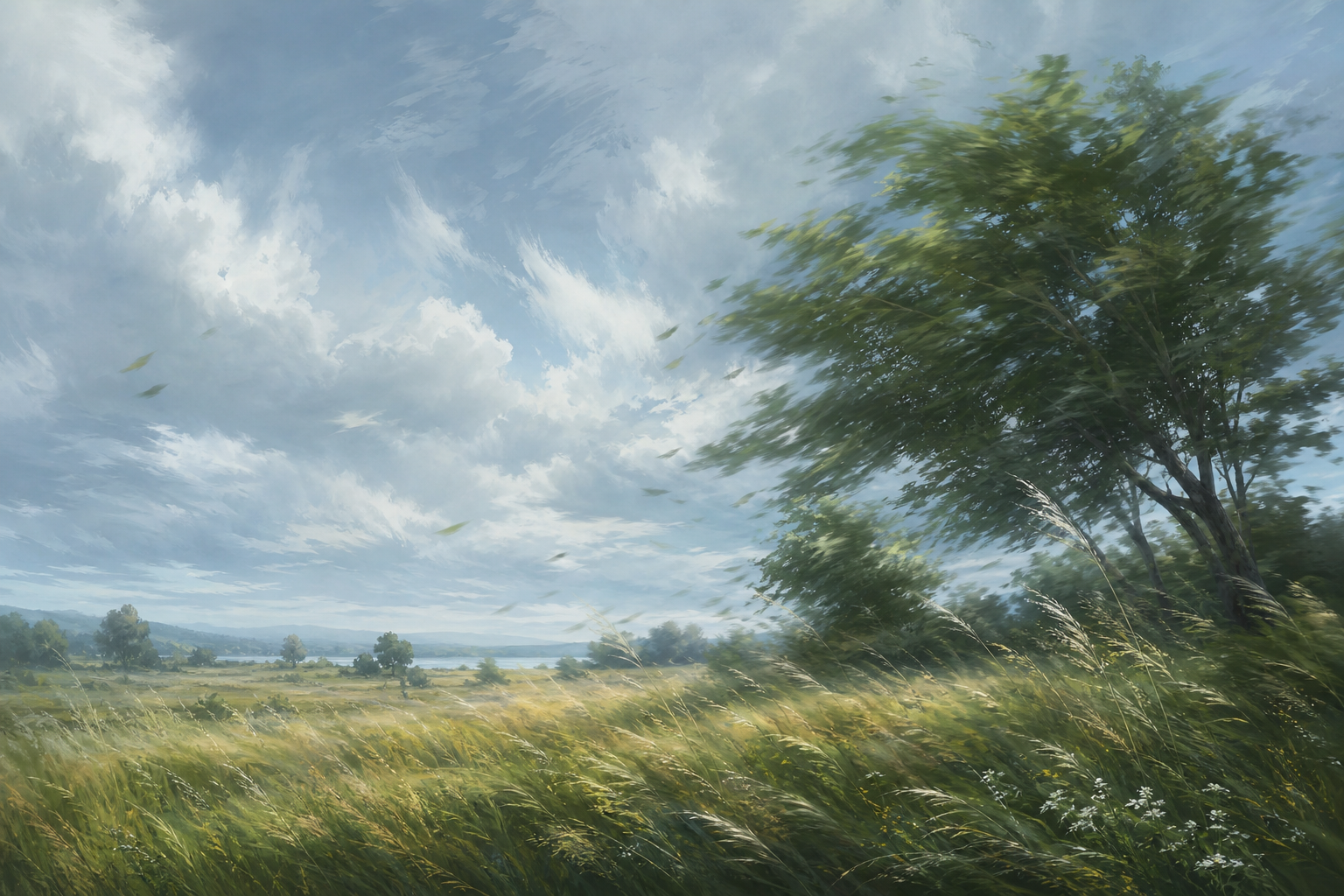
Ocean as three layers, not one wave
Natural surf stacks: (1) deep infrasonic and low-frequency surge felt more than heard, (2) mid-band breaker energy, (3) high foam and spray. Moore and Zwicker describe how low-frequency masking anchors perception while mid-high transients carry salience.[3][7] Collapsing all bands into one normalized MP3 forces mid surf to carry the entire scene — exhausting for serial attention.[8]
ISO soundscape framing treats coastal environments as multi-source scenes — horizon, shore, air — not a single loop.[8] Sound Bubbles bubbles map to those strata.
Brown floor as depth anchor
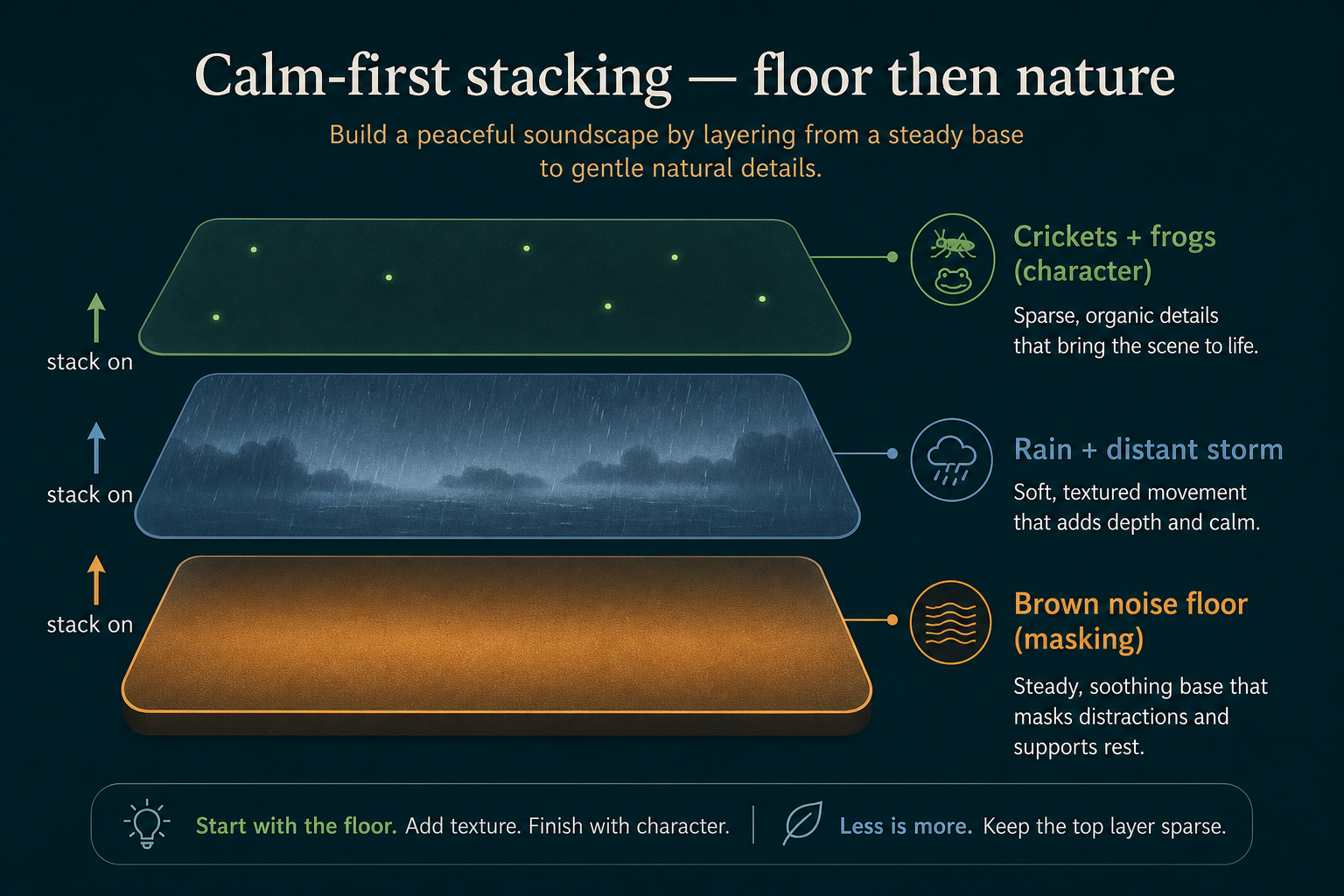
Brown noise (−6 dB per octave slope) supplies continuous rumble analogous to distant surge without repeating wave samples.[15][16] Stanchina proved continuous beds improve sleep against spike noise; ocean surge plays the same structural role for urban bedrooms.[5]
Layer brown at whisper level first; add surf bubble forward with falloff so breakers read "on sand" while brown reads "in chest/body." Bregman location cues maintain separability.[1]
Surf bubble: placement and level
Surf transients have fast attack — Sokolov's orienting response literature applies to sudden level jumps.[11] Keep surf bubble below conversational level; if breakers startle, reduce surf not brown. Riedy's systematic review supports continuous nature-like beds for onset and continuity in noisy settings — modest objective effects, stronger subjective masking.[4]
High falloff pushes surf toward virtual horizon — essential for reading and sleep where foreground waves destroy phonological loop stability.[8][23]
Habituation and TimeLine on long sessions
Rankin notes fully predictable stimuli lose efficacy.[6] Ocean loops that repeat identical breaker timing become hypnotic then seam-detectable.[9][10] TimeLine Orbit or Tide varies statistics slowly — tide metaphor fits coastal gardens.[13]
Alvarsson's recovery paradigm used nature sound at matched SPL — irregularity within bounds aids restoration without requiring silence.[2]
Sleep versus focus tuning
Sleep: brown-dominant, surf at 15–25% of perceived loudness, no gulls close-mic'd (sharp transients). Riedy cautions noise aids are environmental support, not insomnia cure.[4]
Focus: reduce surf further; brown plus distant surf equals café-like moderate noise without speech — Banbury irrelevant speech avoided.[23]
Recovery: slightly more surf motion acceptable for ten-minute breaks — autonomic markers improved with nature vs traffic in Alvarsson.[2]
Combining gulls, wind, and rain
Each species gets spatial slot — gulls high/rear, wind wide, surf forward-low. Fusion at centre mono increases deviance tracking.[1] Limit one "sharp" layer at a time for hyperfocus tasks.
Dose and hearing health
Basner and WHO contexts apply: overnight ocean at loud levels still contributes to dose.[19][20] Comfort cap beats realism fantasy — you are not on a storm beach; you are in a bedroom.
Recipe
- Brown bed rear-centre, whisper.[15]
- Surf bubble forward, falloff high.[14]
- Optional distant gull single bubble, very low.[1]
- TimeLine Tide enabled.[13]
- 60-minute test; surf down if seam noticed.[6]
Ocean layering is companion soundscape design — not blue-noise therapy, not clinical anxiety treatment.[20]
Companion listening in Sound Bubbles
Research above concerns clinical and laboratory sound — not a playlist guarantee. Sound Bubbles offers adjustable living gardens: spatial layers, coloured noise beds, Medical & Wellbeing rooms, and easy mute. Use recommended gardens as environmental support alongside medical care when appropriate.[20]
Not treatment. See clinicians for diagnosis, medication, CBT, neurologic music therapy, or tinnitus programmes. Keep volume comfortable; stop if symptoms worsen.
Why this supports Sound Bubbles — not just "any ambient app"
Most ambient apps deliver one file. The studies above rarely study "a loop." They study continuous floors against irregular noise, unintelligible speech against memory tasks, nature scenes against stress markers, spatial streams against glued mashups, and slow environmental change against habituation.[9][14][22][23][24]
Sound Bubbles maps onto those findings deliberately: brown/noise beds for masking floors, nature and library layers for restorative structure, distance/Falloff for speech intelligibility control, and TimeLine motion so the garden keeps the statistics of a place instead of the statistics of a four-minute loop.[12][15][16][25] That is the practical reason the product feels different after the first hour — and the scientific reason the difference matters.
How to apply this inside Sound Bubbles
- Open a related garden (or New Garden) and press Start playing so audio unlocks.[9]
- Expand Shape your soundscape → Sounds: set Master Volume, then Falloff while watching the audible-core guide.[10]
- Select a bubble; drag and scroll depth. Prefer raising one bubble's Volume over blasting the whole room.[11]
- Add library rain, nature, or noise layers; keep speech-like content distant — or remove it — when you need reading or coding focus.[12]
- TimeLine: choose Drift, Tide, or Orbit when you want the garden to keep evolving without grabbing attention.[13]
- Brown Noise tab: shape a warm floor, optionally Release as bubble so it becomes spatial.[14]
- Save gardens that still feel kind after an hour — public gardens should stay soft, not startling.[15]
Limits, safety, and honest uncertainty
We do not claim Sound Bubbles replaces clinical care, sleep medicine, occupational health programmes, or psychiatric treatment.[1][7] What the product does offer is a listening architecture that matches how hearing and attention actually work: layered sources, spatial distance, and slow change instead of one brittle loop.[18][19]
If sound worsens symptoms, stop. If you need medical advice, see a clinician. If you want a softer room, open a garden, place the bubbles kindly, and stay honest about what sound can — and cannot — do.[20][21]
How this article was researched
We combine first-hand experience placing and tuning Sound Bubbles gardens with citations from peer-reviewed journals, reviews, and institutional pages (including NIH/NCBI, sleep and hearing literature, acoustics, and attention research). Where evidence is mixed or early, we say so. On wellbeing topics we stay cautious: these are companion soundscapes, not cures.
References
Sources cited in this article. Prefer primary literature and institutional guidance; Sound Bubbles is not a medical device and these citations do not imply clinical endorsement.
- (1990). Auditory Scene Analysis. MIT Press.
- (2010). Stress recovery with nature sound. IJERPH. doi:10.3390/ijerph7031036
- (2012). An Introduction to the Psychology of Hearing. Brill.
- (2021). Noise as a sleep aid: systematic review. Sleep Medicine Reviews. doi:10.1016/j.smrv.2020.101385
- (2005). White noise on sleep with ICU noise exposure. Sleep Medicine. doi:10.1016/j.sleep.2004.12.004
- (2009). Habituation revisited. Neurobiology of Learning and Memory. doi:10.1016/j.nlm.2008.09.015
- (1999). Psychoacoustics: Facts and Models. Springer.
- (2014). Soundscape — Definition and conceptual framework. ISO.
- (2009). Habituation revisited. Neurobiology of Learning and Memory. doi:10.1016/j.nlm.2008.09.015
- (2009). Habituation: a history. Neurobiology of Learning and Memory.
- (1963). Perception and the conditioned reflex. Pergamon Press.
- (2010). The free-energy principle. Nature Reviews Neuroscience. doi:10.1038/nrn2787
- (2013). Whatever next? Predictive brains. Behavioral and Brain Sciences. doi:10.1017/S0140525X12000477
- (1990). Auditory Scene Analysis. MIT Press.
- (2012). An Introduction to the Psychology of Hearing. Brill.
- (2024). Colors of noise. Encyclopedic.
- (2013). Acoustical terminology (masking). ANSI.
- (2014). Auditory and non-auditory effects of noise on health. The Lancet. doi:10.1016/S0140-6736(13)61613-X
- (2021). World report on hearing. WHO.
- (2023). Noise and hearing loss prevention. CDC.
- (2005). White noise on sleep with ICU noise exposure. Sleep Medicine. doi:10.1016/j.sleep.2004.12.004
- (2001). Auditory distraction and short-term memory. Human Factors. doi:10.1518/001872001775992390
- (2010). Stress recovery with nature sound. IJERPH. doi:10.3390/ijerph7031036
- (2005). Speech intelligibility and work performance. Indoor Air. doi:10.1111/j.1600-0668.2005.00391.x