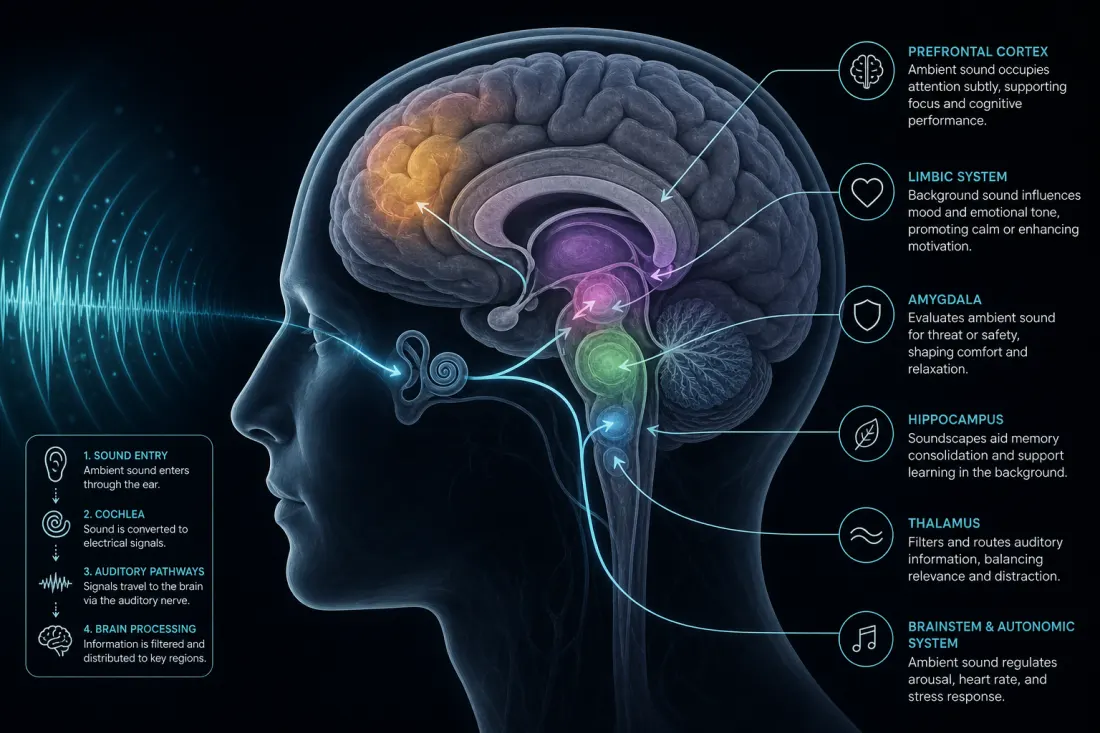

What Deutsch demonstrated
Deutsch's phantom words paradigm alternates isolated syllables or short words across ears in repeating patterns. After sustained listening, coherent pseudo-words emerge — "no way," "quite all right," or idiosyncratic phrases unique to each listener.[1] The illusion depends on stereo separation, repetition, and lexical expectation: phonetic fragments become glued by top-down language networks.[2] Changing which ear leads or shifting attention can flip the perceived phrase without any acoustic change — proof that cognition, not the file alone, supplies meaning.
Moore's psychoacoustics texts place such effects in the broader category of informational masking and perceptual organisation: when grouping cues are weak, higher-level models dominate.[3] Näätänen and Winkler's representational framework predicted that repeated fragments build memory traces that bias toward familiar word forms.[4]
Verbal transformation and auditory pareidolia
Related "verbal transformation" effects show that looping ambiguous phrases ("life" vs "night") causes perceptual flips — the acoustic signal is stable while conscious content reorganises.[2] Phantom words extend that logic across ears: each channel provides partial evidence; the brain fuses them into a single speech stream violating physical source identity.[7] Auditory pareidolia in everyday life — hearing lyrics in wind or radiator hiss — shares machinery: sparse evidence plus strong linguistic priors.
This is not pathology in the demonstration; it is normal inference pushed into an ambiguous regime. Clinicians distinguish benign illusions from hallucination only with full psychiatric context — this article does not diagnose.[8]
Predictive coding: brains expect words
Clark's predictive brain framework casts perception as hypothesis testing: cortex predicts syllable categories; error signals revise percepts.[6] In phantom words, predictions stabilise on a phrase that minimises surprise given repetitive fragments. Sedley and Friston applied similar logic to tinnitus: persistent prediction error without external deviants.[8] Phantom words are the short-lived, laboratory analogue — controlled ambiguity resolving into phantom linguistic objects.
Design implication: any looped ambient layer with speech-like formants risks involuntary lexicalisation after twenty minutes. Rain and brown noise avoid phonetic bands; distant café murmur does not.[23][25]
Parallels with tinnitus and musical earworms
Rauschecker et al. proposed limbic-auditory loops sustaining tinnitus percept — internal signal without external source.[5] Phantom words differ in duration and controllability but share "heard language without intended source" phenomenology. Musical earworms occupy adjacent territory: repetitive melodic prediction. All three warn against tight loops with semantic content in wellbeing gardens.
For tinnitus sufferers, speech-like maskers can worsen intrusiveness by competing in the same cortical networks; broadband beds often fare better clinically — outside consumer app scope but relevant to layer choice.[8]

Stereo, separation, and scene analysis
Bregman's streaming laws predict that alternating syllables across ears form separate streams until fusion succeeds at a higher level.[7] Phantom words emerge when fusion crosses into lexical identification. Sound Bubbles uses spatial separation for benign ends — keeping rain outside and brown inside — the opposite of forcing cross-ear phonetic fusion.
Headphone users experimenting with Deutsch demos should expect vivid illusions; headphone wellbeing mixes should avoid phonetic alternation patterns entirely.[3]
Design rules for living gardens
- No isolated syllable loops or alternating speech fragments in sleep or focus presets.[2]
- Keep café layers unintelligible — distance and Falloff reduce lexical access.[25]
- Prefer continuous non-linguistic spectra for long sessions.[16]
- Use TimeLine drift so statistics stay environmental, not verbal.[9]
- If you notice phantom lyrics in a loop, pop that layer — your brain is telling you the prior is too strong.[6]
Experimental curiosity, not a party trick
Deutsch's illusions belong in auditory science curricula: they demystify "I hear voices in the noise" reports from sleep-deprived students or ICU survivors hearing monitor beeps as speech. Education reduces fear; it does not replace assessment when hallucinations are persistent, commanding, or distressing.[5]
Try the official demonstrations once with good headphones, note how attention steers percepts, then return to gardens engineered for low lexical surprise.[1]
Summary
Phantom words prove hearing is generative. Deutsch's stereo speech illusions, predictive coding accounts, and tinnitus parallels converge on one design commandment for companion audio: never feed the language system repetitive ambiguous phonetics unless you intend poetry or song — not sleep.[1][6][8]
Companion listening in Sound Bubbles
Research above concerns clinical and laboratory sound — not a playlist guarantee. Sound Bubbles offers adjustable living gardens: spatial layers, coloured noise beds, Medical & Wellbeing rooms, and easy mute. Use recommended gardens as environmental support alongside medical care when appropriate.[20]
Not treatment. See clinicians for diagnosis, medication, CBT, neurologic music therapy, or tinnitus programmes. Keep volume comfortable; stop if symptoms worsen.
Why this supports Sound Bubbles — not just "any ambient app"
Most ambient apps deliver one file. The studies above rarely study "a loop." They study continuous floors against irregular noise, unintelligible speech against memory tasks, nature scenes against stress markers, spatial streams against glued mashups, and slow environmental change against habituation.[9][14][22][23][24]
Sound Bubbles maps onto those findings deliberately: brown/noise beds for masking floors, nature and library layers for restorative structure, distance/Falloff for speech intelligibility control, and TimeLine motion so the garden keeps the statistics of a place instead of the statistics of a four-minute loop.[12][15][16][25] That is the practical reason the product feels different after the first hour — and the scientific reason the difference matters.
How to apply this inside Sound Bubbles
- Open a related garden (or New Garden) and press Start playing so audio unlocks.[9]
- Expand Shape your soundscape → Sounds: set Master Volume, then Falloff while watching the audible-core guide.[10]
- Select a bubble; drag and scroll depth. Prefer raising one bubble's Volume over blasting the whole room.[11]
- Add library rain, nature, or noise layers; keep speech-like content distant — or remove it — when you need reading or coding focus.[12]
- TimeLine: choose Drift, Tide, or Orbit when you want the garden to keep evolving without grabbing attention.[13]
- Brown Noise tab: shape a warm floor, optionally Release as bubble so it becomes spatial.[14]
- Save gardens that still feel kind after an hour — public gardens should stay soft, not startling.[15]
Limits, safety, and honest uncertainty
We do not claim Sound Bubbles replaces clinical care, sleep medicine, occupational health programmes, or psychiatric treatment.[1][7] What the product does offer is a listening architecture that matches how hearing and attention actually work: layered sources, spatial distance, and slow change instead of one brittle loop.[18][19]
If sound worsens symptoms, stop. If you need medical advice, see a clinician. If you want a softer room, open a garden, place the bubbles kindly, and stay honest about what sound can — and cannot — do.[20][21]
How this article was researched
We combine first-hand experience placing and tuning Sound Bubbles gardens with citations from peer-reviewed journals, reviews, and institutional pages (including NIH/NCBI, sleep and hearing literature, acoustics, and attention research). Where evidence is mixed or early, we say so. On wellbeing topics we stay cautious: these are companion soundscapes, not cures.
References
Sources cited in this article. Prefer primary literature and institutional guidance; Sound Bubbles is not a medical device and these citations do not imply clinical endorsement.
- (2009). Habituation revisited. Neurobiology of Learning and Memory. doi:10.1016/j.nlm.2008.09.015
- (2009). Habituation: a history. Neurobiology of Learning and Memory.
- (1963). Perception and the conditioned reflex. Pergamon Press.
- (2010). The free-energy principle. Nature Reviews Neuroscience. doi:10.1038/nrn2787
- (2013). Whatever next? Predictive brains. Behavioral and Brain Sciences. doi:10.1017/S0140525X12000477
- (1990). Auditory Scene Analysis. MIT Press.
- (2012). An Introduction to the Psychology of Hearing. Brill.
- (2024). Colors of noise. Encyclopedic.
- (2013). Acoustical terminology (masking). ANSI.
- (2014). Auditory and non-auditory effects of noise on health. The Lancet. doi:10.1016/S0140-6736(13)61613-X
- (2021). World report on hearing. WHO.
- (2023). Noise and hearing loss prevention. CDC.
- (2005). White noise on sleep with ICU noise exposure. Sleep Medicine. doi:10.1016/j.sleep.2004.12.004
- (2001). Auditory distraction and short-term memory. Human Factors. doi:10.1518/001872001775992390
- (2010). Stress recovery with nature sound. IJERPH. doi:10.3390/ijerph7031036
- (2005). Speech intelligibility and work performance. Indoor Air. doi:10.1111/j.1600-0668.2005.00391.x