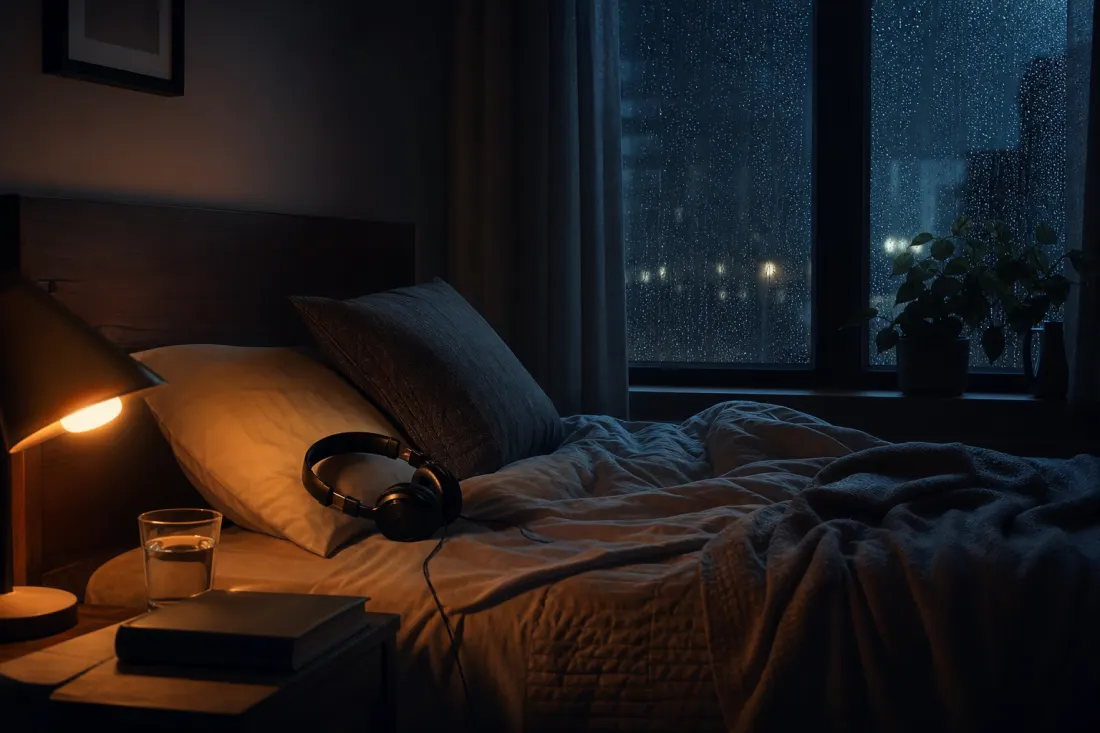

REM sleep is fragile — but not silent-only
REM periods feature vivid dreaming, skeletal muscle atonia, and increased arousal threshold to some stimuli while remaining vulnerable to meaningful or threatening signals.[4] Halperin's review documents autonomic arousals from environmental noise even when polysomnography shows no full wake — fragmenting REM continuity without conscious recall.[5] The goal of rain at night is usually masking those spikes, not "boosting REM duration" — a claim largely absent from peer-reviewed literature.[1]
Riedy's 2021 systematic review of noise as sleep aid found modest support for continuous noise reducing sleep-onset latency and improving subjective quality in noisy environments, with heterogeneous objective polysomnography outcomes.[1] Honest summary: rain helps many people sleep through disturbance; it is not a REM fertiliser.
Why rain spectra work as maskers
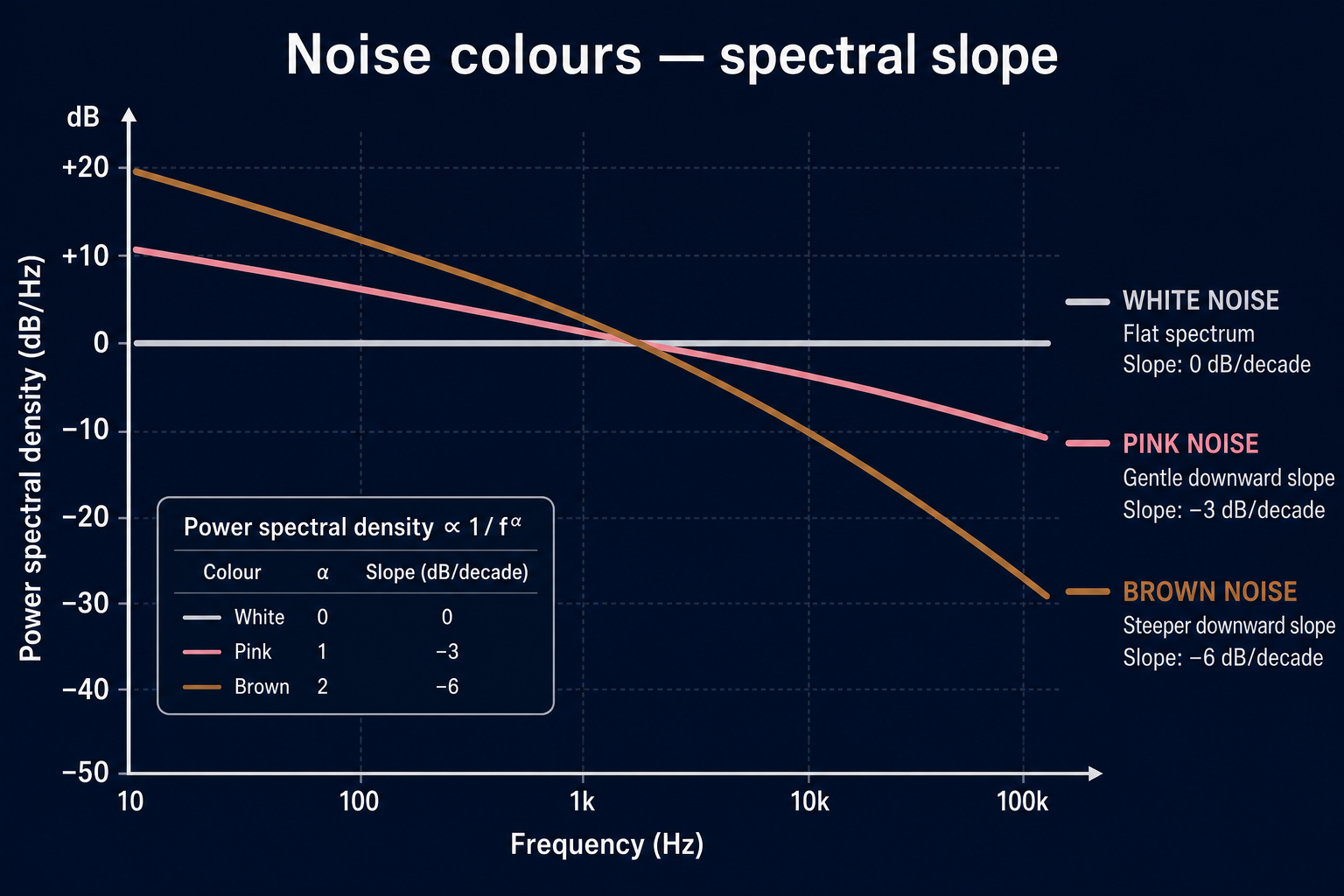
Rain shares statistical properties with pink and brown noise: energy decreases with frequency, matching natural masking curves described by Moore and Zwicker.[15][17] Stanchina showed white noise improved sleep continuity against recorded ICU noise — proof of concept for continuous beds.[2] Rain adds high-entropy modulation (drops, gusts) that reduces monotony versus pure white, addressing habituation concerns in Rankin's framework.[9]
Zhou et al. linked pink noise to more stable sleep complexity in EEG — not rain specifically, but supporting the broader class of 1/f-like beds.[3] Messineo found broadband sound shortened sleep onset in healthy adults.[7] Alvarsson's nature-sound stress recovery data suggest rain-like nature layers may lower pre-sleep sympathetic tone when chosen over rumination-friendly silence.[8]
Volume, salience, and the REM boundary
Basner's WHO-linked work emphasises nocturnal noise dose: even non-wakening events can carry next-day consequences.[6] Rain that creeps too loud becomes its own salient signal — the brain tracks deviants in any stream.[11] Keep beds near just-audible; raise only when external noise demands it.[20][21]
Speech-like content (podcasts, audiobooks) during REM-prone late night carries semantic processing risk unlike rain. Banbury's irrelevant speech paradigm shows verbal material competes with memory systems; rain does not.[23] If you wake at 3am during REM-rich late cycles, prefer unchanged rain over swapping to new content — novelty re-orients.[10]
Rain versus brown noise: practical comparison
Brown noise offers smoother floor; rain offers scene realism and spatial cues. Bregman's scene analysis predicts separable sources feel more natural and less "inside the head" when spatialised.[14] Many listeners combine both: brown bed as floor, rain bubble distant. TimeLine drift prevents the four-minute loop seam from becoming a REM-period micro-arousal.[13]

Bedroom recipe aligned with evidence
- Set rain or pink bed below conversational level.[15][19]
- Use Falloff so rain feels outside the window.[14]
- Avoid lyrics, notifications, and variable podcasts overnight.[23]
- If partner differs, headphones or near-field bubble placement.[25]
- Re-evaluate after two weeks — habituation happens; change layers or motion.[9]
REM myths versus measurable outcomes
Consumer marketing often equates "deep sleep" labels with REM preservation without polysomnographic validation. Carskadon's sleep-architecture primers emphasise that REM rebound follows deprivation — no app guarantees REM minutes.[4] What rain reliably offers is reduced awakening probability from external spikes, which indirectly protects whatever stage you were in when a truck would have otherwise intruded.[1][5] Halperin documented autonomic responses below conscious wake thresholds — masking targets those micro-arousals.[5] Track subjective restedness and next-day function, not unverified in-app "REM scores."
Partners, pets, and shared bedrooms
Shared beds introduce conflicting preferences: one partner needs silence, another needs rain. Spatial headphones or near-field bubble placement with open-back caution preserves relationship peace.[20][25] Pets respond to ultrasonic and high-frequency content differently — keep beds bass-weighted (brown/pink) if animals sleep in room. Revisit volume together monthly; habituation drives solo users to creep levels up unnoticed.[9]
Companion listening in Sound Bubbles
Research above concerns clinical and laboratory sound — not a playlist guarantee. Sound Bubbles offers adjustable living gardens: spatial layers, coloured noise beds, Medical & Wellbeing rooms, and easy mute. Use recommended gardens as environmental support alongside medical care when appropriate.[20]
Not treatment. See clinicians for diagnosis, medication, CBT, neurologic music therapy, or tinnitus programmes. Keep volume comfortable; stop if symptoms worsen.
Why this supports Sound Bubbles — not just "any ambient app"
Most ambient apps deliver one file. The studies above rarely study "a loop." They study continuous floors against irregular noise, unintelligible speech against memory tasks, nature scenes against stress markers, spatial streams against glued mashups, and slow environmental change against habituation.[9][14][22][23][24]
Sound Bubbles maps onto those findings deliberately: brown/noise beds for masking floors, nature and library layers for restorative structure, distance/Falloff for speech intelligibility control, and TimeLine motion so the garden keeps the statistics of a place instead of the statistics of a four-minute loop.[12][15][16][25] That is the practical reason the product feels different after the first hour — and the scientific reason the difference matters.
How to apply this inside Sound Bubbles
- Open a related garden (or New Garden) and press Start playing so audio unlocks.[9]
- Expand Shape your soundscape → Sounds: set Master Volume, then Falloff while watching the audible-core guide.[10]
- Select a bubble; drag and scroll depth. Prefer raising one bubble's Volume over blasting the whole room.[11]
- Add library rain, nature, or noise layers; keep speech-like content distant — or remove it — when you need reading or coding focus.[12]
- TimeLine: choose Drift, Tide, or Orbit when you want the garden to keep evolving without grabbing attention.[13]
- Brown Noise tab: shape a warm floor, optionally Release as bubble so it becomes spatial.[14]
- Save gardens that still feel kind after an hour — public gardens should stay soft, not startling.[15]
Limits, safety, and honest uncertainty
We do not claim Sound Bubbles replaces clinical care, sleep medicine, occupational health programmes, or psychiatric treatment.[1][7] What the product does offer is a listening architecture that matches how hearing and attention actually work: layered sources, spatial distance, and slow change instead of one brittle loop.[18][19]
If sound worsens symptoms, stop. If you need medical advice, see a clinician. If you want a softer room, open a garden, place the bubbles kindly, and stay honest about what sound can — and cannot — do.[20][21]
How this article was researched
We combine first-hand experience placing and tuning Sound Bubbles gardens with citations from peer-reviewed journals, reviews, and institutional pages (including NIH/NCBI, sleep and hearing literature, acoustics, and attention research). Where evidence is mixed or early, we say so. On wellbeing topics we stay cautious: these are companion soundscapes, not cures.
References
Sources cited in this article. Prefer primary literature and institutional guidance; Sound Bubbles is not a medical device and these citations do not imply clinical endorsement.
- (2021). Noise as a sleep aid: systematic review. Sleep Medicine Reviews. doi:10.1016/j.smrv.2020.101385
- (2005). White noise on sleep with ICU noise. Sleep Medicine. doi:10.1016/j.sleep.2004.12.004
- (2012). Pink noise and sleep stabilization. Journal of Theoretical Biology. doi:10.1016/j.jtbi.2012.05.038
- (2011). Normal human sleep: an overview. Principles and Practice of Sleep Medicine.
- (2014). Environmental noise and sleep disturbances. Sleep Science. doi:10.1016/j.slsci.2014.11.003
- (2019). WHO noise guidelines for sleep. Environment International.
- (2017). Broadband sound and sleep onset. Frontiers in Neurology. doi:10.3389/fneur.2017.00586
- (2010). Nature sound stress recovery. IJERPH. doi:10.3390/ijerph7031036
- (2009). Habituation revisited. Neurobiology of Learning and Memory. doi:10.1016/j.nlm.2008.09.015
- (2009). Habituation: a history. Neurobiology of Learning and Memory.
- (1963). Perception and the conditioned reflex. Pergamon Press.
- (2010). The free-energy principle. Nature Reviews Neuroscience. doi:10.1038/nrn2787
- (2013). Whatever next? Predictive brains. Behavioral and Brain Sciences. doi:10.1017/S0140525X12000477
- (1990). Auditory Scene Analysis. MIT Press.
- (2012). An Introduction to the Psychology of Hearing. Brill.
- (2024). Colors of noise. Encyclopedic.
- (1999). Psychoacoustics: Facts and Models. Springer.
- (2013). Acoustical terminology (masking). ANSI.
- (2014). Auditory and non-auditory effects of noise on health. The Lancet. doi:10.1016/S0140-6736(13)61613-X
- (2021). World report on hearing. WHO.
- (2023). Noise and hearing loss prevention. CDC.
- (2005). White noise on sleep with ICU noise exposure. Sleep Medicine. doi:10.1016/j.sleep.2004.12.004
- (2001). Auditory distraction and short-term memory. Human Factors. doi:10.1518/001872001775992390
- (2010). Stress recovery with nature sound. IJERPH. doi:10.3390/ijerph7031036
- (2005). Speech intelligibility and work performance. Indoor Air. doi:10.1111/j.1600-0668.2005.00391.x