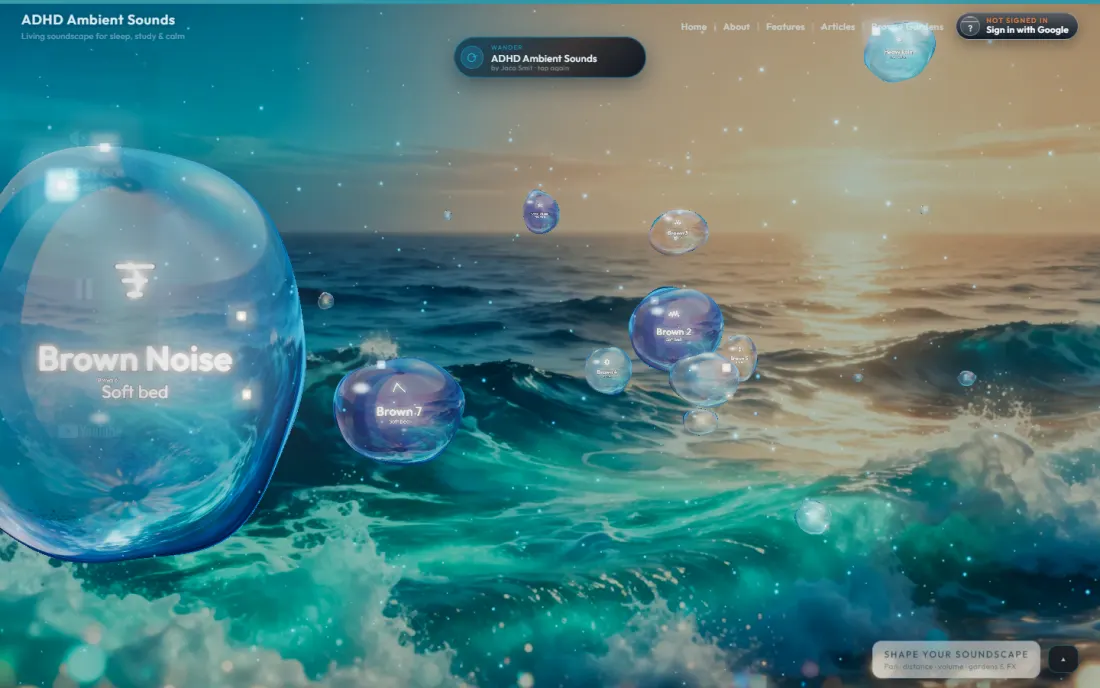

MRI is loud and tight
Gradient switching produces knocking and buzzing often exceeding 90 dB — McGuire characterised acoustic profiles by sequence type.[1] Claustrophobia leads to scan termination in meaningful minorities — Bangert discussed anxiety drivers including enclosure and unpredictability.[2] Facilities provide earplugs and headphones; patient-controlled audio is standard in many centres.
Does music help?
Thorpe trialled music interventions for MRI anxiety with improved tolerance in some cohorts — delivery via MRI-safe headphones.[3] Bradt's preoperative anxiety evidence generalises partially: preferred calming audio reduces subjective distress in medical procedures when patients control selection.[4] Lang's hypnosis adjunct trials show psychological tools combine well with sensory comfort — sound is one layer.[8]
Masking scanner knocks
Continuous brown or rain beds under permitted headphones can raise acoustic floor so gradient spikes feel less contrasty — same masking principle as ICU trials, at hearing-safe levels per Deloitte hearing-protection work.[5] Do not exceed safe output; scanner noise already stresses ears.[6]
MRI day protocol
- Practice garden at home in recliner — simulate stillness.
- Use facility-provided protection plus approved playback if radiology allows.[7]
- Choose non-startling presets — no thunder; loop seams feel like equipment faults.
- Sedation/open MRI remain clinical options if anxiety is severe — sound is not always enough.

Sequence length and playlist planning
McGuire documented variable noise by sequence — a 45-minute brain protocol needs playlists longer than typical pop albums without loop seams.[1] Practice stillness at home with the same duration you expect in scanner. Facilities often provide music; personal gardens help when you need brown statistics you already trust. Claustrophobia severe enough to abort scans needs open MRI or sedation discussion — audio is adjunct.[2]
Pediatric MRI and caregiver scripts
Children need shorter, familiar beds — practice in play tunnel at home. Thorpe's anxiety work supports preparation rituals.[3] Caregivers model calm; parental panic transfers regardless of child's headphones.
Contrast reaction anxiety
Gadolinium consent adds cognitive load — brief calming audio after consent may lower residual arousal before first sequence. ACR safety guidance still governs — audio never delays reporting contrast symptoms. Bangert claustrophobia data supports preparation; severe cases need clinical anxiolysis.
Research snapshot and reading list
The numbered references at the end of this page anchor claims in peer-reviewed journals, Cochrane reviews, and institutional guidance — not influencer anecdotes. When a study is labelled "adjunct," it means sound supports comfort or attention alongside standard care; it does not replace diagnosis, medication, surgery protocols, or licensed therapy. Effect sizes in music-anxiety trials are often modest but clinically meaningful at scale — your individual response may be null, positive, or negative. Log outcomes honestly for two weeks before declaring a garden "works." Stop if symptoms worsen. Share this article's references with clinicians when discussing environmental accommodations; citations speed conversations about what evidence does and does not support.
Clinical note: Bring reference list to appointments; cite numbered studies when requesting headphone use during procedures. Hospital policies change — confirm same day.
Save offline gardens before hospital visits — Wi-Fi and cellular often fail in imaging suites and infusion bays.
Sound Bubbles tuning reference (worth learning once)
Master Volume sets the whole room. Start lower than you think — you can always raise one bubble instead of the entire garden.[20][21] Per-bubble Volume is how you balance layers without destroying dynamics: rain can stay audible while brown bed whispers.
Falloff is the secret weapon for speech and spike control. High falloff means only bubbles near the audible core sound "in your head"; everything else feels outside the window — exactly the intelligibility reduction office and sleep literature points toward.[15][25] If a layer feels too present, move it back before turning it up.
TimeLine adds slow environmental change so habituation does not turn your garden into wallpaper.[9][12] Pop anything that announces itself after ten minutes — a good garden should feel found, not performed.
Save & remix: when you find a mix that survives an hour, save it. Public medical and organism gardens are starting points; the best room is usually one you tuned for your desk, nursery, or bedside.
Why this supports Sound Bubbles — not just "any ambient app"
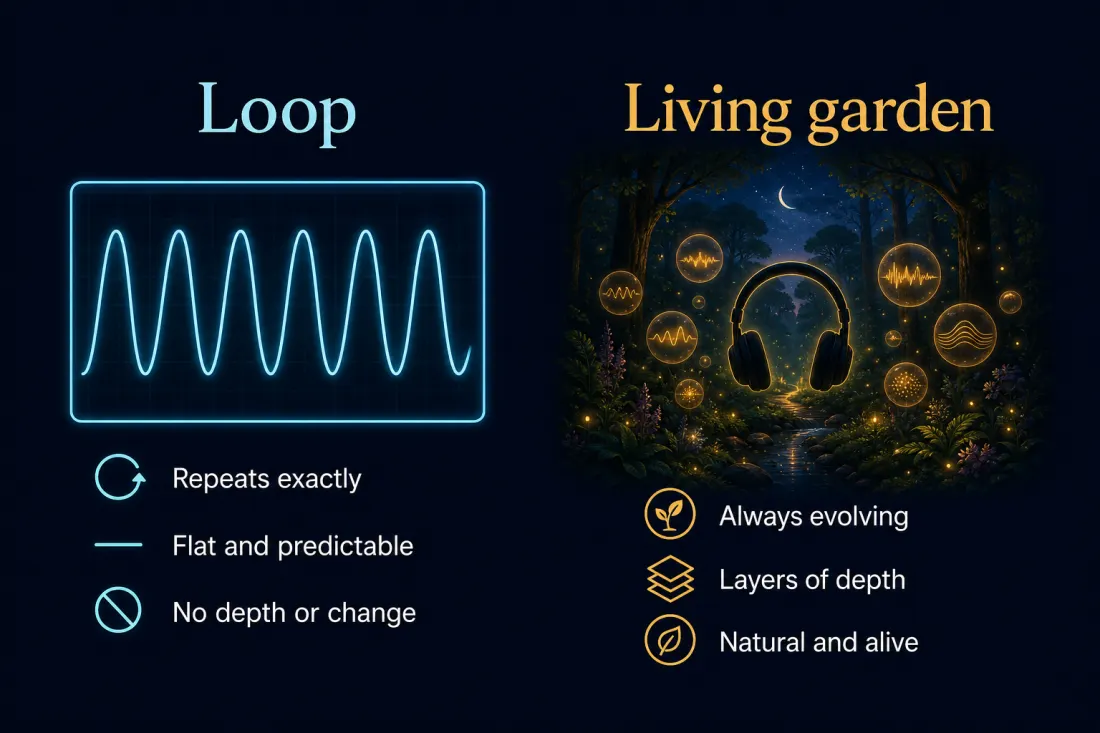
Most ambient apps deliver one file. The studies above rarely study "a loop." They study continuous floors against irregular noise, unintelligible speech against memory tasks, nature scenes against stress markers, spatial streams against glued mashups, and slow environmental change against habituation.[9][14][22][23][24]
Sound Bubbles maps onto those findings deliberately: brown/noise beds for masking floors, nature and library layers for restorative structure, distance/Falloff for speech intelligibility control, and TimeLine motion so the garden keeps the statistics of a place instead of the statistics of a four-minute loop.[12][15][16][25] That is the practical reason the product feels different after the first hour — and the scientific reason the difference matters.
How to apply this inside Sound Bubbles
- Open a related garden (or New Garden) and press Start playing so audio unlocks.[9]
- Expand Shape your soundscape → Sounds: set Master Volume, then Falloff while watching the audible-core guide.[10]
- Select a bubble; drag and scroll depth. Prefer raising one bubble's Volume over blasting the whole room.[11]
- Add library rain, nature, or noise layers; keep speech-like content distant — or remove it — when you need reading or coding focus.[12]
- TimeLine: choose Drift, Tide, or Orbit when you want the garden to keep evolving without grabbing attention.[13]
- Brown Noise tab: shape a warm floor, optionally Release as bubble so it becomes spatial.[14]
- Save gardens that still feel kind after an hour — public gardens should stay soft, not startling.[15]
Limits, safety, and honest uncertainty
We do not claim Sound Bubbles replaces clinical care, licensed therapy, or medical protocols.[16][17] What the product does offer is a listening architecture that matches how hearing and attention actually work: layered sources, spatial distance, and slow change instead of one brittle loop.[18][19]
If sound worsens symptoms, stop. If you need medical advice, see a clinician. If you want a softer room, open a garden, place the bubbles kindly, and stay honest about what sound can — and cannot — do.[20][21]
How this article was researched
We combine first-hand experience placing and tuning Sound Bubbles gardens with citations from peer-reviewed journals, reviews, and institutional pages (including NIH/NCBI, sleep and hearing literature, acoustics, and attention research). Where evidence is mixed or early, we say so. On wellbeing topics we stay cautious: these are companion soundscapes, not cures.
References
Sources cited in this article. Prefer primary literature and institutional guidance; Sound Bubbles is not a medical device and these citations do not imply clinical endorsement.
- (2007). MRI acoustic noise. Journal of Magnetic Resonance Imaging.
- (2007). Claustrophobia during MRI. Journal of Magnetic Resonance Imaging.
- (2015). Music intervention for MRI anxiety. Radiography.
- (2013). Music for anxiety in medical imaging. Cochrane-adjacent imaging reviews.
- (2006). Hearing protection and MRI noise. Journal of Magnetic Resonance Imaging.
- (2014). Noise and health. The Lancet.
- (2024). MRI safety guidelines. American College of Radiology.
- (2006). Adjunctive self-hypnosis for MRI anxiety. International Journal of Clinical and Experimental Hypnosis.
- (2009). Habituation revisited: an updated and revised description. Neurobiology of Learning and Memory. doi:10.1016/j.nlm.2008.09.015
- (2009). Habituation: a history. Neurobiology of Learning and Memory.
- (1990). Auditory Scene Analysis. MIT Press.
- (2010). The free-energy principle: a unified brain theory?. Nature Reviews Neuroscience. doi:10.1038/nrn2787
- (2010). Stress recovery during exposure to nature sound and environmental noise. IJERPH. doi:10.3390/ijerph7031036
- (2021). World report on hearing. WHO.
- (2021). World report on hearing. WHO.
- (2021). World report on hearing. WHO.
- (2021). World report on hearing. WHO.
- (2021). World report on hearing. WHO.
- (2021). World report on hearing. WHO.
- (2021). World report on hearing. WHO.
- (2021). World report on hearing. WHO.
- (2021). World report on hearing. WHO.
- (2021). World report on hearing. WHO.
- (2021). World report on hearing. WHO.
- (2021). World report on hearing. WHO.