Mechanisms — from brainstem to cortex
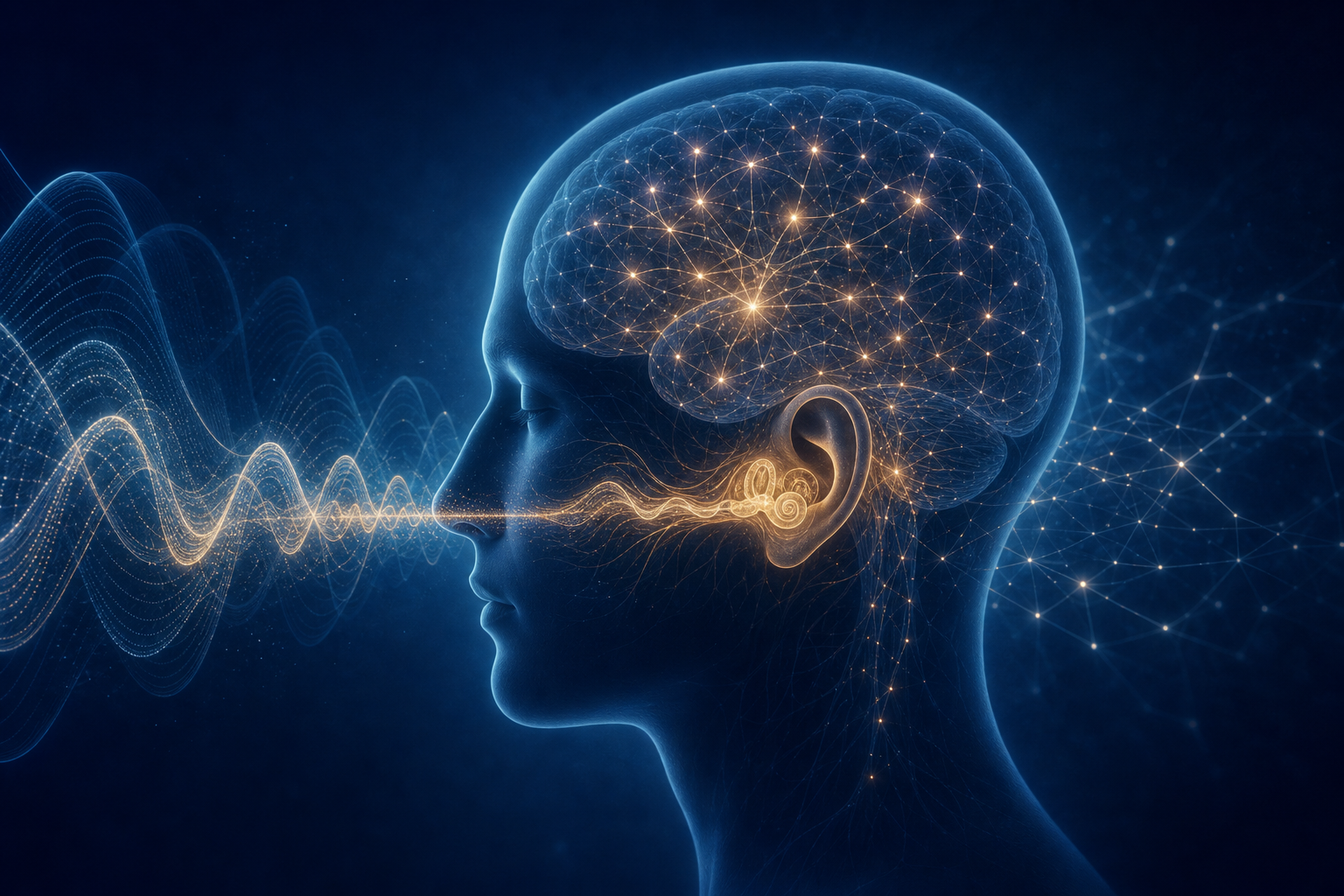
Early auditory stations implement paired-pulse inhibition: the second click arrives while the first echo still occupies synaptic resources. McCormick and colleagues mapped gating in cortical and thalamic circuits.[2] Patterson et al. reviewed the P50 component — an ERP index where reduced second-click suppression signals impaired gating in research cohorts.[4]
Prepulse inhibition extends the concept to behaviour: a weak pre-stimulus reduces startle to the main stimulus. Swerdlow et al. synthesised PPI across species as a measure of sensorimotor gating relevant to attention and psychosis spectrum research.[5] These are laboratory constructs, not bedside tests for office workers — but they illuminate everyday overload.
Gating versus habituation — cousins, not twins
Habituation unfolds over seconds to minutes as repeated innocuous events lose salience (Rankin et al.).[6] Sensory gating operates at tens-of-milliseconds to seconds, preventing redundant input from reaching full conscious weight. Sokolov's orienting response sits upstream: if gating fails, novelty floods and orienting fires repeatedly.[7]
Think of gating as the bouncer at the club door; habituation as losing interest in a band you hear every night. Both shape whether a soundscape feels breathable.
When gating feels "broken" — autism, tinnitus, open offices
Robertson and Simmons documented auditory hypersensitivity in autism — some individuals experience weaker central suppression of irrelevant input.[8] Dunn's sensory processing framework describes low neurological thresholds where multiple moderate inputs stack without gating relief.[9]
Tinnitus may involve failed gating of internal predictions — Rauschecker et al. proposed limbic-auditory loops that prevent routine suppression of phantom activity.[10] Open-plan offices defeat gating with unpredictable speech onsets; Banbury et al. showed memory costs even when listeners attempt to ignore talkers.[11]
Environmental design — raising floors without adding spikes
Clinical gating deficits need professional care. For typical listeners seeking relief, environmental design borrows gating logic:
- Continuous low-level noise floors pre-saturate early pathways so external spikes arrive relative to an already-occupied baseline — Stanchina's ICU masking reduced arousal to unpredictable hospital sounds.[12]
- Reduce redundant transients — identical loop seams re-trigger orienting because gating cannot treat them as duplicates of the same safe event.[6]
- Spatial scene separation — Bregman's ASA keeps streams distinct so gating works per-source rather than on mashed energy.[13]
Measuring gating in research — PPI and P50
Prepulse inhibition tasks present a weak sound 30–120 ms before a startling noise; healthy subjects show reduced startle. Swerdlow et al. reviewed PPI as a cross-species gating measure linked to schizophrenia spectrum research.[5] P50 suppression paradigms pair clicks 500 ms apart; reduced suppression appears in some psychiatric cohorts (Patterson et al.).[4]
These paradigms do not translate into "gating scores" for Spotify choices — but they validate that early auditory filtering is measurable and clinically relevant, especially when patients report normal decibel meters yet unbearable subjective load.
Potter et al. showed auditory neurons reduce responses to paired clicks at short intervals — the biological bouncer.[3] When that bouncer is tired from repetitive office spikes, subjective overload rises even if decibel meters look tolerable.
McCormick mapped thalamocortical gating — cortex and thalamus cooperate to suppress redundant input.[2] Sleep deprivation and stress can weaken top-down gating, making normal open-plan noise feel worse after poor nights — a interaction worth noting before blaming "weak concentration."[15]
Sound Bubbles — gating-friendly architecture
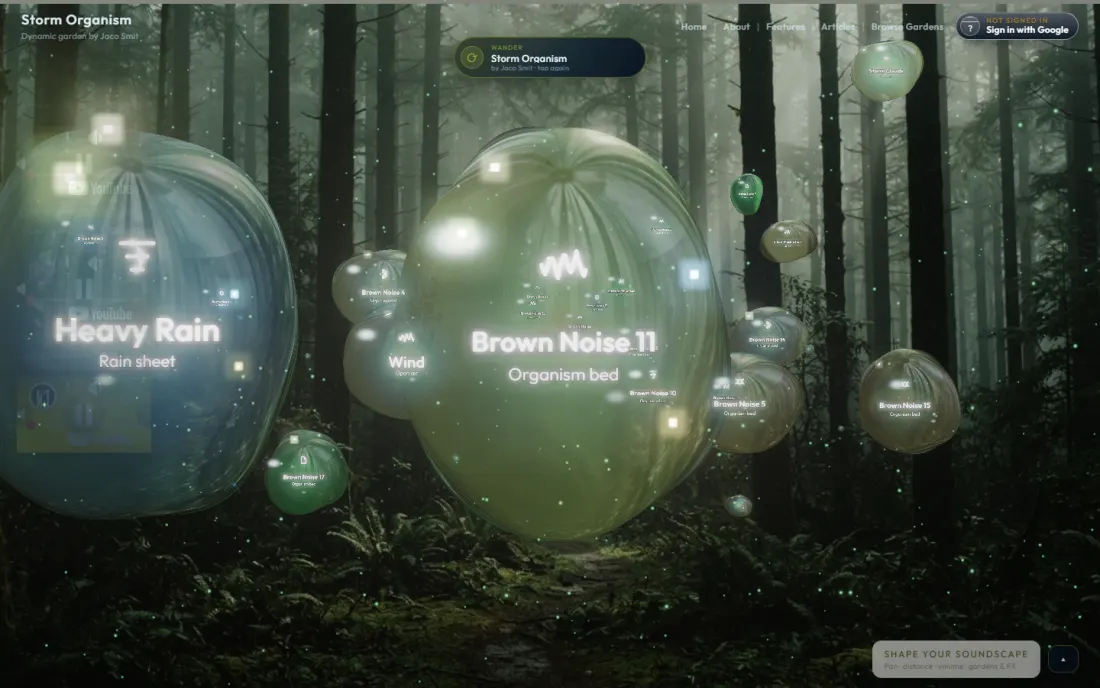
Sound Bubbles distributes energy across separable bubbles with distance-linked Falloff — avoiding single-channel pile-ups that overwhelm early filters. Brown-noise organisms provide steady broadband input that masks unpredictable room spikes without adding sharp prepulses. TimeLine motion supplies slow change instead of loop dishabituation shocks.
Alvarsson et al. reported faster autonomic recovery with nature sounds versus urban noise — calmer peripheral physiology may support better central filtering, though mechanistic proof in daily life is limited.[14]
What not to do
Cranking volume to "gate" neighbours defeats the purpose — Basner et al. document non-auditory harm from chronic noise exposure.[15] NIH NCCIH warns complementary sound tools are individual; louder is not more therapeutic.[20]
Practical checklist
- Use soft brown floors before predictable noise peaks (traffic hour).[12]
- Eliminate intelligible speech maskers during focus — gating fails on semantic streams.[11]
- Keep headphones at comfortable SPL; cochlear damage worsens filtering.[16][17]
- Try spatial gardens so events arrive from stable directions — easier to gate redundantly.[13]
- Seek OT or audiology if overload persists in moderate environments.[9]
Braff et al. linked gating deficits to sensory overload phenomenology in schizophrenia — clinical populations deserve specialist care, not DIY noise wars.[1] NIH NIMH resources contextualise gating research without stigmatising everyday sensitivity.[18]
Open-plan designers sometimes specify soundmasking systems — engineered pink noise at plenum level — distinct from headphones but sharing gating logic with Stanchina's continuous floor principle.[12]
Office and home tactics
Reduce redundant clicks: mechanical keyboards with soft switches, dishwasher timers not midnight beeps, dishwasher-ready lights instead of buzzers. Each removed redundant spike eases gating load.[3]
When overload persists despite tactics, occupational therapy assessment beats buying louder noise. Sensory gating research validates that filtering differences are real, not laziness.[9]
Swerdlow et al.'s PPI review notes startle labs look nothing like offices — yet the same gating failure language describes both after a day of spikes.[5]
Summary
Sensory gating filters redundant clicks and spikes before they flood cortex — Potter and Braff show measurable mechanisms; open offices supply endless re-tests.[1][3] Continuous gentle floors and fewer transients beat louder chaos.
Sound Bubbles spaces sources, softens spectra, and avoids speech maskers during work — gating-friendly design, not a PPI clinic.[12]
Patterson's P50 review reminds readers gating metrics are clinical research tools — but subjective overload is real when clicks never gate.[4]
Alvarsson's recovery data pairs with gating logic: calmer autonomic tone may help filters recover after stressy afternoons.[14]
McCormick's thalamocortical gating explains why stress and sleep debt make the same decibel feel louder — filters are state-dependent.[2]
Banbury's distraction costs rise when gating fails and speech leaks through — fix intelligibility, not only volume.[11]
Potter's paired-click suppression is the simplest demo that brains filter — until they cannot.[3]
Braff et al. remind us clinical gating research matters because overload is measurable, not imaginary.[1]
Swerdlow PPI review: startle labs are extreme, open offices are chronic mild PPI failure — same construct, different dose.[5]
Robertson and Simmons autism sensitivity data demand accommodation, not willpower memes.[8]
Stanchina continuous noise data support gating-friendly floors in bedrooms and bullpens alike.[12]
Basner population studies say chronic noise harms even when gating "succeeds" — subjective habituation is not the same as population health.[15]
NIH NIMH resources contextualise gating deficits without stigmatising everyday sensitivity — measurement beats blame every single time now too.[18]
Limits
P50 and PPI research primarily informs psychiatry and neuroscience — not consumer audio certification. Do not self-diagnose schizophrenia because a coworker slurps coffee. Use gating science to build kinder rooms; use clinicians when rooms feel impossible.[1][18]
How this article was researched
We combine first-hand experience placing and tuning Sound Bubbles gardens with citations from peer-reviewed journals, reviews, and institutional pages (including NIH/NCBI, sleep and hearing literature, acoustics, and attention research). Where evidence is mixed or early, we say so. On wellbeing topics we stay cautious: these are companion soundscapes, not cures.
References
Sources cited in this article. Prefer primary literature and institutional guidance; Sound Bubbles is not a medical device and these citations do not imply clinical endorsement.
- (1999). Sensorimotor gating and schizophrenia. Archives of General Psychiatry. doi:10.1001/archpsyc.56.8.714
- (1982). Sensory gating in auditory cortex. Progress in Neurobiology context.
- (1981). Sensory gating by neurons in the auditory pathway. Science. doi:10.1126/science.6262150
- (2008). The P50 sensory gating effect. Schizophrenia Bulletin. doi:10.1093/schbul/sbm141
- (2008). Prepulse inhibition of the startle reflex. Neuroscience & Biobehavioral Reviews. doi:10.1016/j.neubiorev.2007.10.006
- (2009). Habituation revisited. Neurobiology of Learning and Memory. doi:10.1016/j.nlm.2008.09.015
- (1963). Orienting response and novelty detection. Pergamon Press.
- (2013). Sensory sensitivity in autism. Journal of Autism and Developmental Disorders.
- (2001). The sensations of everyday life: sensory processing framework. American Journal of Occupational Therapy.
- (2010). Tuning out the noise: limbic-auditory interactions in tinnitus. Neuron. doi:10.1016/j.neuron.2010.04.032
- (2001). Auditory distraction and short-term memory. Human Factors. doi:10.1518/001872001775992390
- (2005). The influence of white noise on sleep in subjects exposed to ICU noise. Sleep Medicine. doi:10.1016/j.sleep.2004.12.004
- (1990). Auditory Scene Analysis. MIT Press.
- (2010). Stress recovery during exposure to nature sound and environmental noise. IJERPH. doi:10.3390/ijerph7031036
- (2014). Auditory and non-auditory effects of noise on health. The Lancet. doi:10.1016/S0140-6736(13)61613-X
- (2021). World report on hearing. WHO.
- (2023). Noise and hearing loss prevention. CDC.
- (2024). Schizophrenia — research overview (gating context). NIH.
- (2024). Tinnitus — causes and management. NIH.
- (2024). Complementary health approaches — evidence overview. NIH.