What ASMR actually is
Autonomous Sensory Meridian Response names a pattern first described in peer-reviewed literature by Barratt and Davis in 2015: a flow-like, tingling sensation that often begins at the scalp and travels down the neck and spine, triggered by quiet, close, deliberate audio-visual stimuli — whispering, soft tapping, brushing sounds, careful hand movements, crinkling paper.[1] The acronym was already circulating in online communities; the science job was to ask whether the feeling was idiosyncratic imagination or a reproducible state.
Early surveys were striking. In Barratt and Davis’s sample, 98% of ASMR-experiencers reported using it to relax, 82% to help sleep, and large majorities described improved mood.[1] That is not a clinical trial — it is phenomenology — but it explains why the format exploded: people were self-medicating stress with microphones before universities caught up.
Not everyone feels tingles. “ASMR responders” and “non-responders” are a real divide in lab studies; pleasant calm can still show up without scalp sparkles, and some listeners get only sleepiness or emotional softening.[2][6] If you have never felt tingles, you may still be an ASMR-adjacent listener who loves soft, close, low-threat sound — a category Sound Bubbles leans into without requiring mouth sounds at all.
What the physiology shows
Poerio and colleagues ran the landmark lab study: ASMR-experiencers watching trigger videos showed reduced heart rate (roughly 3.4 beats per minute on average) alongside increased skin conductance — a mix interpreted as relaxed physiology with attentive, emotionally tinged arousal, not simple sedation.[2] Pleasant affect rose only in people who identified as ASMR-sensitive; controls watching the same videos did not get the same mood lift.[2]
Brain imaging pushes the story past “it’s relaxing.” Lochte and colleagues reported activation in regions tied to reward, social bonding, and empathy during tingling — suggesting ASMR overlaps circuitry used when we feel safely attended to, not merely when we hear quiet noise.[7] Smith and colleagues’ fMRI work found ASMR videos engaging sensory, motor, and attention networks in responders, with connectivity patterns that differ from non-responders.[8] Valtakari and others linked ASMR stimulation to pupil dilation — another sign the state is somatic, not purely imagined.[9]
EEG studies add nuance: experienced ASMR listeners sometimes show increased frontal alpha (associated with relaxed wakefulness) while non-experiencers may show the opposite pattern on identical audio.[10] The field is young — sample sizes are modest, stimuli are mostly YouTube-style triggers — but the direction is consistent: ASMR is a body event, not a placebo label influencers invented.
Why it can feel “better than benzos” — and where that comparison breaks
Listeners say this in comments, in DMs, in therapy waiting rooms: a twenty-minute ASMR session hits faster than their anti-anxiety med, with no pill hangover. We take that seriously as lived experience while refusing to turn it into a medical claim.
Where the comparison has plausibility: Benzodiazepines reduce anxiety primarily through GABAergic sedation; they are effective for many acute episodes but carry dependence risk, tolerance, cognitive dulling, and withdrawal syndromes that can be dangerous if stopped abruptly.[5][11] ASMR, by contrast, is a voluntary sensory context: you choose triggers, duration, and volume; you stop instantly; there is no pharmacy gate. Poerio’s heart-rate data and Barratt’s mood reports describe a downshift that arrives without ingesting a substance — valuable for listeners who want a non-pharmacological first step on a tense night.[1][2]
Where the comparison fails: ASMR has no equivalent RCT evidence for generalized anxiety disorder, panic disorder, or alcohol/benzodiazepine withdrawal. It does not replace diagnosis, titration, or medical supervision. Effects are smaller and more variable than therapeutic doses of anxiolytics for clinical populations. Non-responders exist. Misophonia sufferers may find mouth-trigger ASMR actively aversive.[12][13] Framing ASMR as “nature’s benzo” is catchy and wrong; framing it as a often-free, low-risk calm lever many people underuse is accurate.
If sound calms you reliably, that is worth building into your week. If you need medication, that is also valid. The enemy is not pills — it is shame and bad information.
Two ASMRs: whisper roleplay vs ambient micro-detail
Platform ASMR is dominated by close-mic whisper roleplay — haircuts, medical exams, attentive friends. That format maximises social-attention cues (the bonding networks Lochte observed).[7] It is powerful and polarising: devotees describe rescue from insomnia; misophonia listeners flee mouth sounds entirely.[13]
There is a second tradition less discussed in wellness press: ambient ASMR — rain on canvas, distant thunder, fireplace crackle, keyboard taps, brush-on-microphone without narrative. McErlean and Banissy note personality and empathy differences among ASMR users; ambient listeners often score high on openness and sensory sensitivity without wanting performative intimacy.[14] Crackle, drip, and rustle provide micro-transients: low-intensity, unpredictable, non-linguistic events that tickle prediction-error systems gently rather than shouting surprise.[15][16]
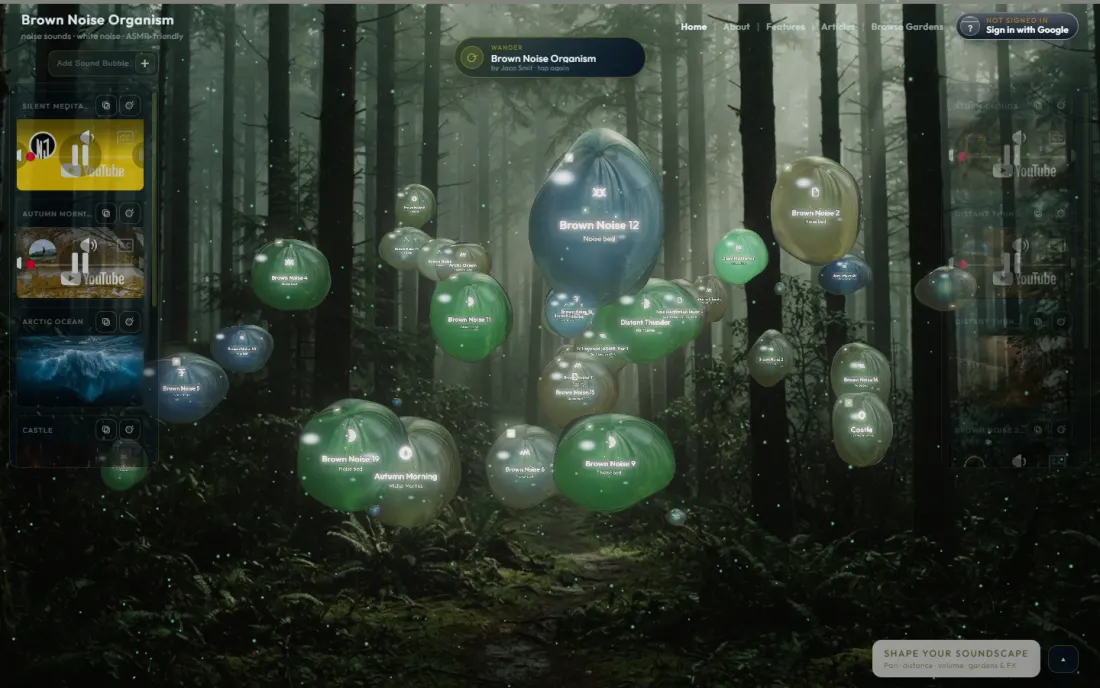
Sound Bubbles lives here. We are not a whisper-roleplay channel. We are spatial gardens where each bubble is a sound source you place at depth: a hearth crackle at the far wall, sheet rain mid-field, brown noise under the floor, one soft mechanical tick if you want tactile rhythm without a person pretending to cut your hair. TimeLine drift keeps statistics changing so the ear does not habituate to a frozen loop — the same failure mode that kills single-file “ASMR rain” videos at 3am.[17][18]

Who ASMR helps — and who should skip it
- Responders seeking wind-down — heart-rate and mood data support short-session calming; many use audio before sleep.[2][19]
- Listeners who want attention without lyrics — soft triggers occupy the auditory foreground without narrative hijack (unlike emotional music, which can steer mood sharply).[20]
- People who dislike silence — ASMR and ambient beds share a continuous floor that masks sudden house noise; anxiety literature parallels apply.[21][22]
- Misophonia or mouth-sound aversion — skip whisper; use non-oral micro-textures (rain, crackle, wind, brown beds).[13]
- Clinical insomnia or GAD — see a clinician; use sound as companion, not sole treatment.[4][5]
Build an ASMR-caliber garden in Sound Bubbles (no whisper required)
Think in layers, not one magic track:
- Floor first — brown or pink noise bubble at 30–45% master, high Falloff so only nearby sources feel “in-head.” Masks HVAC and hallway spikes without bright hiss.[22][23]
- One tactile micro-layer — keyboard taps, soft brush, page turns, distant clock — single bubble, low volume, mid-distance. ASMR triggers are often sparse; one close tap repeating reads as alarm, not calm.[1]
- One organic texture — rain, hearth crackle, or wind through trees. Irregular natural statistics defeat loop fatigue.[15][17]
- TimeLine → Drift or Tide, Chaos low. Motion should be subconscious.[18]
- Pop anything sharp — close thunder, solo birds, intelligible speech. ASMR-adjacent calm dies when orienting reflexes fire.[16]
- Save and revisit — ASMR sensitivity shifts with stress; rebuild stacks weekly.
Try starting from Brown Noise Organism, add a crackle or rain bubble from the library, push charisma to the horizon, and treat the result as ambient ASMR — tingles optional, calm mandatory.
Research snapshot
| Claim | Strength | Caveat |
|---|---|---|
| ASMR reduces heart rate in responders | Moderate (lab, replicated direction) | Effect size modest; not long-term outcome data[2] |
| ASMR engages reward / social-bonding networks | Moderate (fMRI) | Small samples; mostly video triggers[7][8] |
| ASMR improves sleep or mood surveys | Moderate (cross-sectional) | Self-report; publication bias possible[1][19] |
| ASMR replaces benzodiazepines | Not supported | Anecdote ≠ clinical equivalence; withdrawal needs medical care[5] |
| Ambient micro-sounds produce ASMR-like calm without tingles | Emerging / mechanistic | Less studied than whisper; aligns with scene-analysis & masking literature[15][22] |
What we owe ASMR as a product
Putting “ASMR” in the title tag while never writing about ASMR was a mismatch. The phenomenon deserves the same seriousness we gave brown noise, hospital sound, and psychedelic-adjacent listening: named mechanisms, honest limits, practical build guides. Sound Bubbles will keep expanding ASMR coverage — whisper-free gardens, trigger design, sleep stacks, misophonia-safe paths — because for many listeners this is the calming thing that works, and they should not have to dig through template SEO to understand why.
If ASMR makes you softer, build a garden and stay with it. If it does nothing, you may be a non-responder — try nature-recovery or brown-floor articles instead. If sound makes you worse, stop. Silence remains valid.[4]
How this article was researched
We combine first-hand experience placing and tuning Sound Bubbles gardens with citations from peer-reviewed journals, reviews, and institutional pages (including NIH/NCBI, sleep and hearing literature, acoustics, and attention research). Where evidence is mixed or early, we say so. On wellbeing topics we stay cautious: these are companion soundscapes, not cures.
References
Sources cited in this article. Prefer primary literature and institutional guidance; Sound Bubbles is not a medical device and these citations do not imply clinical endorsement.
- (2015). Autonomous Sensory Meridian Response (ASMR): a flow-like mental state. PeerJ. doi:10.7717/peerj.851
- (2018). More than a feeling: ASMR is characterized by reliable changes in affect and physiology. PLOS One. doi:10.1371/journal.pone.0196645
- (2022). Still more than a feeling: ASMR and the reduction of anxiety. Journal of Affective Disorders Reports. doi:10.1016/j.jadr.2021.100260
- (2024). Complementary health approaches — evidence and safety framing. National Institutes of Health.
- (2022). Benzodiazepine use, dependence, and clinical anxiety management context. APA / clinical guidance.
- (2017). An examination of personality traits associated with ASMR. Frontiers in Psychology. doi:10.3389/fpsyg.2017.01780
- (2018). An fMRI investigation of the neural correlates underlying the ASMR. BioImpacts. doi:10.15171/bi.2018.25
- (2019). An examination of the default mode network in individuals with ASMR. Social Neuroscience. doi:10.1080/17470919.2019.1596269
- (2019). An eye-tracking approach to ASMR: the physiology and nature of tingles. PeerJ. doi:10.7717/peerj.7120
- (2022). The effects of ASMR on mood, attention, heart rate, skin conductance and EEG. PLOS One. doi:10.1371/journal.pone.0262668
- (2015). Management of benzodiazepine misuse and dependence. Australian Prescriber. doi:10.18773/austprescr.2015.055
- (2016). Could ASMR be therapeutic? Evidence and challenges. Perspectives in Psychological Science (commentary context).
- (2022). Misophonia — clinical phenomenology, overlap with sensory sensitivity. JAMA Psychiatry / review literature.
- (2018). Assessing individual variation in personality and empathy in ASMR. Multisensory Research. doi:10.1163/22134808-00002525
- (1990). Auditory Scene Analysis. MIT Press.
- (2009). Auditory distraction and deviance detection. Journal of Experimental Psychology.
- (2009). Habituation revisited: an updated and revised description. Neurobiology of Learning and Memory. doi:10.1016/j.nlm.2008.09.015
- (2009). Habituation: a history. Neurobiology of Learning and Memory.
- (2022). ASMR: survey of usage to promote sleep and relieve stress. Sleep Medicine (survey literature).
- (2014). Brain correlates of music-evoked emotions. Nature Reviews Neuroscience. doi:10.1038/nrn3666
- (2010). Stress recovery during exposure to nature sound and environmental noise. International Journal of Environmental Research and Public Health. doi:10.3390/ijerph7031036
- (1985). The Effects of Noise on Man — masking and acoustic floors. Academic Press.
- (2005). Speech intelligibility and masking in workplaces. Indoor Air. doi:10.1111/j.1600-0668.2005.00391.x