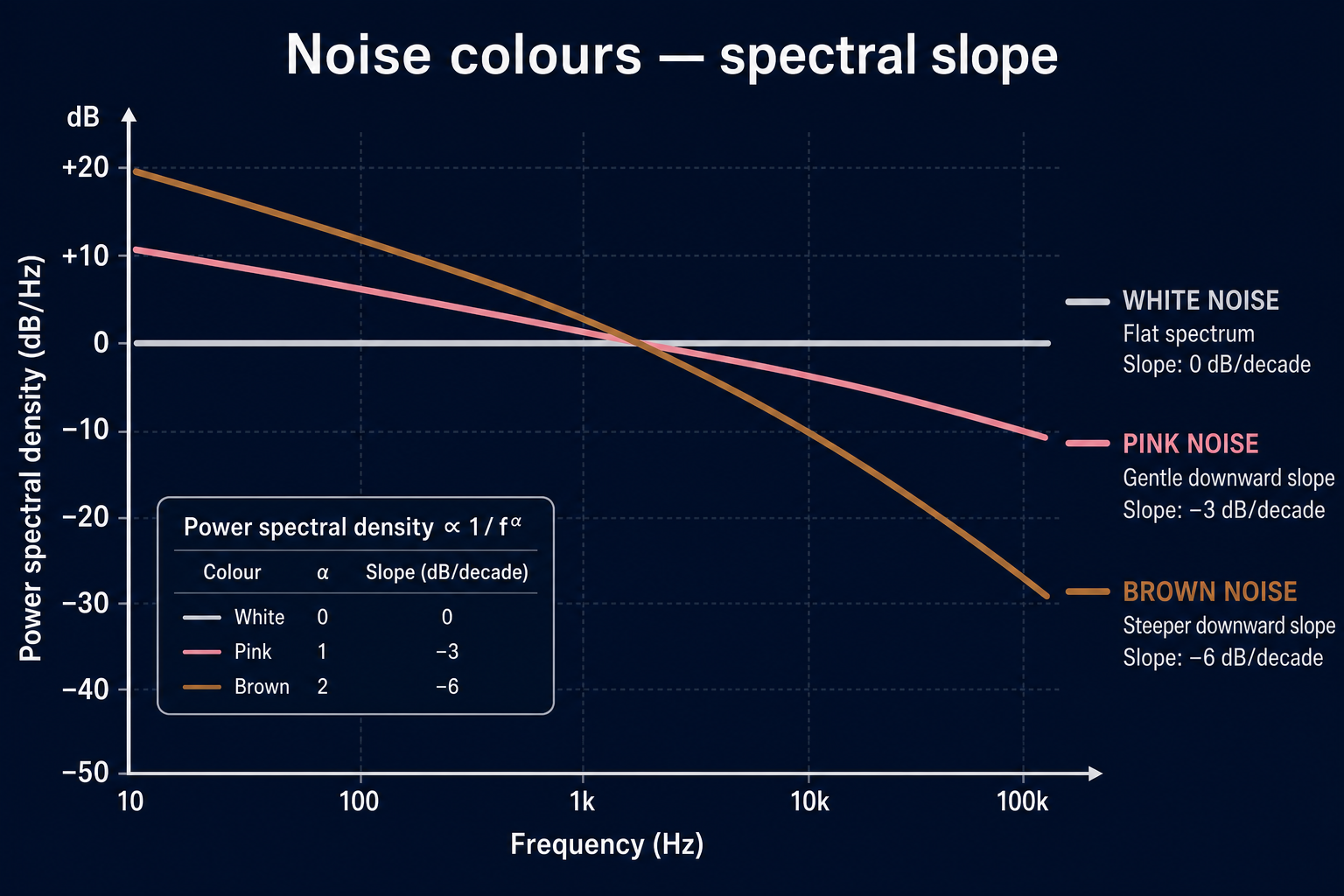
Spectral slopes in one paragraph
White noise: flat power density. Pink: −3 dB per octave. Brown (red): −6 dB per octave — more energy in lows, less in highs.[3][16] Zwicker and Fastl model loudness and masking by band — brown reduces high-frequency perceptual weight that many listeners find abrasive overnight.[4]
What sleep reviews actually pooled
Riedy reviewed noise as sleep aid — modest support for continuous noise reducing onset latency and improving subjective continuity in noisy environments; heterogeneous polysomnography outcomes.[1] The review discusses broadband colours collectively; it is not a brown-versus-white championship trial.
Stanchina showed white noise improved sleep during recorded ICU noise — proof of masking principle.[2] Brown would plausibly share mechanism with different spectral comfort; direct head-to-head overnight RCTs in healthy adults remain limited.[1]

Pink noise and brain rhythm headlines
Zhou et al. linked pink noise to more stable sleep complexity in modelling work — often misquoted as "pink guarantees deep sleep."[5] Laboratory phase-locked acoustic stimulation differs from phone pink MP3s. Do not import lab entrainment claims into consumer colour wars.[11]
Ebben examined white noise and night-time blood pressure — modest effects reminding us outcomes are subtle.[6]
When brown wins subjectively
Listeners who dislike white "hiss" often prefer brown's steep roll-off — psychoacoustic plausibility, not placebo proof.[3] For masking traffic rumble and HVAC drone, brown targets the correct band where spikes emerge from silence.[18] Partners may tolerate brown beds better than bright white at equal masking efficacy.[25]
When pink or white may win
Some listeners need more mid-band energy to mask speech leakage — Hongisto intelligibility contexts — where overly brown beds under-mask consonants.[25] Focus tasks in under-aroused profiles sometimes use white noise per Söderlund ADHD literature (see student articles) — arousal tuning is individual.[23]
Habituation applies to every colour
Rankin: predictable loops habituate regardless of colour label.[8] Spatial brown gardens with TimeLine motion outperform any static colour file after an hour.[9][14] Colour choice matters less than level, motion, and scene depth.
Dose and health
Basner warns cumulative noise dose affects health markers — colour does not exempt listeners from WHO safe listening guidance.[7] Louder brown is not safer brown.[20]
Practical A/B protocol
- Same SPL at pillow, one week brown, one week pink, diary onset and night wakes.[1]
- Keep volume conservative — masking not drowning.[18]
- Add spatial separation and TimeLine before declaring colour failure.[14]
Bottom line
Brown is scientifically plausible and subjectively popular for overnight comfort and rumble masking — not a universal winner on every trial endpoint. Riedy supports broadband masking; Stanchina demonstrated white; Zhou complicates pink headlines.[1][2][5] Choose by ear and task; avoid colour tribalism replacing measurement.[3]
Companion listening in Sound Bubbles
Research above concerns clinical and laboratory sound — not a playlist guarantee. Sound Bubbles offers adjustable living gardens: spatial layers, coloured noise beds, Medical & Wellbeing rooms, and easy mute. Use recommended gardens as environmental support alongside medical care when appropriate.[20]
Not treatment. See clinicians for diagnosis, medication, CBT, neurologic music therapy, or tinnitus programmes. Keep volume comfortable; stop if symptoms worsen.
Why this supports Sound Bubbles — not just "any ambient app"
Most ambient apps deliver one file. The studies above rarely study "a loop." They study continuous floors against irregular noise, unintelligible speech against memory tasks, nature scenes against stress markers, spatial streams against glued mashups, and slow environmental change against habituation.[9][14][22][23][24]
Sound Bubbles maps onto those findings deliberately: brown/noise beds for masking floors, nature and library layers for restorative structure, distance/Falloff for speech intelligibility control, and TimeLine motion so the garden keeps the statistics of a place instead of the statistics of a four-minute loop.[12][15][16][25] That is the practical reason the product feels different after the first hour — and the scientific reason the difference matters.
How to apply this inside Sound Bubbles
- Open a related garden (or New Garden) and press Start playing so audio unlocks.[9]
- Expand Shape your soundscape → Sounds: set Master Volume, then Falloff while watching the audible-core guide.[10]
- Select a bubble; drag and scroll depth. Prefer raising one bubble's Volume over blasting the whole room.[11]
- Add library rain, nature, or noise layers; keep speech-like content distant — or remove it — when you need reading or coding focus.[12]
- TimeLine: choose Drift, Tide, or Orbit when you want the garden to keep evolving without grabbing attention.[13]
- Brown Noise tab: shape a warm floor, optionally Release as bubble so it becomes spatial.[14]
- Save gardens that still feel kind after an hour — public gardens should stay soft, not startling.[15]
Limits, safety, and honest uncertainty
We do not claim Sound Bubbles replaces clinical care, sleep medicine, occupational health programmes, or psychiatric treatment.[1][7] What the product does offer is a listening architecture that matches how hearing and attention actually work: layered sources, spatial distance, and slow change instead of one brittle loop.[18][19]
If sound worsens symptoms, stop. If you need medical advice, see a clinician. If you want a softer room, open a garden, place the bubbles kindly, and stay honest about what sound can — and cannot — do.[20][21]
How this article was researched
We combine first-hand experience placing and tuning Sound Bubbles gardens with citations from peer-reviewed journals, reviews, and institutional pages (including NIH/NCBI, sleep and hearing literature, acoustics, and attention research). Where evidence is mixed or early, we say so. On wellbeing topics we stay cautious: these are companion soundscapes, not cures.
References
Sources cited in this article. Prefer primary literature and institutional guidance; Sound Bubbles is not a medical device and these citations do not imply clinical endorsement.
- (2021). Noise as a sleep aid: systematic review. Sleep Medicine Reviews. doi:10.1016/j.smrv.2020.101385
- (2005). White noise on sleep with ICU noise exposure. Sleep Medicine. doi:10.1016/j.sleep.2004.12.004
- (2012). An Introduction to the Psychology of Hearing. Brill.
- (1999). Psychoacoustics: Facts and Models. Springer.
- (2012). Pink noise and sleep stabilization. Journal of Theoretical Biology. doi:10.1016/j.jtbi.2012.05.038
- (2021). White noise and sleep quality. Sleep Medicine.
- (2014). Auditory and non-auditory effects of noise on health. The Lancet. doi:10.1016/S0140-6736(13)61613-X
- (2009). Habituation revisited. Neurobiology of Learning and Memory. doi:10.1016/j.nlm.2008.09.015
- (2009). Habituation revisited. Neurobiology of Learning and Memory. doi:10.1016/j.nlm.2008.09.015
- (2009). Habituation: a history. Neurobiology of Learning and Memory.
- (1963). Perception and the conditioned reflex. Pergamon Press.
- (2010). The free-energy principle. Nature Reviews Neuroscience. doi:10.1038/nrn2787
- (2013). Whatever next? Predictive brains. Behavioral and Brain Sciences. doi:10.1017/S0140525X12000477
- (1990). Auditory Scene Analysis. MIT Press.
- (2012). An Introduction to the Psychology of Hearing. Brill.
- (2024). Colors of noise. Encyclopedic.
- (2013). Acoustical terminology (masking). ANSI.
- (2014). Auditory and non-auditory effects of noise on health. The Lancet. doi:10.1016/S0140-6736(13)61613-X
- (2021). World report on hearing. WHO.
- (2023). Noise and hearing loss prevention. CDC.
- (2005). White noise on sleep with ICU noise exposure. Sleep Medicine. doi:10.1016/j.sleep.2004.12.004
- (2001). Auditory distraction and short-term memory. Human Factors. doi:10.1518/001872001775992390
- (2010). Stress recovery with nature sound. IJERPH. doi:10.3390/ijerph7031036
- (2005). Speech intelligibility and work performance. Indoor Air. doi:10.1111/j.1600-0668.2005.00391.x