Two arousal levers: pills and pixels
Castellanos and Tannock framed ADHD as catecholamine dysregulation affecting fronto-striatal circuits.[6] Stimulants compress the gap toward neurotypical alertness. Cortese's network meta-analysis ranks medication classes by efficacy — individual titration matters more than class myths.[5] Sikström and Söderlund's dopamine model predicts background noise helps when internal signal is low — medicated peak hours may already sit at optimum, making added white noise overstimulating.[7]
What noise studies actually tested
Söderlund 2007 used children off medication windows in some cohorts — read methods before assuming results apply mid-stimulant.[1] 2010 memory study: inattentive subgroup gained, hyperactive-impulsive did not.[2] Baijot added EEG evidence for noise benefit in ADHD — still paediatric paradigms.[3] Helps showed super-attentive children performed worse with noise — medicated ADHD adults sometimes report similar "jitter" if dose peaks overlap loud café simulation.[4]
Practical timing heuristics (not medical rules)
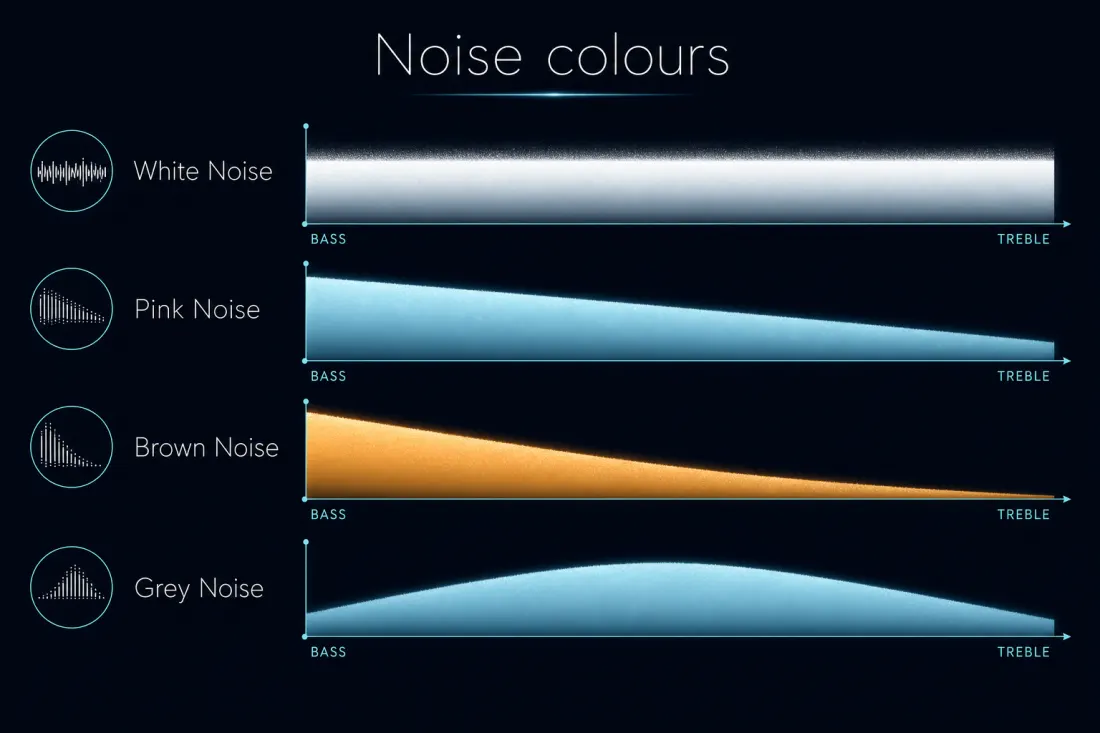
Before dose kicks in: slight brown or white bed may scaffold morning email — analogous to pre-medication low arousal.[1]
Peak plasma window: try lower volume or nature without café speech; overstimulation feels like physical anxiety.[4]
Afternoon rebound: some regain noise benefit as dose fades — log personally, do not trust internet charts.
NICE NG87 emphasises multimodal care — medication plus psychoeducation; sound gardens are environmental adjunct only.[8]
Speech, music, and medication
Irrelevant speech still hurts serial memory on or off stimulants — Banbury mechanism unchanged.[23] Lyrics compete with coding and reading. During medicated hyperfocus, deviant sounds (notification chimes, podcast laughs) may trigger disproportionate orienting — keep gardens stable, low Chaos.[11]
Sleep and evening medication
Stimulants delay sleep if taken late. Evening gardens for wind-down should differ from daytime focus — rain or pink at low level, no café. Pair with sleep hygiene per NICE; rain does not override pharmacokinetics.[8]
Safety and prescriber coordination
Report anxiety, tinnitus, or paradoxical agitation to prescriber — could be dose, comorbid anxiety, or sensory overload from stacked stimulant + noise.[5] Never adjust medication based on article advice. Sound Bubbles is companion audio, not ADHD treatment.
Personal experiment protocol
- Baseline week: note focus with med times in journal.
- Week 2: add brown bed only at fixed volume.[2]
- Week 3: adjust per phase — peak vs off-peak.
- Stop if heart rate, anxiety, or tinnitus rises.[19][20]
- Share patterns with clinician at follow-up.[8]
Comorbid anxiety, autism, and sensory processing
ADHD frequently co-occurs with anxiety and sensory processing differences — stimulant plus café simulation may stack overstimulation.[6][8] Autistic students may prefer predictable brown beds over irregular café clatter despite ADHD diagnosis — individual sensory profile beats category labels. NICE multimodal guidance applies across comorbidities; sound is one dial among many.[8]
Long-acting versus short-acting formulations
Formulation half-life shifts the noise-optimal window — XR profiles flatten peaks, IR creates sharper windows. Log medication time and garden SPL together for two weeks; patterns often emerge that contradict generic internet advice. Never adjust timing without prescriber.[5]
Paediatric versus adult contexts
Most noise-benefit trials enrolled school-age children; adult ADHD responses differ in life demands and comorbidity.[2][3] Parents managing child medication should consult paediatrician before classroom white-noise devices — school policy and hearing safety intersect.[8][20]
Substance interactions and sleep overlap
Evening stimulant rebound plus alerting café gardens can delay sleep — separate daytime focus presets from evening wind-down rain beds. Caffeine stacked with medication and moderate noise may elevate heart rate subjectively without improving output — track somatic symptoms honestly.[5][8]
Medication holidays and dose changes
During planned medication breaks, prior noise presets may suddenly feel essential — log whether benefit returns off-stimulant before attributing gains to apps alone. Dose increases can invert preference toward silence within days. Share journals with prescriber at titration visits.[5][8]
Companion listening in Sound Bubbles
Research above concerns clinical and laboratory sound — not a playlist guarantee. Sound Bubbles offers adjustable living gardens: spatial layers, coloured noise beds, Medical & Wellbeing rooms, and easy mute. Use recommended gardens as environmental support alongside medical care when appropriate.[20]
Not treatment. See clinicians for diagnosis, medication, CBT, neurologic music therapy, or tinnitus programmes. Keep volume comfortable; stop if symptoms worsen.
Why this supports Sound Bubbles — not just "any ambient app"
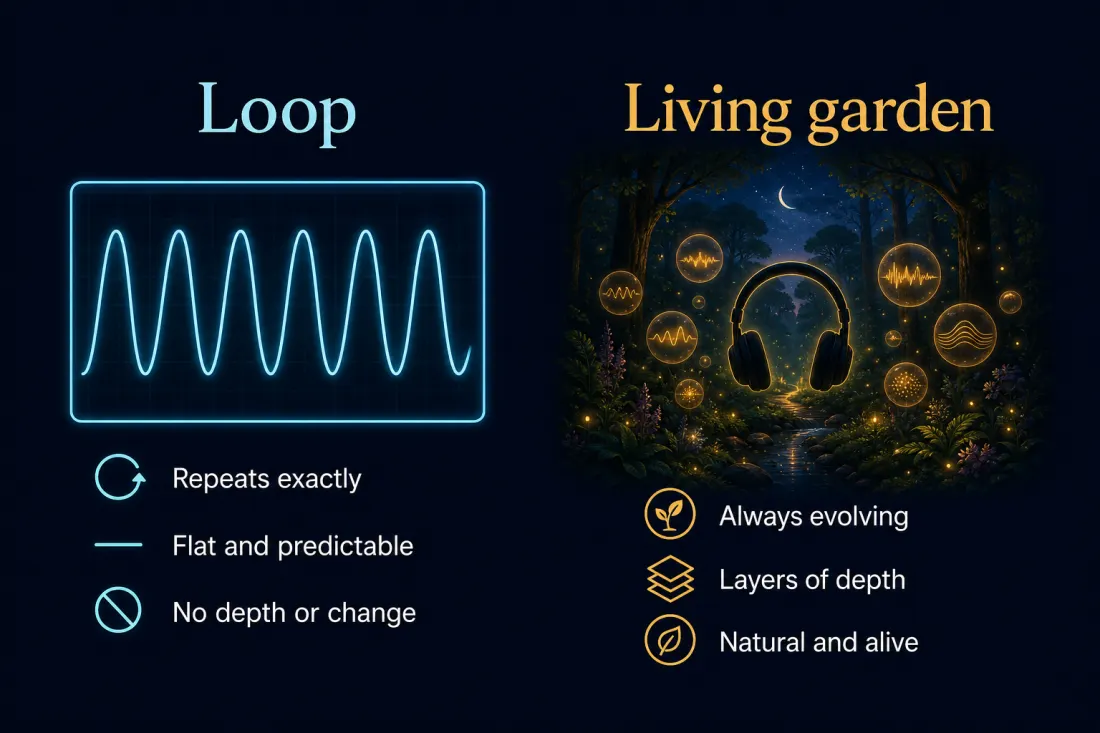
Most ambient apps deliver one file. The studies above rarely study "a loop." They study continuous floors against irregular noise, unintelligible speech against memory tasks, nature scenes against stress markers, spatial streams against glued mashups, and slow environmental change against habituation.[9][14][22][23][24]
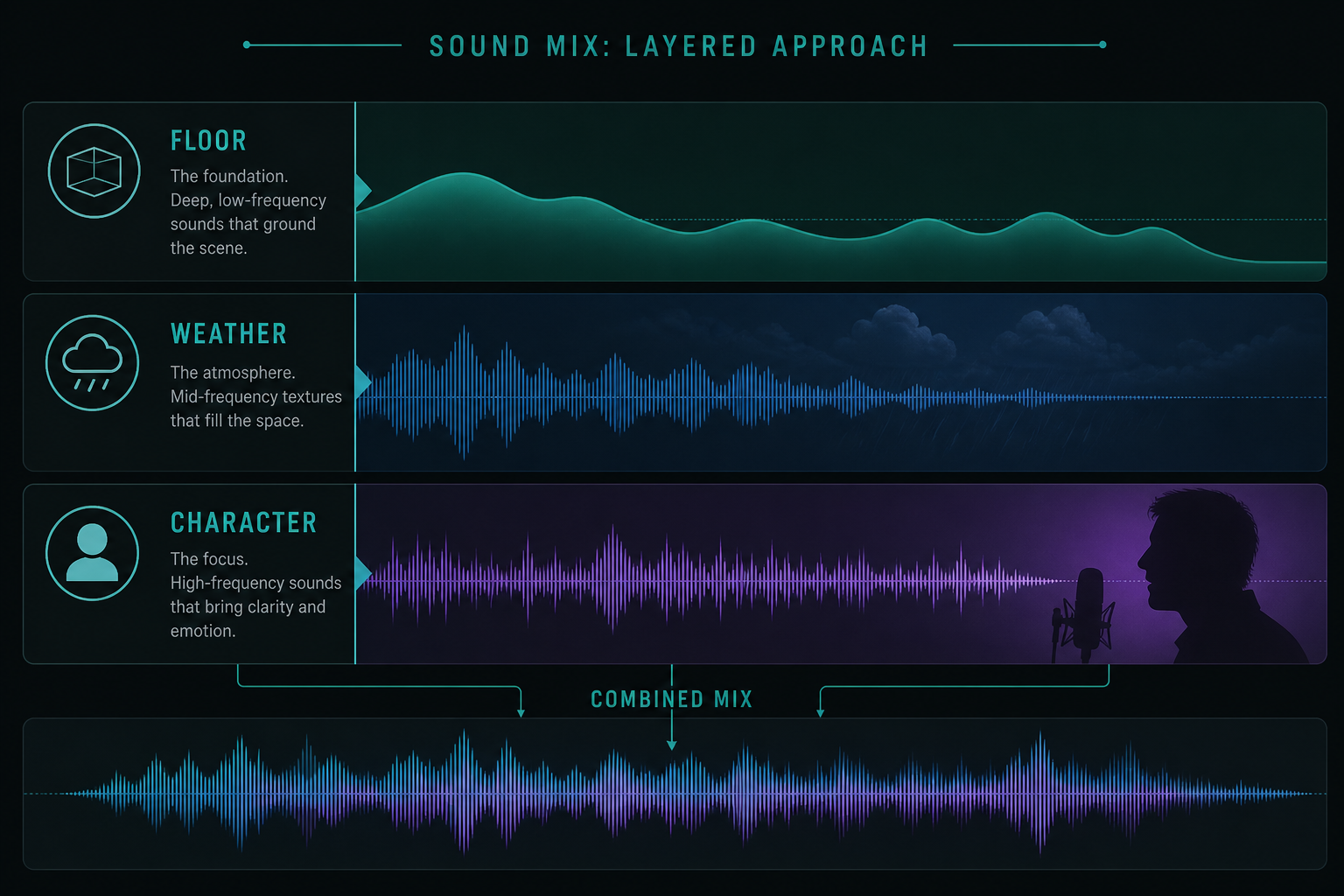
Sound Bubbles maps onto those findings deliberately: brown/noise beds for masking floors, nature and library layers for restorative structure, distance/Falloff for speech intelligibility control, and TimeLine motion so the garden keeps the statistics of a place instead of the statistics of a four-minute loop.[12][15][16][25] That is the practical reason the product feels different after the first hour — and the scientific reason the difference matters.
How to apply this inside Sound Bubbles
- Open a related garden (or New Garden) and press Start playing so audio unlocks.[9]
- Expand Shape your soundscape → Sounds: set Master Volume, then Falloff while watching the audible-core guide.[10]
- Select a bubble; drag and scroll depth. Prefer raising one bubble's Volume over blasting the whole room.[11]
- Add library rain, nature, or noise layers; keep speech-like content distant — or remove it — when you need reading or coding focus.[12]
- TimeLine: choose Drift, Tide, or Orbit when you want the garden to keep evolving without grabbing attention.[13]
- Brown Noise tab: shape a warm floor, optionally Release as bubble so it becomes spatial.[14]
- Save gardens that still feel kind after an hour — public gardens should stay soft, not startling.[15]
Limits, safety, and honest uncertainty
We do not claim Sound Bubbles replaces clinical care, sleep medicine, occupational health programmes, or psychiatric treatment.[1][7] What the product does offer is a listening architecture that matches how hearing and attention actually work: layered sources, spatial distance, and slow change instead of one brittle loop.[18][19]
If sound worsens symptoms, stop. If you need medical advice, see a clinician. If you want a softer room, open a garden, place the bubbles kindly, and stay honest about what sound can — and cannot — do.[20][21]
How this article was researched
We combine first-hand experience placing and tuning Sound Bubbles gardens with citations from peer-reviewed journals, reviews, and institutional pages (including NIH/NCBI, sleep and hearing literature, acoustics, and attention research). Where evidence is mixed or early, we say so. On wellbeing topics we stay cautious: these are companion soundscapes, not cures.
References
Sources cited in this article. Prefer primary literature and institutional guidance; Sound Bubbles is not a medical device and these citations do not imply clinical endorsement.
- (2007). Noise beneficial for ADHD cognition. J Child Psychol Psychiatry. doi:10.1111/j.1469-7610.2007.01749.x
- (2010). White noise and inattentive children. Behavioral and Brain Functions. doi:10.1186/1744-9081-6-55
- (2016). White noise benefits in ADHD children. Behavioral and Brain Functions. doi:10.1186/s12993-016-0095-y
- (2014). White noise across attention profiles. PLOS ONE. doi:10.1371/journal.pone.0112768
- (2018). Comparative efficacy of ADHD medications. Lancet Psychiatry. doi:10.1016/S2215-0366(18)30269-4
- (2002). Neuroscience of ADHD. Nature Reviews Neuroscience. doi:10.1038/nrn1306
- (2007). Stimulus-dependent dopamine release in ADHD. Psychological Review. doi:10.1037/0033-295X.114.4.1047
- (2018). ADHD diagnosis and management NG87. NICE.
- (2009). Habituation revisited. Neurobiology of Learning and Memory. doi:10.1016/j.nlm.2008.09.015
- (2009). Habituation: a history. Neurobiology of Learning and Memory.
- (1963). Perception and the conditioned reflex. Pergamon Press.
- (2010). The free-energy principle. Nature Reviews Neuroscience. doi:10.1038/nrn2787
- (2013). Whatever next? Predictive brains. Behavioral and Brain Sciences. doi:10.1017/S0140525X12000477
- (1990). Auditory Scene Analysis. MIT Press.
- (2012). An Introduction to the Psychology of Hearing. Brill.
- (2024). Colors of noise. Encyclopedic.
- (2013). Acoustical terminology (masking). ANSI.
- (2014). Auditory and non-auditory effects of noise on health. The Lancet. doi:10.1016/S0140-6736(13)61613-X
- (2021). World report on hearing. WHO.
- (2023). Noise and hearing loss prevention. CDC.
- (2005). White noise on sleep with ICU noise exposure. Sleep Medicine. doi:10.1016/j.sleep.2004.12.004
- (2001). Auditory distraction and short-term memory. Human Factors. doi:10.1518/001872001775992390
- (2010). Stress recovery with nature sound. IJERPH. doi:10.3390/ijerph7031036
- (2005). Speech intelligibility and work performance. Indoor Air. doi:10.1111/j.1600-0668.2005.00391.x