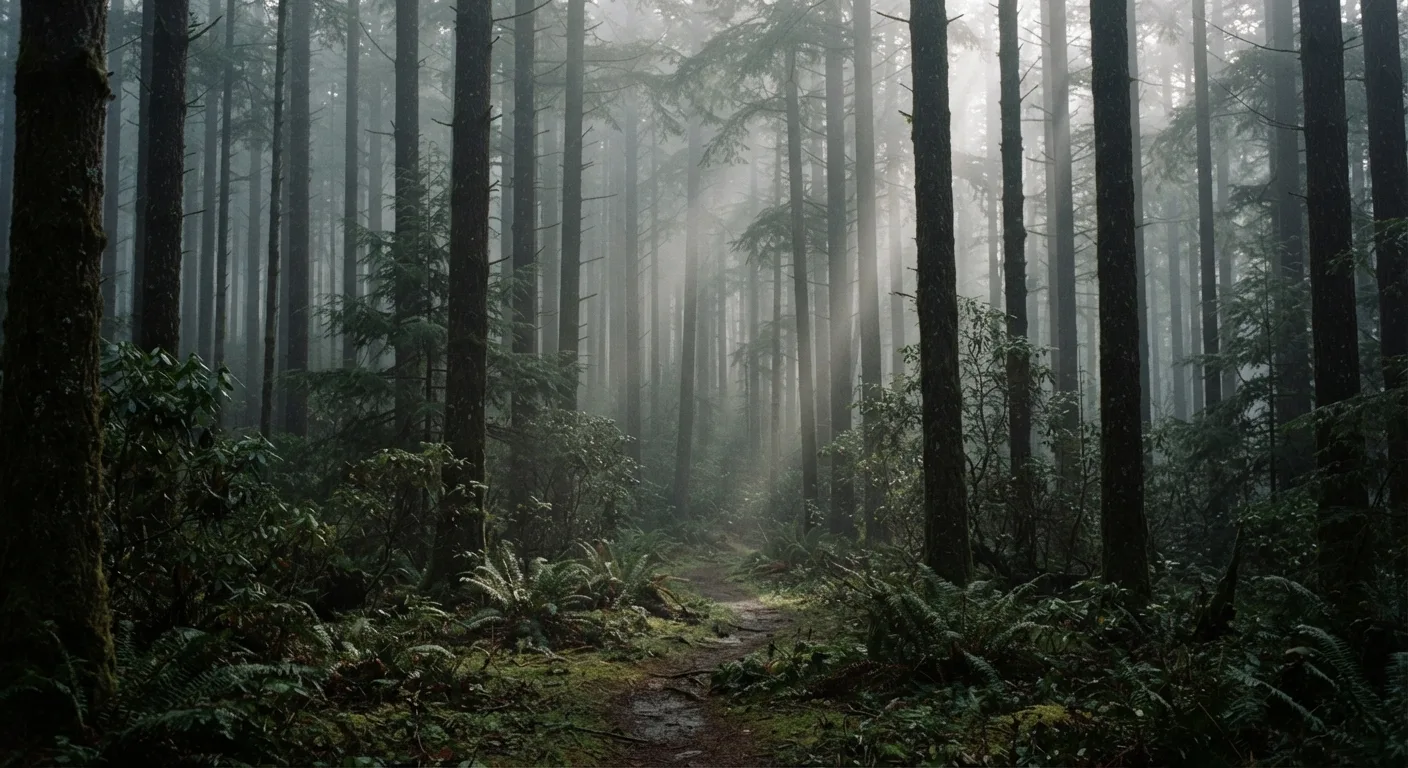

Season as multisensory zeitgeber
Wright's circadian entrainment work confirms light dominates phase setting, yet multimodal cues — temperature, activity, meal timing, soundscape density — reinforce social and biological calendars.[3] Thapan linked morning light to cortisol awakening response amplitude.[4] Spring chorus arriving earlier each week matches photoperiod lengthening; listening to dense summer birds in midwinter creates subtle predictive mismatch per Clark's predictive coding — not dangerous, but optionally uncanny for attentive listeners.[13] Seasonal garden rotation improves coherence.
Seasonal affective disorder and acoustic complement
Peng's seasonal affective reviews emphasise light therapy as evidence-based core — sound is adjunct at best.[2] Winter presets might emphasise soft rain, distant hearth, low birdsong density — calm not stimulation — paired with clinical light protocols when prescribed. Bratman's rumination reduction used summer green walks; winter indoor listeners may need sparse soundscapes that do not mock absent foliage.[5] Korpela's restorative experience framework suggests coherence between sensory expectation and content aids self-regulation.[1]

Spring: chorus ramp and renewal cues
As daylight lengthens, increase bird layer density gradually over weeks — mimics ecological dawn chorus ramp documented in ornithology reviews.[6] Add light wind and distant water; avoid thunder unless user opts in. Morning focus sessions benefit from gentle arousal contour — not alarm, not silence. Alvarsson's nature recovery data support non-threatening nature beds during stress periods common in Q1 work cycles.[6]
Summer: heat, cicadas, open windows
Summer soundscapes skew high-frequency insect and bright leaf rustle — higher masking of open-window traffic if level controlled. Basner's noise-health data cap comfortable SPL even when windows open.[19] Hunter's nature-sound scoping review notes insect buzz divides listeners — misophonia risk. Offer cicada-off variant within summer preset. Evening wind-down shifts toward ocean or river — cooler associative palette.[7]
Autumn: wind, leaves, thinning chorus
Deciduous transition increases leaf-crunch and gust variability — excellent entropy for habituation resistance per Rankin.[9] Reduce bird density; add distant geese optional. Bratman-style rumination may rise in autumn for some — nature sound as companion during homework, not treatment. Benfield's affective soundscape work supports mood lift at moderate nature levels.[8]
Winter: muffled hush and sparse cues
Snow absorbs high frequencies — winter presets bias brown bed plus very soft wind, minimal birds. High-latitude listeners face compressed photic input; acoustic cues cannot replace light box but may soften morning transition when paired with lamp timing per clinical guidance.[2][4] Holiday stress periods: keep gardens stable and predictable — excessive novelty stacks load.
Rotating gardens without losing favourites
- Save four seasonal base gardens; duplicate not overwrite.[1]
- Adjust bird density and insect layers first — biggest seasonal tell.[6]
- Match TimeLine motion to season — brisk spring Drift, slow winter Tide.[13]
- Calendar reminder quarterly to swap default preset.[3]
- Keep summer favourite for mood rescue days — user agency over rigid calendar.[1]
Latitude, hemisphere, and travel
Southern hemisphere users need inverted seasonal presets — product labels should say spring-like not March-only. Travel across zones: temporary mismatch is fine; reset on return. Shift workers cross seasonal cues nightly — pick one stable garden for work blocks, seasonal rotation for off-day restoration.[3]
Indoor workers and ecological honesty
Knowledge workers may spend entire seasons under fluorescent light without registering outdoor acoustic change — seasonal gardens reconnect calendar sense when body would otherwise infer "eternal Tuesday." Korpela's restorative experience model emphasises coherence: winter rain preset while snow lies outside your window is acceptable substitution; summer cicada in open-plan December meeting may distract colleagues who notice mismatch.[1] Share seasonal presets in team docs as optional ambience, never mandatory sound — Hongisto-type speech intelligibility conflicts apply if nature layers creep loud during calls.[25] Document personal seasonal favourites in Sound Bubbles saves; rotate quarterly like wardrobe, not like password.
Companion listening in Sound Bubbles
Research above concerns clinical and laboratory sound — not a playlist guarantee. Sound Bubbles offers adjustable living gardens: spatial layers, coloured noise beds, Medical & Wellbeing rooms, and easy mute. Use recommended gardens as environmental support alongside medical care when appropriate.[20]
Not treatment. See clinicians for diagnosis, medication, CBT, neurologic music therapy, or tinnitus programmes. Keep volume comfortable; stop if symptoms worsen.
Why this supports Sound Bubbles — not just "any ambient app"
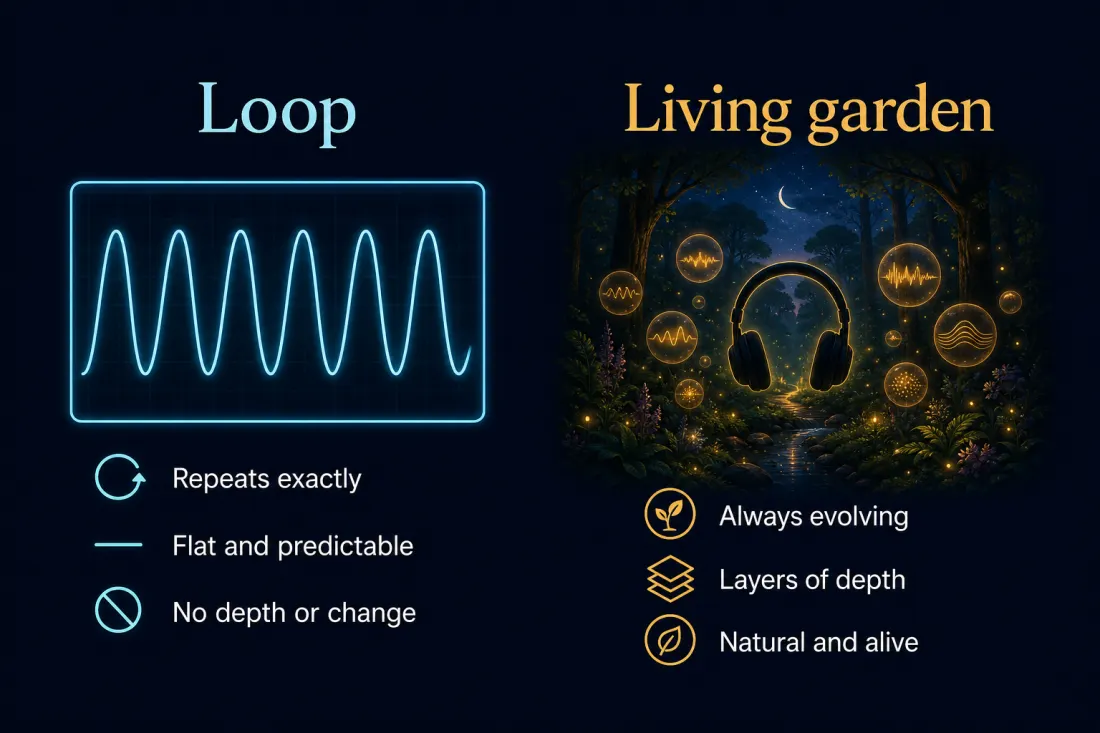
Most ambient apps deliver one file. The studies above rarely study "a loop." They study continuous floors against irregular noise, unintelligible speech against memory tasks, nature scenes against stress markers, spatial streams against glued mashups, and slow environmental change against habituation.[9][14][22][23][24]
Sound Bubbles maps onto those findings deliberately: brown/noise beds for masking floors, nature and library layers for restorative structure, distance/Falloff for speech intelligibility control, and TimeLine motion so the garden keeps the statistics of a place instead of the statistics of a four-minute loop.[12][15][16][25] That is the practical reason the product feels different after the first hour — and the scientific reason the difference matters.
How to apply this inside Sound Bubbles
- Open a related garden (or New Garden) and press Start playing so audio unlocks.[9]
- Expand Shape your soundscape → Sounds: set Master Volume, then Falloff while watching the audible-core guide.[10]
- Select a bubble; drag and scroll depth. Prefer raising one bubble's Volume over blasting the whole room.[11]
- Add library rain, nature, or noise layers; keep speech-like content distant — or remove it — when you need reading or coding focus.[12]
- TimeLine: choose Drift, Tide, or Orbit when you want the garden to keep evolving without grabbing attention.[13]
- Brown Noise tab: shape a warm floor, optionally Release as bubble so it becomes spatial.[14]
- Save gardens that still feel kind after an hour — public gardens should stay soft, not startling.[15]
Limits, safety, and honest uncertainty
We do not claim Sound Bubbles replaces clinical care, sleep medicine, occupational health programmes, or psychiatric treatment.[1][7] What the product does offer is a listening architecture that matches how hearing and attention actually work: layered sources, spatial distance, and slow change instead of one brittle loop.[18][19]
If sound worsens symptoms, stop. If you need medical advice, see a clinician. If you want a softer room, open a garden, place the bubbles kindly, and stay honest about what sound can — and cannot — do.[20][21]
How this article was researched
We combine first-hand experience placing and tuning Sound Bubbles gardens with citations from peer-reviewed journals, reviews, and institutional pages (including NIH/NCBI, sleep and hearing literature, acoustics, and attention research). Where evidence is mixed or early, we say so. On wellbeing topics we stay cautious: these are companion soundscapes, not cures.
References
Sources cited in this article. Prefer primary literature and institutional guidance; Sound Bubbles is not a medical device and these citations do not imply clinical endorsement.
- (2001). Restorative experience and self-regulation. Journal of Environmental Psychology. doi:10.1006/jevp.2000.0191
- (2020). Seasonal affective disorder and circadian rhythm. Frontiers in Psychiatry. doi:10.3389/fpsyt.2020.00081
- (2013). Entrainment of the human circadian clock. Current Biology. doi:10.1016/j.cub.2013.08.034
- (2001). Light and the cortisol awakening response. Journal of Endocrinology. doi:10.1677/joe.0.1690205
- (2015). Nature experience reduces rumination. PNAS. doi:10.1073/pnas.1510459112
- (2010). Nature sound stress recovery. IJERPH. doi:10.3390/ijerph7031036
- (2019). Evidence for nature sound and health. IJERPH. doi:10.3390/ijerph16173003
- (2014). Affective benefits of nature soundscapes. Journal of Environmental Psychology. doi:10.1016/j.jenvp.2014.02.001
- (2009). Habituation revisited. Neurobiology of Learning and Memory. doi:10.1016/j.nlm.2008.09.015
- (2009). Habituation: a history. Neurobiology of Learning and Memory.
- (1963). Perception and the conditioned reflex. Pergamon Press.
- (2010). The free-energy principle. Nature Reviews Neuroscience. doi:10.1038/nrn2787
- (2013). Whatever next? Predictive brains. Behavioral and Brain Sciences. doi:10.1017/S0140525X12000477
- (1990). Auditory Scene Analysis. MIT Press.
- (2012). An Introduction to the Psychology of Hearing. Brill.
- (2024). Colors of noise. Encyclopedic.
- (2013). Acoustical terminology (masking). ANSI.
- (2014). Auditory and non-auditory effects of noise on health. The Lancet. doi:10.1016/S0140-6736(13)61613-X
- (2021). World report on hearing. WHO.
- (2023). Noise and hearing loss prevention. CDC.
- (2005). White noise on sleep with ICU noise exposure. Sleep Medicine. doi:10.1016/j.sleep.2004.12.004
- (2001). Auditory distraction and short-term memory. Human Factors. doi:10.1518/001872001775992390
- (2010). Stress recovery with nature sound. IJERPH. doi:10.3390/ijerph7031036
- (2005). Speech intelligibility and work performance. Indoor Air. doi:10.1111/j.1600-0668.2005.00391.x