The breath of Earth
Stand in a field at dusk and listen. Rain arrives and leaves. Crickets phase in as birds phase out. A stream pushes and releases. Wind rises, slacks, rises again. The ocean does not play one wave — it plays tides tied to the moon, seasons tied to the sun, storms that pass and return. Nothing holds a single volume forever. Nothing repeats on a perfect seam.
Life has been dancing to that rhythm for more than two billion years. Circadian clocks — the internal timers that align biology with day and night — appear in ancient cyanobacteria and run through every lineage that followed, including ours.[5][6] We did not evolve inside a flat MP3. We evolved inside ebb and flow: constant reach for balance, constant push above and below the line. The smell of rain on dry soil, the first cricket at night, the hush after thunder, the way a brook throws new information at the ear every few seconds without ever becoming a speech task. That is the acoustic diet our nervous systems were shaped for.[7][8]
Sound Bubbles was built with that rhythm in mind — homeostasis made audible, not an adjective on a landing page.
What nature suggests about calm
In the wild, stability is never frozen. Tides overshoot and return. Seasons warm and cool back. For some listeners — including Jaco — anxiety feels like threat gain stuck wide open, recovery slow to arrive. Insomnia at night is the flip side: the brain will not downshift when the room is either too empty (every drip in the house becomes an event) or too rigid (the same loop becomes a second vigilance task).[9][10]
Medication helps many people; this app is not a substitute. A pill adjusts chemistry inside silence. What was missing was an environment that behaved like the outdoors: soft floors, irregular kindness, motion without narrative, surprise without alarm. Research on nature-sound recovery after stress shows faster autonomic rebound during natural audio than during harsh noise — not because nature is magic, but because its statistics feel safe and alive.[7][11] Attention Restoration Theory describes the same pull: soft fascination in natural scenes replenishes directed attention instead of draining it.[8][12]
The goal was a room that breathed — not a file that repeated.

Why loops fail
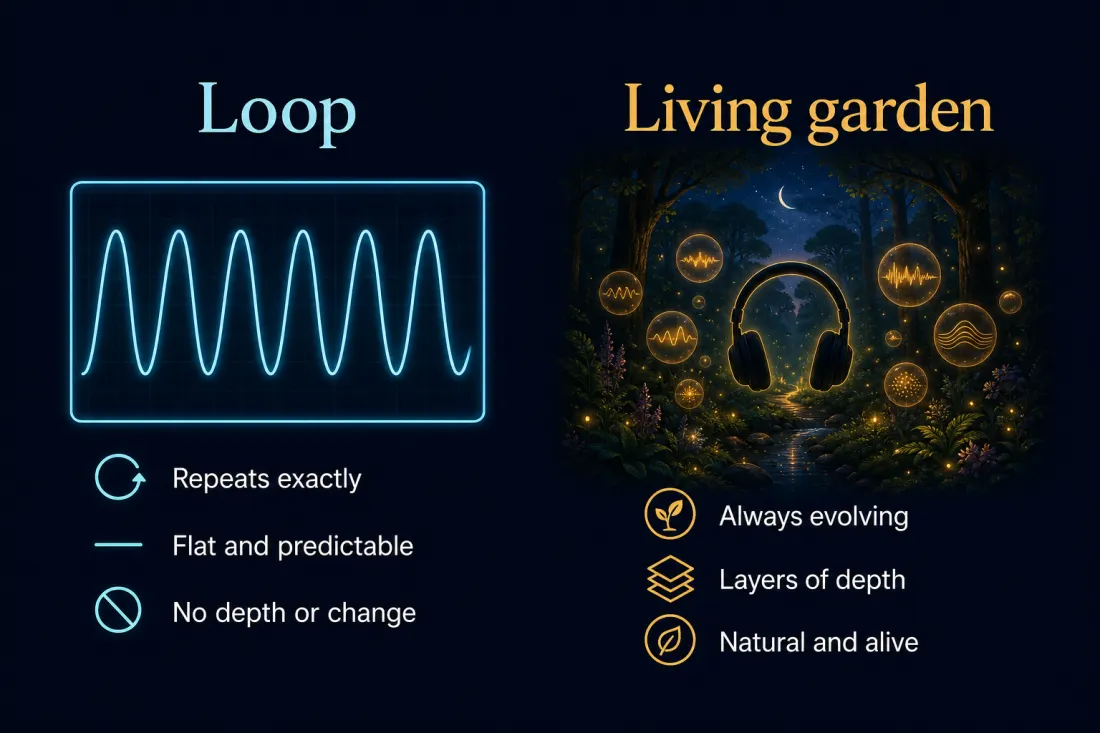
The pattern is familiar. Minute one: gorgeous. Minute twenty: wallpaper. Minute forty — or 3am — seam detection: the brain finds the loop point and the spell dies. Sometimes the sound never changed volume, never changed distance, never let a layer leave the stage. Sometimes it was technically “high quality” and still felt dead, because dead repetition is not how forests work.[3][4]
Habituation research explains it. Identical stimulation loses salience; when the repetition finally breaks, orienting snaps back — a micro-alarm in the middle of sleep.[3][13] Predictive-processing accounts say the cortex forecasts the next acoustic sample; a short loop telegraphs its restart and prediction error spikes.[14][15] You are not “getting tired of nice sound.” You are noticing that the sound is not a place anymore.
What was needed was weather, not another loop with better artwork.
Living organisms — bubbles that breathe in and breathe out
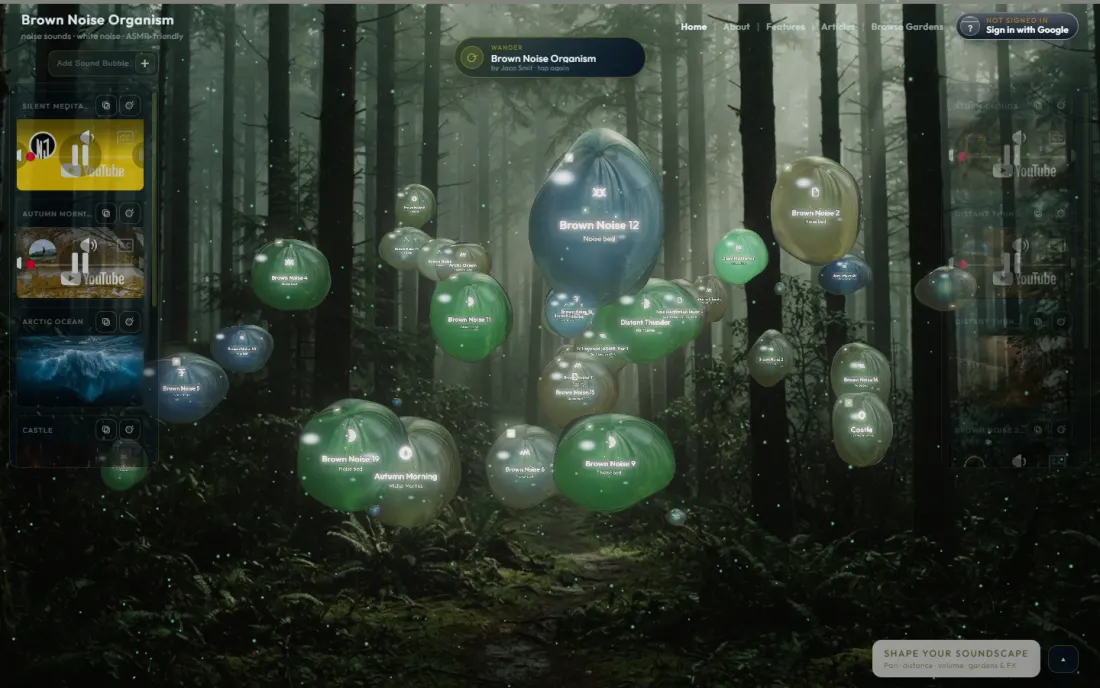
Sound Bubbles treats every source as a bubble in space: rain here, brown noise there, distant thunder at the horizon, crickets at the edge of hearing. Each bubble has its own volume, depth, and path. TimeLine motion lets them drift closer and farther — like tides, like gusts, like animals moving through grass. Layers enter, soften, and make room for others. Nothing owns the full stage at one fixed loudness forever.
The big curated gardens are called organisms — Brown Noise Organism, Storm Organism, Living Drift — because they are not presets. They are casts of bubbles designed to recombine: breathe in new combinations, breathe out what faded, keep the scene slightly new and slightly familiar at once. There is no single four-minute seam to memorise. You get the soothing constancy of a floor with the subtle change the ear expects — enough to break cycles, not enough to become a second task.[16][17]
Not stimulation. Not silence. Alive steadiness.
What the research supports
Later reading mapped cleanly onto the architecture:
- Auditory scene analysis — the brain parses separate streams with their own continuity; thirty bubbles beat one mashed stereo file for long-session realism.[16]
- Masking without monotony — continuous floors lower contrast against spikes; irregular nature layers keep the floor from becoming its own seam.[18][19]
- Slow environmental change — defeats total predictability while staying subconscious at night.[3][14]
- Spatial distance — close reads intimate; far reads safe. Falloff is the paranoia dial.[20]
None of this makes Sound Bubbles medicine. It makes it congruent with how hearing and regulation actually behave — the same congruence rain and crickets have carried for geological time.[21][22]
Try it (ten minutes)
- Open Brown Noise Organism and press Start.
- Do not touch knobs for three minutes. Notice layers arriving and receding without a loop seam.
- Raise Falloff until only nearby bubbles feel “in your head” — the rest should sit outside the window.
- TimeLine → Drift, Chaos low. Let the garden breathe.
- Pop one charismatic layer. The organism adjusts — it does not collapse.
- Stay twenty more minutes. Compare to any “ten-hour” single-file rain on the web.
Who it is for
Listeners who are anxious, insomniac, or loop-fatigued — anyone who wants rain that behaves like rain, streams that come and go, nights with crickets, days with wind, moons pulling tides through sound instead of volume sliders frozen at noon.
It is not for everyone. Misophonia, hyperacusis, and clinical conditions need real care, not an app essay. If sound worsens your state, stop. Silence is also a valid room.[22]
Closing thought
When someone saves a garden — strips a storm organism down for sleep, stacks frogs and brown beds, pushes coffee-shop clatter to the horizon — they are doing what Earth does: regulating with change. The loop industry still has not learned what cyanobacteria knew two billion years ago: stability is not stillness. Stability is a living wave.
Pop what grates. Keep what soothes. Let the bubbles drift.
Recommended gardens — open in one click
These gardens match what this article describes. Each link opens the garden in the player — press Start playing and adjust Falloff if anything feels too close.
- Brown Noise OrganismStart hereThe default organism — thirty bubbles, storm and brown layers, TimeLine drift. Good first listen for ebb and flow.Open garden →
- Living Drift OrganismMaximum gentle ebb and flow — layers arrive and leave like weather.Open garden →
- Rain OrganismRain that behaves like rain — not one four-minute file pretending to be twelve hours.Open garden →
- Wander Forest OrganismCrickets, stream, canopy — the acoustic diet we evolved with, separated in space.Open garden →
- Night Bed OrganismBuilt for anxious nights — soft floors, low chaos, nothing shouting at 3am.Open garden →
- Pulse Rain OrganismTidal rhythm without a loop point — push and release like the ocean.Open garden →
Browse all gardens · remix any public garden · save your own when you find the mix that fits.
How this article was researched
We combine first-hand experience placing and tuning Sound Bubbles gardens with citations from peer-reviewed journals, reviews, and institutional pages (including NIH/NCBI, sleep and hearing literature, acoustics, and attention research). Where evidence is mixed or early, we say so. On wellbeing topics we stay cautious: these are companion soundscapes, not cures.
References
Sources cited in this article. Prefer primary literature and institutional guidance; Sound Bubbles is not a medical device and these citations do not imply clinical endorsement.
- (2009). Habituation revisited: an updated and revised description. Neurobiology of Learning and Memory. doi:10.1016/j.nlm.2008.09.015
- (2009). Habituation: a history. Neurobiology of Learning and Memory.
- (2015). Circadian rhythms in cyanobacteria. Annual Review of Genetics. doi:10.1146/annurev-genet-120213-092357
- (2024). Circadian rhythms fact sheet. National Institutes of Health.
- (2010). Stress recovery during exposure to nature sound and environmental noise. International Journal of Environmental Research and Public Health. doi:10.3390/ijerph7031036
- (1995). The restorative benefits of nature: toward an integrative framework. Journal of Environmental Psychology. doi:10.1016/0272-4944(95)90001-2
- (2000). A model of neurovisceral integration in emotion regulation and dysregulation. Journal of Affective Disorders.
- (2014). Auditory and non-auditory effects of noise on health. The Lancet. doi:10.1016/S0140-6736(13)61613-X
- (2015). Sleep in the modern family: protective roles of sleep. Sleep Health. doi:10.1016/j.sleh.2015.05.001
- (1989). The Experience of Nature: A Psychological Perspective. Cambridge University Press.
- (2009). Auditory distraction and deviance detection. Journal of Experimental Psychology.
- (2013). Whatever next? Predictive brains, situated agents. Behavioral and Brain Sciences. doi:10.1017/S0140525X12000477
- (2006). Sweet Anticipation: Music and the Psychology of Expectation. MIT Press.
- (1990). Auditory Scene Analysis. MIT Press.
- (2026). Living organism gardens — Brown Noise Organism architecture. Sound Bubbles.
- (1985). The Effects of Noise on Man — masking. Academic Press.
- (2005). Speech intelligibility and masking in workplaces. Indoor Air. doi:10.1111/j.1600-0668.2005.00391.x
- (1997). Spatial Hearing: The Psychophysics of Human Sound Localization. MIT Press.
- (2018). Environmental noise guidelines for the European Region. World Health Organization.
- (2024). Complementary health approaches — evidence and safety framing. National Institutes of Health.